







By Raju Dahal
Two recent studies, one by Strengthening Access to Holistic, Gender Responsive, and Accountable Justice (SAHAJ) in association with Emory University and one by Mother and Infant Research Activities (MIRA), highlight the peril that women and girls face when there is adversity such as the ongoing Covid pandemic. According to the first study, more than 30% of women chose to forgo medical care during lockdown while according to the second study, 76% of women who died during maternity did not seek care on time.
Women and girls have suffered some of the greatest impacts of the pandemic. Samiksha M. Shrestha, a mother of three, said that she was really scared when she started showing symptoms. “Just thinking about going to the hospital was a nightmare for me. I prayed that I only had a common cold. I was also thinking what if someone infected me at the hospital, it would have a devastating effect on my family. When I tested positive I felt very much alone and my confidence was really shaken. I genuinely felt what other people who are ostracized by our society must feel.”
UN women study in Nepal has found that women’s financial security had decreased and this has had a direct result in their ability to make decisions on their own health. The finding that 92% of women that lost their lives during maternity did not make their own incomes giving them less power to make decisions on their own health care is shocking.
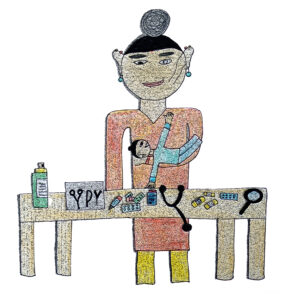
The impact of the pandemic has been devastating on the medical community as well. Dr Basudha Khanal, MD, had to stay away from home in order to respond to the growing medical need of Biratnagar, her city. As a paediatrician, she worried about her own children’s health and met them only after six months. Dr Sunita Maleku also was similarly concerned about returning home to her family and her lovely daughter and son.
Ankila Bajracharya (name changed) is a staff nurse at a major Nepalese hospital. When the hospital was declared a key Covid response center, she felt so much pressure at home that she left her only child, husband, and in-laws and went to live with her parents – there, too, in the furthest corner of the house and with very little contact with others. “Neighbors, family members, friends, and others that I thought would support me were really scared of me and did not want me in their communities,” she said. Despite hospital grade preventive steps and PPEs, she tested positive and it was only after isolation and recovery that her family accepted her back as they now felt that she was immune.
The study by SAHAJ shows that many of the women have grown more assertive during this period. Alimun Nisha is 17 and lives in Rupendehi. She was in grade 10 and a member of the awareness and trust-building group “Rupantaran” or “Transformation.” She firmly stopped her proposed arranged marriage and got her family to invest the dowry fund into her education.“This money will help me become an engineer!” she said as she talked about her hope to be able to stand on her own two feet so could tackle crises and problems that will come into her own life, into the lives of the family, or the community.
Seventy per cent of mothers in the districts studied have also been very pleased to receive more help from their daughters, female members of the family, as well as from men in the family as they dealt with the impact of the pandemic in their daily lives.

Login to add a comment