








By Narayan Prasad Mishra
I was born and grew up in Bhaktapur, but we had a house at Kilaghal in Kathmandu. I remember I stayed some time in that house whenever we came to Kathmandu during my childhood. Later, I realized that the house belonged to my eldest brother Bhawani Prasad Mishra, then the school teacher, and later on, the professor, who was living with us, as the house was given to him by my father, Pt. Durga Prasad Mishra for a share of the ancestral property. The property was divided among the three brothers at my eldest brother’s pressure when I was just a year old, and my younger brother Punya Prasad Mishra was into my mother’s tummy. So, my younger brother did not have that share as he was not yet born. I was told that that was the intention and reason for my eldest brother’s pressure to be separated so that he would not be at some loss in getting his share in the future – after my younger brother’s birth. However, I lived in that house for some time with my second elder brother Surya Prasad Mishra until there was no problem living after I came to Kathmandu from Bhaktapur for college study. Despite having that house, we had to move to a rented room soon after. We lived at many different localities in Kathmandu, renting rooms according to our needs. It gave me some excellent opportunities to be closely acquainted with many toles (localities) and Kathmandu people. I am happy to remember that some of my landlords loved me like their brothers and sons. I, too, loved them the same way. After I joined the university and after my marriage with my beloved wife Shanti Mishra, we lived at the university’s professor’s Quater at Sundarighat, near Chovar Hill.
My father was a devout Brahmin, devoted wholly to Lord Shiva, who performed Shiva’s Rudri with full rituals (Hours chanting the greatness of Lord Shiva, offering the holy running water to the head of it) every day before having his meal, who was regarded as a Tantric by the people closely known to him. It seemed Sardar Rudra Raj Pandey, the well-known writer and educational of the country, knew his this caliber. He disclosed it to me when he came to realize I was the son of Pt. Mishra. He loved his eldest son and the daughter-in-law and made them live together even after the property’s separation. I loved and respected my eldest brother, but I did not have a good feeling towards him since I came to know this bitter truth. He was a learned man and reputed as an English professor even considered a man of well study and knowledge of English language and literature by Mahakavi (Great Poet) Laxmi Prasad Devkota, Prof. Ram Prasad Manamdhar, Prof. Yadunath Khanal, Sirdar Bhim Bahadur Pandey, his contemporary and friends. I know he even tutored and taught their sons and daughters. Sadly, I had to regard him as the most selfish son and brother ever seen and heard in our society. It gives some pictures of Nepali family life, parent’s selfless love towards the son, and some family members’ greed and selfishness in possessing the property even in a highly educated society.
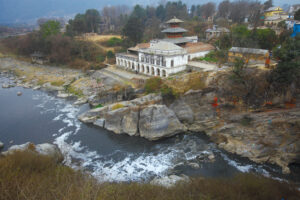
Holy Bagmati River
Sundarighat means the beautiful holy riverbank in Nepali. That was a lovely, charming spot then. There was a beauty of clean water flowing in the Bagmati River and the shadow of green Chovar Hill on it with a majestic view of the snow peaks in the north, all at the same time at a glance. We enjoyed living there. We were the first family to move to that place. That was on 18 January 1971. Even the electricity had not been fixed in the house. But I was happy there with my wife Shanti Mishra and my little daughter Pragya who was just born.
There was a full academic atmosphere in the university under Sardar Rudra Raj Pandey’s leadership, the Vice-Chancellor, and Dr. Trailokyanath Upreti, the Registrar. The university made a criterion for distributing and allocating the Professors Quarters to the professors. Under the same criteria, the university reserved three houses for the three officials – The Chief Librarian, The Medical Officer, and the Warden of the Hostel who were regarded as the essential officers to be living on the campus for the service needed even after the office hours, 10 am to 5 pm. So, we had to be lived on the campus even if we did not want to live there, being the chief of the Tribhuvan University Central Library. The criteria were changed later on with the pressure of Dr. Harka Bahadur Gurung when he became the most powerful member of the National Education Committee. That office was created above the university with the introduction of the New Education System Plan, 1971, during the time of Prof. Surya Bahadur Shakya, the Vice-Chancellor. So, we moved to our newly built house at Kuleshwor, Balkhu, where I bought the land at the rate of Rs 4000 per popani in 1969 before I got married. People expect about 16 crores for the same size of land in the area at selling now. What a change in the price. It is not easy for me to think about. it. From this point, I am a multimillionaire now. But it has no meaning for me now since my beloved wife Shanti Mishra left me alone.
The area of Balkhu was under the Village Panchayat then. There was no tap water, running drinking water supply. There were not even wells around there. There were very few houses which one could count in your fingers. The Bagmati and Balkhu rivers were clean. The locality people used the water from the rivers for drinking also though we did not consider it the drinking water. There was no electricity line in the area. There were no shops around. The Ring Road had not come yet. The Sanepa area of Patan and Balkhu area of Kathmandu was so close, just a few hundred meters distance, but there was no connection as there was no bridge in the Bagmati River. We had to go to Thapathali to go to Sanepa if we needed to go there by motor car from Balkhu.
In the same way, there was no present road to Kalimati from Balkhu, Kuleshwor. We needed to go to Kalimati, taking a round through Teku. We lived in a house without water and electricity for some time. We created a beautiful dwelling with an equally stunning interior with attractive decorations and an exterior with beautiful plants and trees with my wife. The house was designed by a renowned Swiss architect Robert Weise, the architect of the Hotel Annapurna, the Malla Hotel, etc., our good friend and well-wisher, at free cost as a gift. Our dear friend Lottie Weise, Robert Weise’s spouse, fixed all the curtains needed for the house as making her surprise gift. We were so lucky. We lived in a house with great joy and happiness having a beautiful view of the Bagmati River from our bedrooms. The visitors always thought we were fortunate to have that view, which was auspicious in the Nepali culture.
Even at that time, there was a talk and rumour about the Nepalese society’s corruption, though there was not much corruption compared to present-day Nepal. According to the diplomatic circle, Nepal was a country of corruption. We heard from them that the meager salary scale of the government employees, not enough to live life, was the main reason for the country’s corruption, which we never agreed with them. My beloved wife and I always denied this version. We tried to convince them that that was not the reason behind the reason for corruption.
(To be continued)
The writer can be reached at: narayanshanti70@gmail.com

Login to add a comment