








The story behind Indian occupation in Kalapani

By Pushpa Raj Pradhan
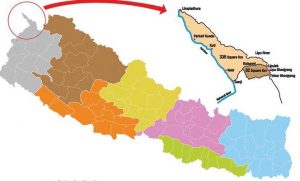
Kalapani, Lippulekh and Limpiyadhura are Nepali territory, yet, the Indians are occupying it and when Nepal claimed for return of the territory, they are saying that at the behest of someone else [China] Nepal is claiming the territory.
All evidences speak that the territory belongs to Nepal. Senior politician Bishwabandhu Thapa, 93, says that Kalapani is the Nepali territory, it is not an issue since Nepal accepted the Sugauli Treaty in 1816, the eastern part of the Mahakali (Kali) River belongs to Nepal.
After British quit India, Indians had accepted the territory handed over to them by the British rulers. The British rulers in India had endorsed the Sugauli Treaty with Nepal in which the Nepali territory has been clearly defined. Thapa makes clear that there is no need to debate on Kalapani when Kali River has been identified as the border river between Nepal and India.
NEWS ANALYSIS
Thapa, who enjoyed high ranking positions along with introduction of the Panchayat democracy by King Mahendra, in interviews in different television channels, has explained on how Indian force was granted shelter in Kalapani. India had faced humiliating defeat in its war with China in 1962. China and India had opened war in north-east part of India-China border. After the defeat, Indian prime minister Jwaharlal Nehru was very shocked and he was afraid that China may strike on India from western border – across Kalapani also, which is very close destination from Delhi. After such an analysis, Nehru decided to deploy the Indian force in her border with China in Uttarakhanda (earlier UP). In search of a suitable land, the Indians reached Kalapani. When Nehru felt that the territory belonged to Nepal, he wrote a letter to King Mahendra for Nepal’s approval to keep the Indian force there temporarily. King Mahendra asked Nepal’s ambassador in Delhi, Sardar Yedhunath Khanal about the Indian request. Khanal had briefed the King that as a gesture of goodwill and good neighbourly relations, it was okay allowing them to take shelter for some period. Thapa believes, there could be certain understanding/agreement between the Nepali ambassador in Delhi and the Indian foreign ministry officials while allowing Nepali territory to be given to the Indians for some period.
 However, the Indians didn’t play a fair game and later tried to occupy the area permanently, Thapa believes. During the difficult time for them, Nepal had helped India by giving shelter but they came to claim the territory as if it was their own, Thapa has remarked.
Former foreign minister and currently ambassador designated to China Mahendra Pandey had publicly blamed that King Mahendra, to save the then autocratic panchayat rule, had secretly handed over the territory to India. When asked about any such a deal, senior politician Thapa declined it. Thapa said that he knows that the Indians were given shelter in Kalapani area for some time only. When Pandey like responsible leaders of the Nepal Communist Party make such a cheap argument, what can the nation expect from such an ambassador?
Political analysts remark that if King Mahendra had done any negotiation to handover Kalapani to the Indians, until now the Indians would have already been produced evidences! How King Mahendra could have handed over the Nepali territory without any documents, and if the territory was really handed over to the Indians, why not the Indians asked to provide necessary document to them?
Former King Gyanendra’s granddaughter Princess Purnika Shah had recently remarked that the late King Mahendra in 1962, when the Indian army was returning after defeating war with China, had given temporary shelter to them in Kalapani.
“Upon the request of India, the late King Mahendra had given temporary shelter to the Indian force in Kalapani” Princess Purnika has written. Detail text of her write-up has appeared in Sanghu online portal.
“By 1968, the late King had already removed 17 Indian military camps from Nepali territory. When asked to remove the camp in Kalapani, the Indian side created dispute on the territory on the base of the Sugauli Treaty and origin of the Mahakali River. Then, the disputed issue on Kalapani was handed over to a study team with an agreement for not including the disputed area by both the countries in their respective political maps until finalization of the dispute”, she has written.
“This is why, Lipiyuadhura was not included in Nepal’s old map”, she has remarked.

Princess Purnika has further explained that in 1971, King Mahendra passed away and Crown Prince Birendra ascended to the throne. It was the Royal Institution’s responsibility to address border disputes including the Kalapani dispute, however, the movement in 1989 introduced multiparty in the country by empowering political parties and making the Royal Institution powerless. The Royal Institution was thus unable to solve the border disputes including Kalapani.
Whom the study team submitted the report, the Royal Institution is still unaware, she has disclosed.
Following the domestic as well as foreign conspiracy the Royal Palace bloodbath took place inviting republicanism ending the existence of the Royal Institution. After 12 years of introduction of republicanism by sidelining the Royal Institution India dared to unveil the political map by including the Kalapani territory, she has explained.
She has further stated that the Royal Institution has never missed to protect nation’s border and the Institution will love this country forever!
Princess Purnika’s remarks have hinted on how India conspired to grasp the Kalapani territory. It is understandable that the 1989 people’s movement, 2006 people’s uprising, the Maoist insurgency and the Tarai uprising were all solely sponsored by Indians and some of them were sponsored by the Europeans as well.
The Royal Palace bloodbath, announcement of republicanism can be taken as a foreign conspiracy to grab Nepali territory. Since signing of thee 12-point agreement in Delhi, it took more than a decade to include Kalapani territory in the Indian map followed by inauguration of the India-China link-road via Nepali territory.
Be that as it may, the entire nation is united against Indian annexation of Nepali territory and people are alert on whether our leaders known to be SD Muni and Shyam Sharan’s puppets’ possible conspiracy in protecting Nepali territory!

Login to add a comment