







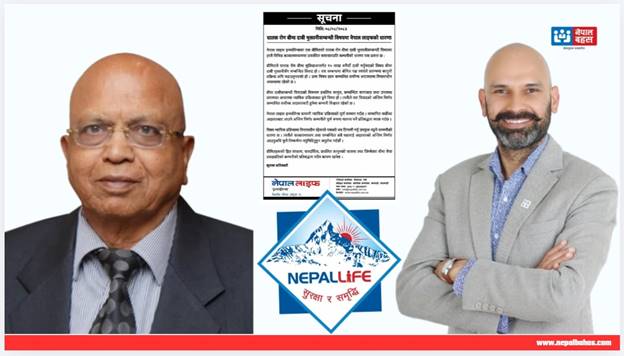
Kathmandu, November 28: Serious questions have been raised about the conduct of Nepal Life Insurance Company after an insured person was forced to approach the courts to claim insurance benefits the company had pledged to provide in times of financial hardship. Indra Bahadur Rijal, the insured, has accused Nepal Life of delaying the payment of Rs. 1.5 million (Rs. 15 lakh) under a critical illness insurance policy and attempting to evade legal obligations by issuing misleading statements and providing inaccurate information to regulatory authorities.
According to Rijal, the Nepal Insurance Authority had already ruled in his favour in the insurance claim dispute, and the High Court Patan subsequently upheld that decision. However, instead of implementing the verdicts of two judicial and regulatory levels, Nepal Life has allegedly been prolonging the matter by citing the registration of a case at the Supreme Court as an excuse.
Rijal argues that although a petition seeking a review of a case can be filed at the Supreme Court after the regular appeal process is no longer available, merely registering such a petition does not automatically suspend the implementation of a lower court’s verdict.
According to the available information, Nepal Life’s case concerning Indra Bahadur Rijal has been registered at the Supreme Court, but no hearing has taken place so far. Rijal maintains that the company’s public statement claiming that the case is sub judice at the Supreme Court is misleading, as the court has not yet granted permission to reopen the case, commonly known as “nissa”.
Since a regular appeal is not available in this situation, Nepal Life filed a petition seeking permission to review the case. In such proceedings, the court must first list the matter before a bench and issue an order on whether the case merits further consideration. Only after such permission is granted does the matter proceed to substantive judicial review.
However, Nepal Life has allegedly issued a public statement portraying the case as pending consideration before the Supreme Court, despite the fact that no hearing has taken place.
The High Court Patan’s verdict dated March 24, 2026 (Chaitra 10, 2082 B.S.) explicitly states that the case should be sent back to the original authority, the Nepal Insurance Authority, for implementation of the verdict and that the High Court’s case record should be closed.
Namrata Gaire, Information Officer at the High Court Patan, has also clarified that once the High Court upholds a decision, the implementation process must proceed through the original authority.
According to her, after the High Court sends the verdict to the Nepal Insurance Authority for implementation, the concerned authority is responsible for enforcing it.
Under the applicable legal framework, once two judicial levels have delivered consistent decisions in a case, the verdict becomes final. A regular appeal to the Supreme Court is not available in such circumstances. Therefore, the final verdict must be implemented immediately and unconditionally. Otherwise, the company’s management and board members could potentially face contempt of court proceedings.
Rijal has further accused Nepal Life of submitting incomplete and misleading information regarding the Supreme Court proceedings to both the Nepal Insurance Authority and the Office of the Prime Minister and Council of Ministers.
According to him, the company has been presenting the mere registration of a petition at the Supreme Court as grounds for withholding payment, even though the case has not yet been heard. He claims that the matter is scheduled to be listed for a hearing only in the coming month of Magh, when the court will consider whether to grant permission for a review.
There have also been several previous instances in which courts directed the Nepal Insurance Authority to implement insurance claim decisions within a specified timeframe and submit compliance reports. In a dispute involving Sagarmatha Insurance Company and Ram Karki of Gaurishankar Furniture, the High Court had ordered the immediate implementation of the verdict.
Public Questions Nepal Life’s Business Practices
Nepal Life’s latest statement, posted on its social media platforms, has also attracted criticism from members of the public over the company’s conduct and insurance claim settlement practices.
Many social media users have questioned why an insurance company, which is supposed to provide prompt financial protection to its customers, forces policyholders to approach the courts to receive legitimate claim payments. They argue that such practices contradict the fundamental purpose of insurance.
Those commenting on social media have also questioned why the company has failed to make payments even after the Nepal Insurance Authority issued its decision. Questions have also been raised about the effectiveness of the regulatory authority.
They say it is deeply unfortunate that insured individuals must fight prolonged legal battles for years simply to obtain benefits to which they are entitled.
Insurance trainer and author Kamal Pandey has commented that delays in insurance claim settlements can negatively affect a company’s business as well as its credibility.
Similarly, social media users including Bipin Pandey, Mero Serofero and Kiranti Samir have questioned why policyholders are forced to approach the courts when the very purpose of insurance is to protect them against unexpected financial risks.
Kiranti Samir has pointed out that insurance is not merely a means of saving or earning dividends but a mechanism for reducing financial risks arising from unforeseen circumstances. He has argued that the practice of forcing insured individuals to knock on the doors of the courts to obtain their rightful claims must come to an end.
He also commented that if the allegations reported in the media are incorrect, the concerned media outlets should face legal action and the facts should be established. Otherwise, the company should not evade responsibility merely by issuing public statements.
Meanwhile, Dil Bahadur Kunwar, who also claims to have been victimised by Nepal Life, has alleged that the company paid only Rs. 800,000 against medical bills worth approximately Rs. 1.3 million submitted for treatment of a critical illness.
Questions Also Raised Over the Regulator’s Role
The controversy has also raised questions about the effectiveness of the Nepal Insurance Authority as the sector’s regulator.
The Authority is responsible for regulating insurance companies and protecting the rights of policyholders. However, questions are being raised over why it has failed to play a sufficiently effective role in enforcing court verdicts and ensuring timely settlement of insurance claims.
The growing tendency among insurance companies to attract customers with promises of attractive returns, bonuses and financial security, but subsequently cite procedural requirements and legal complexities when claims arise, poses a serious risk to public confidence in the entire insurance sector.
The fundamental responsibility of an insurance company is not limited to collecting premiums. It must also provide policyholders with the agreed benefits when insured risks materialise.
Therefore, Nepal Life must provide a clear explanation, supported by facts and legal grounds, regarding the questions raised over the Rs. 1.5 million insurance claim dispute.
There is growing demand for the Nepal Insurance Authority to strengthen monitoring and take an active role in enforcing decisions so that policyholders are no longer forced to spend years approaching courts and regulatory bodies to obtain their rightful insurance benefits.

Login to add a comment