







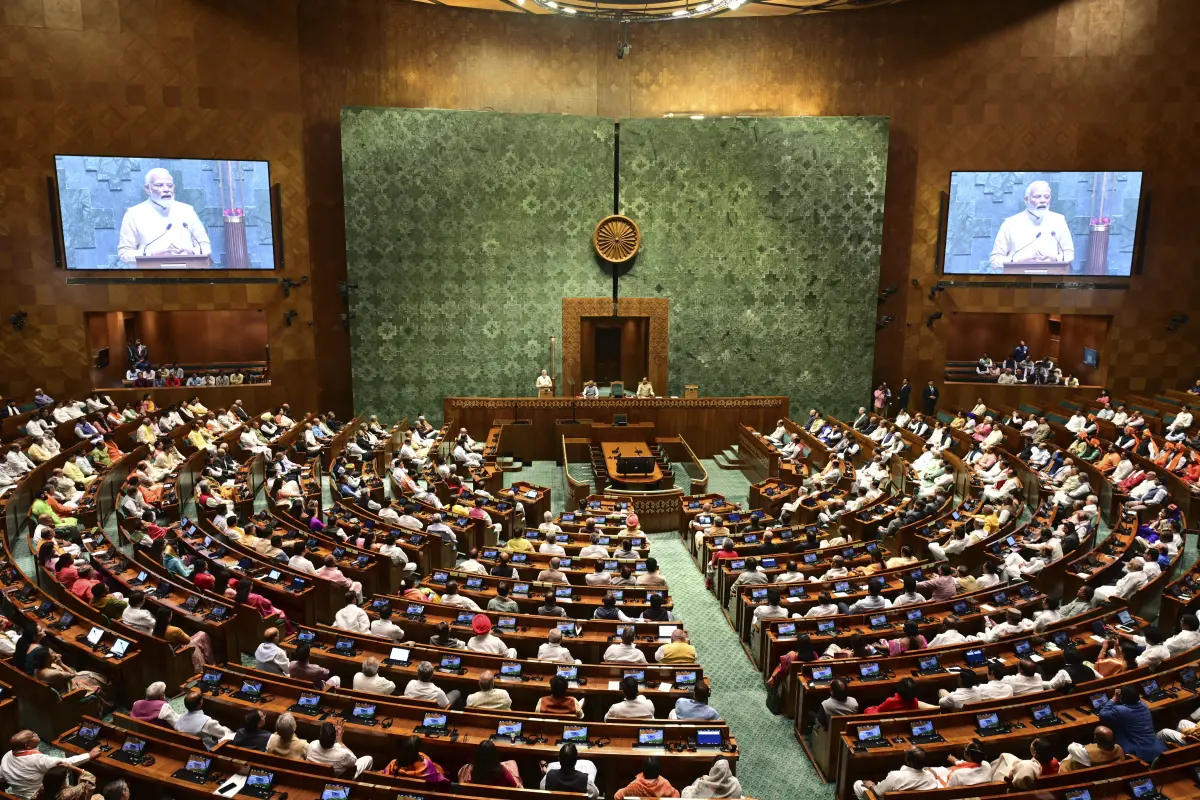
Kathmandu, Nov 28: India’s Cabinet has approved a proposal to increase the number of seats in the Lok Sabha and state legislative assemblies by 50 per cent. The decision was taken at a Cabinet meeting on Friday.
Under the proposal, the Lok Sabha’s current strength of 543 seats would increase by 50 per cent to 815, adding 272 seats.
However, the total could rise to around 824, as seat allocations in states with fractional figures are rounded to whole numbers. The proposal also provides for the possibility of increasing the total strength to 850.
The proposal recommends using the 1971 census as the basis for determining the number of seats and the 2011 census for delimiting parliamentary constituencies.
It also includes plans to reserve the additional seats for women. The total number of seats would remain unchanged for the next 25 years.
The government plans to pass a bill during a special parliamentary session. The government is preparing to pass the delimitation bill during a special session of Parliament beginning November 30. Union Minister Kiren Rijiju has urged opposition parties to participate in the debate on the legislation.
The Congress (I), however, has accused the government of trying to secure a majority through deceptive means to pass the bill.
A bill introduced in Parliament on April 16 had focused on increasing seats through population-based delimitation, a process of redrawing constituency boundaries, determining their number and restructuring representation. The proposal had raised concerns that it could alter the relative representation of different states.
The revised bill proposes increasing the number of seats in each state by 50 per cent while maintaining the current proportional representation among states until 2051. This means that although the total number of Lok Sabha seats would increase, no state would lose its share of representation relative to another.
The Modi government had convened a special parliamentary session from April 16 to 18, 2026, to introduce constitutional amendment bills on delimitation and women’s reservation.
The government had argued that passing the bills was necessary to implement the women’s reservation law by the 2029 general elections. A total of 298 MPs voted in favour of the bill, while 230 voted against it. As many as 528 MPs participated in the voting.
A constitutional amendment bill requires the support of at least two-thirds of members present and voting. The legislation therefore needed at least 352 votes to pass. It fell short by 54 votes, securing only 298. The NDA currently has 320 MPs in the Lok Sabha. With three seats vacant, a maximum of 540 MPs can participate in the vote.
The bill would need 360 votes, or a two-thirds majority, to pass under these circumstances. The NDA is therefore short of 40 votes. Similarly, the NDA has 151 MPs in the Rajya Sabha, where an estimated 243 members are expected to vote. The bill would require 162 votes to secure a two-thirds majority, leaving the NDA short of 11 votes.
People’s News Monitoring Service

Login to add a comment