







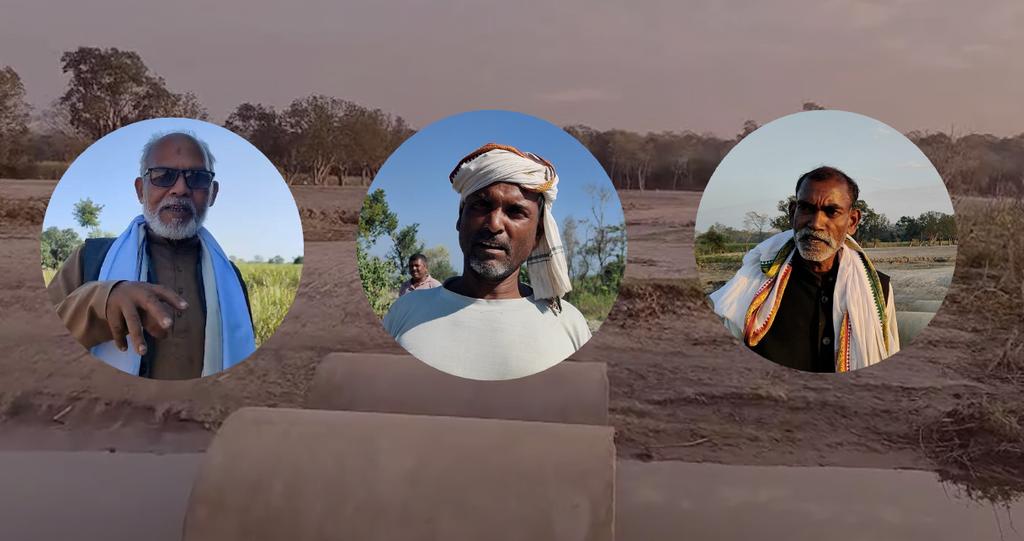
Kathmandu, November 22: Residents of Susta in Susta Rural Municipality of Nawalparasi West district urge Prime Minister Balendra Shah to resolve the long-standing border dispute between Nepal and India, which remained unresolved for decades.
For the people of Susta, who have been protecting Nepali territory for generations, the PM’s visit should not be limited to diplomatic meetings. They expect it to provide an opportunity to reclaim encroached land, restore missing border pillars and resolve citizenship and land ownership certificate (lalpurja) problems.
Local residents have repeatedly drawn the government’s attention to the problems facing Susta, which have been compounded over the years by erosion caused by the Narayani River, obstruction from the Indian side and the unresolved border dispute.
However, despite the passage of many years, their fundamental problems remain unresolved. Residents are still waiting for the government to ensure their ownership and right to use their ancestral land.
According to the Susta Protection Campaign, Susta covers a total area of 40,980 hectares. Of this, 14,500 hectares have allegedly been encroached upon by the Indian side, 19,480 hectares remain disputed, and Nepalis have been able to cultivate and use only 7,000 hectares.
Due to the lack of clear border demarcation and border pillars, local residents have been unable to freely use even land for which they hold ownership certificates in their own names.
Adam Khan, coordinator of the Susta Protection Campaign in Nawalparasi West, said Susta residents have high expectations of PM Shah. Speaking to Nepal News Bank, he said residents hope the PM will directly raise the issue of encroachment of Susta’s territory with his Indian counterpart, Narendra Modi, and seek a solution through diplomatic initiatives.
Khan said, “We, the people of Susta, as well as Nepalis living in different parts of the country, are hopeful. We have a young Prime Minister, and we expect him to meet his Indian counterpart, Narendra Modi, and take diplomatic initiatives. India can never earn respect and honour by encroaching upon Nepal’s territory. We must reclaim our land, but we do not want even an inch of Indian territory.”
He said both countries’ prime ministers should take political and diplomatic initiatives to resolve the border dispute. Technical teams from both countries should also be mobilised to demarcate the boundary in areas where border pillars are missing. He stressed that the problem should be resolved so that future generations do not have to suffer the same difficulties.
According to Khan, Susta residents have repeatedly approached successive governments and prime ministers in the past, seeking a solution. Although they have tried to convey their concerns to the Prime Minister’s Secretariat, the issue has failed to move forward beyond that level.
“Initiatives are being taken, but they go only as far as the Prime Minister’s Secretariat. Nothing moves beyond that. This has been the situation,” he said.
They Have Land Ownership Certificates but Cannot Cultivate Their Own Fields
The problems in Susta are not limited to border pillars and territorial disputes. Local residents complain that they are unable to cultivate even land registered in their own names. The Indian Sashastra Seema Bal (SSB) restricts farming, claiming that the land is disputed, while Nepali residents insist that it is their ancestral property.
Kamala Harijan, a local resident born in Susta, said his family has been unable to cultivate its one-and-a-half bighas of land for years because of obstruction from the Indian side. According to him, four bighas belonging to Munna Khan and more than 20 bighas of land belonging to several other local residents have also become disputed.
Pointing towards his land, he said, “This is our land, for which we have ownership certificates. I have one-and-a-half bighas, while Munna Khan has four bighas. Ram Chandra Kurmi and a Mian family also have land here. More than 20 bighas are involved. The Indian side does not allow us to cultivate it, claiming that the land is disputed.”
According to him, his paternal uncle was once beaten by people from the Indian side when he went to cultivate their field. Following the incident, local residents became frightened and stopped going to their land to farm. He complained that repeated delegations to the local administration have failed to resolve the problem.
Harijan said Prime Minister Balendra Shah should take concrete initiatives to address Susta’s problems during his visit to India. He called for the border dispute to be resolved at the political and diplomatic levels and for clear demarcation of the land that Nepali residents have traditionally cultivated and used.
“I humbly request the Prime Minister to find a way to resolve Susta’s problems and return with a solution. The land that we have been cultivating and using should be clearly demarcated by installing border pillars. This would ensure that future generations do not have to suffer the same hardships,” he said.
He also said Susta’s problems are not confined to the border dispute. He urged the government to raise the issue of controlling erosion and inundation caused by the Narayani River with India. According to him, changes in the river’s flow following the construction of the Gandak Barrage have aggravated erosion and flooding on the Susta side.
“When the Gandak Barrage was constructed, the flow of the river changed. Now, water is being directed towards Susta through structures designed to control and redirect the river, with the result that the land is being eroded. We hope the Prime Minister will also take initiatives to control this problem,” he said.
Harijan recalled that he had previously carried soil from Susta to meet then Prime Minister Pushpa Kamal Dahal and draw his attention to the plight of the residents. He said he had even held Dahal’s hand and asked whether Susta’s territory could be protected.
According to Harijan, Dahal had promised to prioritise the issues of Susta, Kalapani, Lipulekh and Limpiyadhura during his tenure. However, Harijan expressed dissatisfaction that the issue was not raised during Dahal’s visit to India.
“I carried soil from Susta to his office. I made a Shivalinga out of it and offered tika to him. Holding his hand for five minutes, I asked him to give me an answer: Would Susta’s soil and territory be protected or not? He said he would work on Susta, Kalapani, Lipulekh and Limpiyadhura during his tenure. But when he went to India, he did not say anything about these issues,” Harijan recalled.
He said Susta residents are now equally hopeful about Prime Minister Balendra Shah.
Generations Have Suffered from the Border Dispute
The border dispute in Susta is not a recent development. According to historical documents provided by the Susta Protection Campaign, the Narsahi Ranger Post had been looking after the forests and woodlands in the Susta area since 2012 BS (1955/56).
The dispute intensified following an incident on Chaitra 17, 2020 BS (March 30, 1964), when Indian timber smugglers attacked a team of forest officials, killing five employees.
In 2022 BS (1965/66), under the orders of then King Mahendra, a mixed settlement was established under the leadership of Kishor Gurung. People from different communities, including Gurung, Magar, Brahmin, Chhetri, Kurmi, Musahar, Muslim and Harijan, were brought together to establish the settlement.
Susta Panchayat was established in 2025 BS (1968/69). Subsequently, steps were taken to establish a ward office, school and police post.
According to the campaign’s historical records, in 2027 BS (1970/71), Indian security personnel detained a team deployed by the Nepal government to conduct land surveys and took them to Bettiah Jail in Bihar. Two years later, another land survey was conducted, and ownership certificates were distributed for 556 bighas of land.
A major flood in 2034 BS (1977/78) forced Susta residents to leave their homes. The government subsequently arranged alternative settlements for families holding citizenship certificates in other areas. However, 36 families who did not have citizenship certificates and land ownership documents returned to Susta and resumed living there.
The fertile soil deposited by the Narayani River gradually expanded the cultivable land, attracting people from other places who also began settling in the area.
On Bhadra 30, 2040 BS, Indian police entered Susta and opened fire, killing local residents Rafiq Khan, Jangali Mian and Bandhu Khatik, according to the campaign’s records. The incident further highlighted the seriousness of the border dispute and security challenges in the area.
Later, as the presence of the Indian Sashastra Seema Bal increased, the issue of encroachment of Susta’s territory attracted greater attention.
Around 2062 BS (2005/06), local residents began protesting against alleged attempts by the Indian SSB and Indian citizens to encroach upon Nepali territory and set fire to sugarcane crops cultivated in Susta. Subsequently, the Susta Protection Campaign Nepal was established to raise the border dispute as a national issue.
No Border Pillars; Citizenship and Land Ownership Problems Persist
The absence of proper border demarcation and border pillars remains one of the major problems in Susta. According to local residents, no boundary pillars can be found along a stretch of 46 kilometres from Border Pillar No. 1.
They also claim to have located an old boundary pillar associated with the Sugauli Treaty, photographed it and submitted the photographs to government authorities.
According to local resident Shyam Sundar Kurmi, the Indian side continues to claim ownership of land in the eastern part of Susta, for which Nepalis hold ownership certificates, and prevents them from cultivating it.
“Our birth and entire lives are connected to this place. The land in Susta is registered in our names. But the SSB tells us that this is India. We have all the land ownership certificates, but how can we cultivate our land? They have classified everything as disputed,” he said.
According to him, resolving the border dispute would address several problems simultaneously. He called for proper border demarcation, construction of embankments and resolution of citizenship-related issues.
The Susta Protection Campaign estimates that around 150 households in the area are without citizenship certificates. In Asar (June/July) this year, residents staged a protest in Kathmandu demanding citizenship certificates and legal ownership of their land.
Following the protest, details of local residents facing citizenship-related problems were collected and forwarded to the Ministry of Home Affairs. However, the campaign complains that no satisfactory initiative has been taken so far.
Without citizenship certificates, residents have also been deprived of various services and facilities provided by the state. The inability to guarantee the identity and land ownership rights of people who have struggled for generations to protect their ancestral territory has become another irony of Susta’s situation.
Visits by Governments and Senior Leaders, but Problems Remain Unresolved
Various political leaders and senior government officials have visited Susta in the past to assess the situation. According to the campaign, Giriraj Mani Pokharel, who was then Health Minister, was the first minister to visit Susta in an official capacity.
Subsequently, the President, the Chairperson of the National Assembly, ministers and senior leaders of various political parties have also visited the area.
Some development activities have taken place in Susta in recent years. Infrastructure projects include Nepal’s longest suspension bridge, four kilometres of embankments, the People’s Housing Programme, a solar mini-grid, reinforced concrete (RCC) roads and expansion of electricity services.
However, despite improvements in physical infrastructure, questions concerning the rights and security of local residents remain unresolved.
According to local residents, transportation and access have become easier than before. Nevertheless, the border dispute, restrictions on cultivating land, citizenship problems and river erosion continue. They also say that confrontations and clashes with the SSB sometimes occur when Nepali citizens go to cultivate disputed land.
The Susta Protection Campaign has repeatedly submitted memorandums to the government, sent delegations to various government agencies and organised protests. However, according to the campaign, although some of its demands have been addressed, the border dispute and land ownership issues remain unresolved.
Whether Prime Minister Shah’s visit to India will address the decades-long concerns of Susta residents remains to be seen. That will depend on the diplomatic initiatives taken in the coming days. For the people of Susta, however, the visit should not become just another formal diplomatic engagement; they hope it will provide a decisive opportunity to protect their territory and identity.
Susta residents say they have repeatedly brought their problems to the attention of successive prime ministers, including Girija Prasad Koirala, Sushil Koirala, Sher Bahadur Deuba, Jhala Nath Khanal, Pushpa Kamal Dahal, Dr. Baburam Bhattarai and KP Sharma Oli. However, their problems remain unresolved.
Prime Minister Balen Shah departed for India on Sunday for a two-day visit.

Login to add a comment