







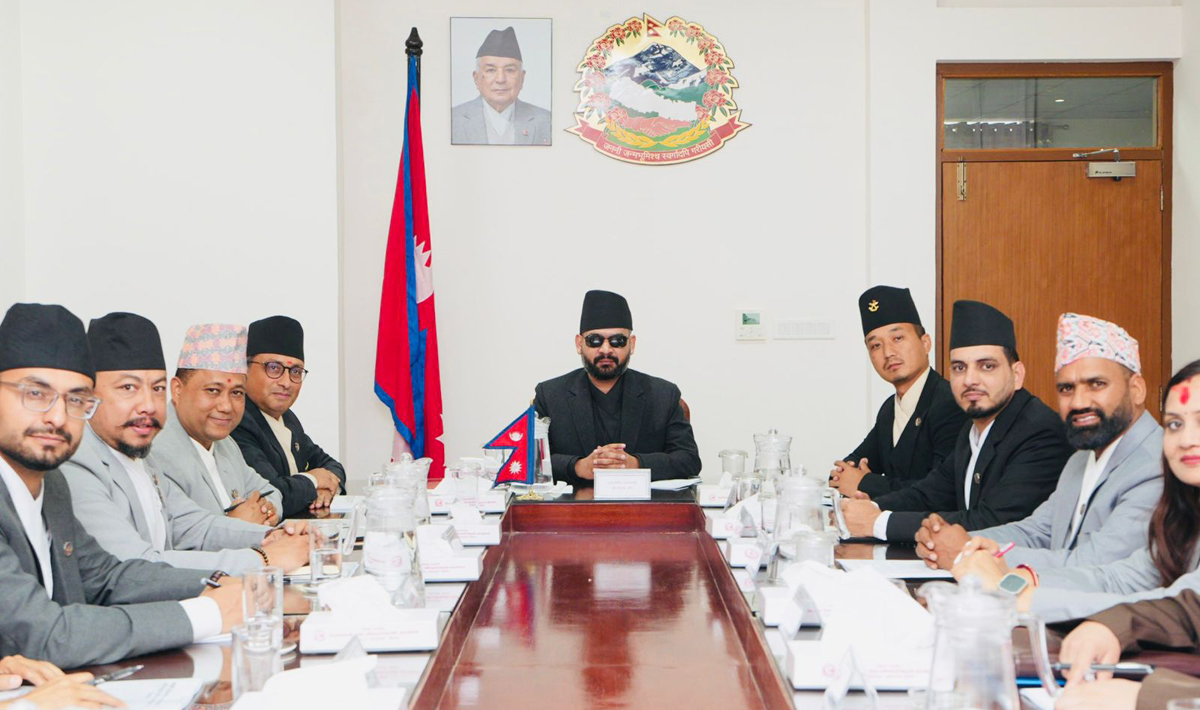
By Our Political Analyst
Prime Minister Balendra Shah entered the latest monsoon session with a political advantage few governments enjoy: a parliamentary strength only two seats short of a two thirds majority. Yet as the session ended at midnight on October 2, the size of that majority stood in contrast to a recurring question: how effectively did Parliament hold the government, particularly the prime minister, to account?
The session, which began on May 11, saw 68 meetings of the House of Representatives and 51 of the National Assembly. Eleven bills were passed, including three budget related bills, treaties were ratified and a special parliamentary committee was formed to study the Bhotekoshi flood. Still, much of the political debate centred on Shah’s limited engagement with Parliament.
Opposition parties repeatedly demanded that the prime minister appear before the House and answer questions. The dispute intensified after Shah attended question hour on May 31 and said Nepal had also encroached on Indian territory in several places. Opposition lawmakers demanded details of the areas he was referring to, but the prime minister did not provide them in Parliament.
Instead, Shah later addressed the controversy at the Rastriya Swatantra Party’s general convention in Chitwan. That choice became part of a broader debate over parliamentary accountability. When questions originate in the legislature, responding from a party platform inevitably raises questions about the place Parliament occupies in the government’s political priorities.
The confrontation also spilled into the budget debate. Opposition lawmakers demanded Finance Minister Swarnim Wagle’s resignation over allegations that proposed tax changes involving electric vehicles and customs duties had reached business groups before the budget became public. They also questioned the clearance of large numbers of vehicles through customs before the budget announcement. The protests disrupted proceedings, but neither controversy produced sustained parliamentary scrutiny.
Eventually, the opposition allowed proceedings to resume without securing the answers it had demanded. This exposed another side of the accountability problem. Parliamentary oversight depends not only on whether the government answers questions, but also on whether opposition parties can sustain focused scrutiny and use parliamentary mechanisms effectively.
Questions about executive decision making extended beyond Parliament. Home Minister Sudan Gurung was removed only 26 days after the government took office, while Labour Minister Dipak Kumar Sah left after 14 days. Industry Minister Gauri Kumari Yadav resigned after 153 days. Such rapid changes inevitably raised questions about how ministers were initially selected and assessed.
Legislative output provides another measure of the session. Parliament passed 11 bills, including legislation concerning the budget, public procurement, elections, cooperatives, money laundering and alternative development finance. Several other bills reached committees. The Federal Civil Service Bill arrived only near the end of the session, with parliamentary officials estimating that its passage could require at least six months.
Meanwhile, three resolution motions and five proposals on urgent public matters became inactive with the session’s closure. They covered issues including landless squatters, tax reform and agricultural losses caused by wild animals.
The session therefore leaves a mixed institutional record. Parliament conducted substantial business, but a commanding majority did not automatically produce stronger legislative scrutiny or smoother executive accountability. In a parliamentary system, numerical strength gives a government the ability to govern. It does not reduce its obligation to answer Parliament.
For Shah’s government, that distinction may become increasingly important. A large majority can pass laws and budgets with relative ease. The harder test is whether that political strength operates alongside a legislature capable of questioning decisions, demanding explanations and receiving answers from those exercising executive power.

Login to add a comment