







By Sharachchandra Bhandary
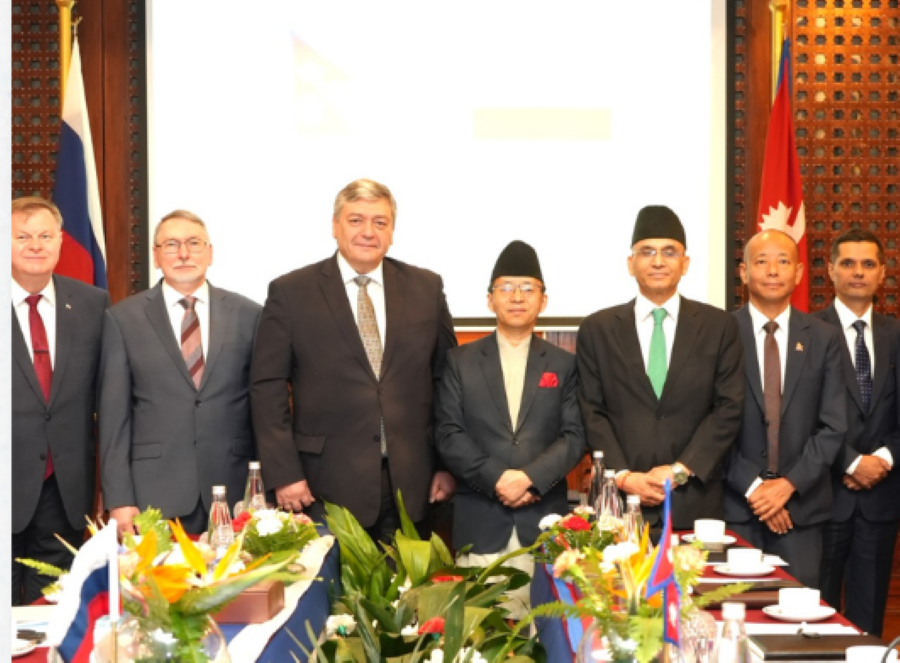
The third meeting of the Nepal-Russia Bilateral Consultation Mechanism is taking place in Kathmandu today, eight years after the second meeting, as the two countries mark the 70th anniversary of the establishment of diplomatic relations.
The Nepali delegation is being led by Foreign Secretary Amrit Bahadur Rai, while the Russian delegation is headed by visiting Deputy Foreign Minister Andrey Rudenko.
The consultation mechanism was established under a protocol signed between the foreign ministries of Nepal and Russia in 1995 to facilitate regular consultations and exchanges of views on bilateral, regional and international issues.
The first meeting was held in Moscow in 2007 at the level of foreign secretaries, while the second meeting took place in Kathmandu on April 17, 2018.
The meeting is expected to review the overall state of Nepal-Russia relations and discuss ways to expand cooperation in trade, investment, tourism, education, culture and technical fields. Regional and international issues and cooperation in multilateral forums are also expected to feature in the discussions.
Speaking at an Open Dialogue organised by the Russian Embassy in Kathmandu on Tuesday evening, Rudenko outlined Russia’s perspective on the rapidly changing international situation and Moscow’s approach to its foreign policy.
He said the world was moving towards a multipolar order, while different regions were witnessing confrontation and growing geopolitical tensions.
Rudenko referred to the Russia-Ukraine conflict, US sanctions imposed on Russia and several other countries, and the continued backing of Ukraine by the United States, European Union and their allies.
Referring to diplomatic efforts to end the Ukraine conflict, including the peace proposal put forward by the Trump administration, he stressed the importance of dialogue and political and diplomatic means in resolving international disputes.
On US-China relations, Rudenko referred to the strategic rivalry between the two major powers and President Xi Jinping’s recent visit to the United States. He described the understanding reached between Washington and Beijing as a “temporary truce” in their tensions.
He also referred to the Taiwan issue and tensions in the South China Sea, as well as the situation on the Korean Peninsula, as part of the wider geopolitical challenges confronting the international community.
In the South Asian context, Rudenko referred to the India-Pakistan conflict. Developments involving Iran, Venezuela and Libya were also cited in his broader assessment of the changing geopolitical landscape.
Against this backdrop, he stressed the need for adherence to the UN Charter and international law, saying respect for the principles of international law was essential for maintaining international peace, stability and a balanced world order.
Turning to Nepal, Rudenko said Russia would make its best efforts to contribute to Nepal’s national economy by encouraging Russian investment in Nepal, despite the difficult circumstances Russia itself was facing at home.
He said Russia remained interested in expanding economic cooperation with Nepal and exploring opportunities for Russian investors to contribute to Nepal’s development.
Rudenko also expressed deep sympathy to the Government of Nepal and the Nepali people over the loss of lives and property caused by the recent devastating floods.
He praised Prime Minister Balendra Shah for drawing international attention to the impact of climate change on Nepal in his address to the United Nations General Assembly, saying the issue raised by Nepal served as an “alarm bell” for the international community.
Rudenko said Russia stood ready to assist Nepal within its capacity in dealing with the consequences of the disaster. He acknowledged that Russia itself was going through difficult times, but said Moscow would nevertheless try its best to support Nepal.
He also highlighted educational cooperation between the two countries, saying Russia would provide 52 scholarship places for Nepali students pursuing higher studies in Russia.
The visiting deputy foreign minister said education, culture and people-to-people contacts were important areas for further strengthening Nepal-Russia relations.
During his visit, issues concerning Nepali nationals recruited into the Russian military, missing Nepalis and compensation for the families of those who died are also expected to be discussed.
Nepal and Russia established diplomatic relations on July 20, 1956, and are marking the 70th anniversary of their diplomatic ties this year.

Login to add a comment