







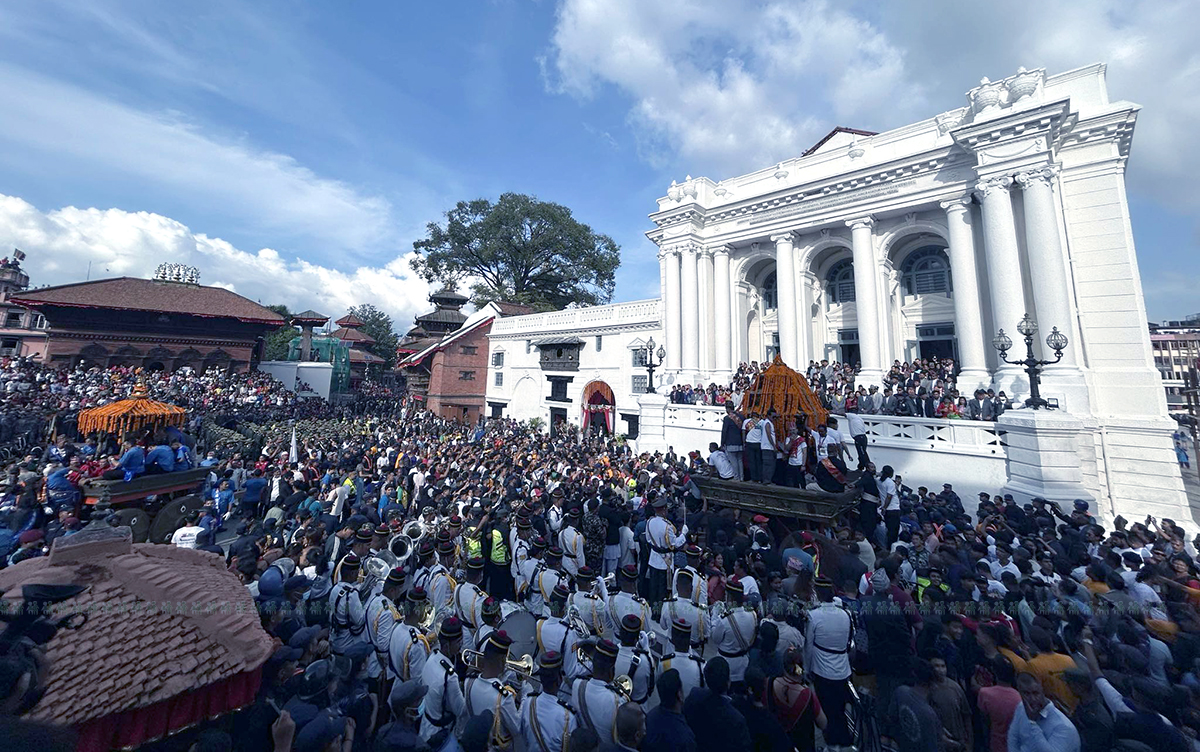
KATHMANDU: Indra Jatra is being celebrated with prayers to Indra, the god of rain and prosperity, and a range of religious and cultural events.
Observed each year on the fourteenth day of the bright fortnight of Bhadra, the festival is celebrated in Kathmandu, Lalitpur, Bhaktapur, Dhulikhel and Dolakha, among other places.
The eight-day festival begins when the Yahsin, a ceremonial pole bearing Indra’s banner, is raised in front of Hanuman Dhoka on the twelfth day of the bright fortnight. Dances, chariot processions and worship of deities follow.
Professor Dr Ramchandra Gautam, a religious scholar and former chair of the Nepal Panchanga Nirnayak Samiti, said an auspicious time was set for raising the pole on Saturday because the twelfth lunar day lasted until 6:57 am. The main celebration was set for Sunday, when the fourteenth lunar day falls at sunrise.
Tradition holds that Bhairav is worshipped at the base of the pole. Indra Jatra is also associated with a celebration of victory over enemies and with the worship of Indra’s banner as a symbol of strength.
On the festival’s main day, the President traditionally watches the chariot processions of the Kumari, revered as a living goddess, and of Ganesh and Bhairav from the Gaddi Baithak at Hanuman Dhoka.
Performances include the Bhakku, Mahakali and Lakhe dances, Dashavatar, and Pulukisi, which depicts Airavata, Indra’s elephant.
Devotees also worship Anantanath, a form of Lord Vishnu, on the fourteenth lunar day, known as Ananta Chaturdashi. Some tie a consecrated thread around their wrist in the belief that it will bring good fortune throughout the year.
People’s News Monitoring Service

Login to add a comment