







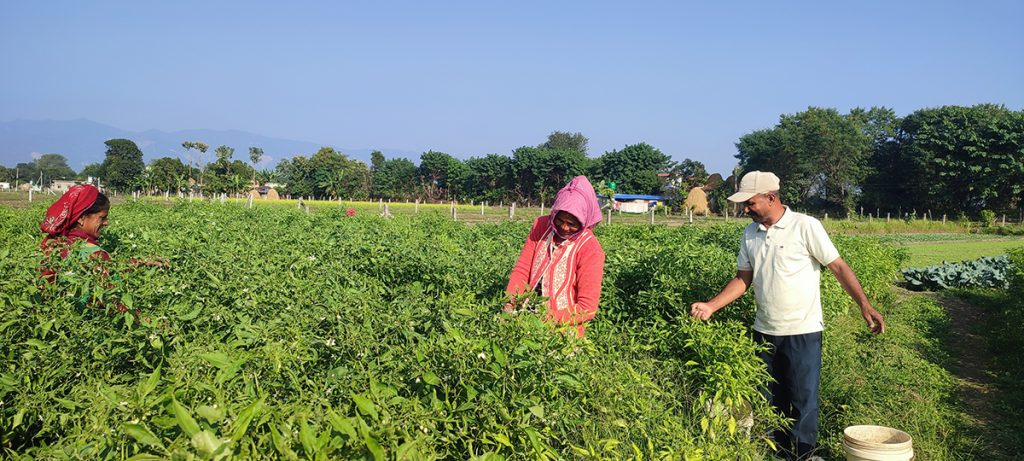
Kathmandu, November 21: Bir Bahadur Khadka of Bhujela, Bhimdatta Municipality-11, Kanchanpur, has been engaged in commercial vegetable farming for the past decade.
He initially invested just Rs 500 to grow vegetables on one kattha of land. After earning Rs 10,000 from selling his produce, he gradually expanded his farming activities.
Encouraged by the good income from vegetable farming, Khadka continued to increase the area under cultivation. He now grows various types of vegetables on three bighas of land. Having started commercial vegetable farming in 2015, he said he chose this business because it generates up to three times more profit than paddy and wheat cultivation.
“I started farming on one kattha of land and gradually expanded it. During the COVID-19 pandemic, my two sons, who had been working in India, also returned home,” Khadka said. “After that, we joined hands and further expanded our vegetable farming business.”
Khadka, who currently cultivates vegetables on three bighas of land, has been covering household expenses as well as his children’s education costs with the income from farming.
“After deducting all expenses, I earn up to Rs 2.5 million annually from selling vegetables,” he said. “With the money earned from farming, I invested Rs 2 million to send one of my sons abroad and also built a house. Earlier, I used to carry vegetables to the market on a bicycle. Now, I own three motorcycles. I have also purchased an autorickshaw with a 50 per cent government subsidy.”
Khadka’s vegetable farm provides regular employment to two people, each receiving a monthly salary of Rs 15,000. In addition, around 100 people get seasonal or daily-wage employment at the farm over the course of a year, he said.
Although he does not face difficulties in finding markets for his produce, Khadka said vegetables imported from India through the open border make it difficult for local farmers to obtain reasonable prices.
“Because of vegetables coming from India, we do not get the expected prices for our produce,” he said. “Our production costs are higher. However, we are compelled to sell our vegetables at lower prices to compete with cheaper Indian imports.”
Khadka grows cauliflower, cabbage, broccoli, potatoes, onions, eggplants and chillies, among other vegetables. According to him, off-season vegetable farming generates better income than seasonal cultivation.
“Farmers can earn a good income if they manage to produce vegetables during the off-season rather than during the regular growing season,” he said. “It would be much easier for farmers if the government provided crop insurance facilities.”

Login to add a comment