








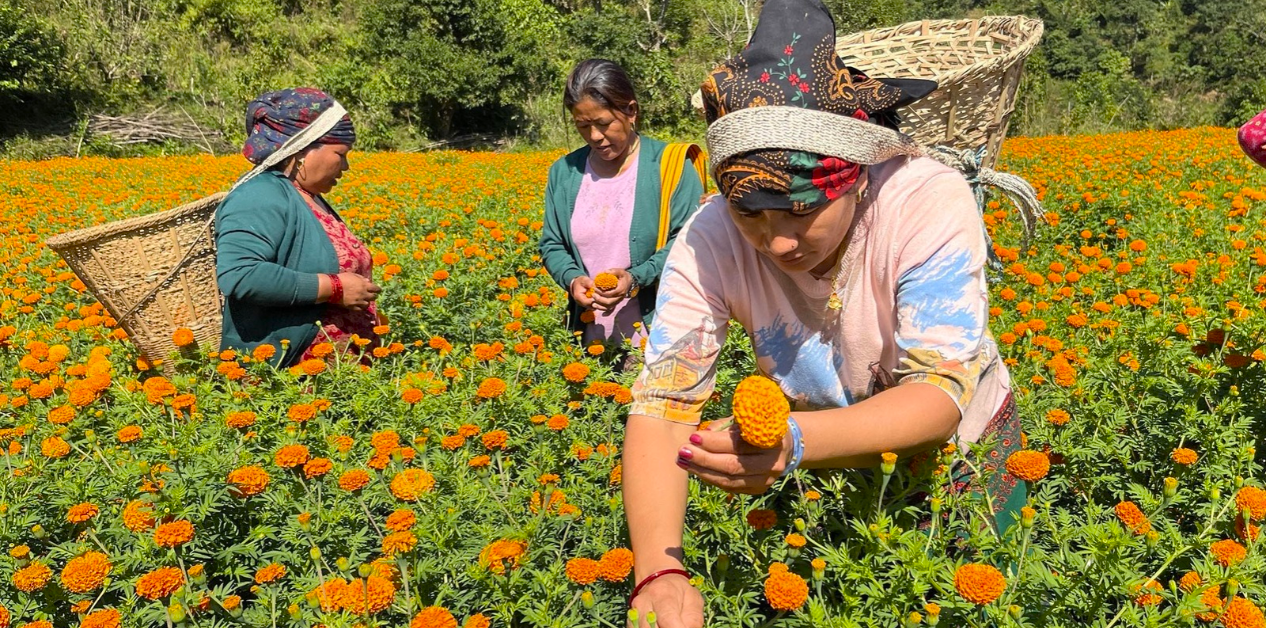
Kathmandu, Nov 9: Locally grown marigolds have filled markets and homes across Nepal this Tihar, with expanding commercial cultivation enabling domestic farmers to meet a large share of the festival’s flower demand.
The government has tightened controls on flower imports from India to protect local growers, reducing legal imports of both natural and artificial flowers.
According to the Department of Customs, Nepal imported artificial flowers worth Rs 3.204 million and natural flowers, excluding marigolds and globe amaranths, worth Rs 9.685 million during the first three months of fiscal year 2026/27. Flowers imported from India must meet prescribed standards, including quarantine testing.
Nepali farmers now produce garlands comparable in quality to Indian products, said Hiramani Sharma, general secretary of the Floriculture Association Nepal (FAN). He said the association has also fixed retail prices to protect consumers. A one-metre marigold garland costs Rs 80 to 90 at wholesale and up to Rs 150 at retail, while globe amaranth garlands cost Rs 80 to 100.
Commercial marigold farming is concentrated in Chitwan, Makwanpur, Kavre, Kathmandu Valley, Dang, Rupandehi, Morang, Jhapa and all eight districts of Madhes Province. Chitwan is the largest producer.
FAN estimates demand for six lakh globe amaranth garlands this Tihar, with domestic production meeting the entire requirement. Around 400,000 will be sold locally, while the remainder is expected to be exported. Trade in these garlands is projected at Rs 27 million.
Demand for marigold garlands stands at 4.5 million, of which domestic farmers are expected to supply around four million, generating an estimated Rs 405 million in business.
The association also estimates demand for 20,000 chrysanthemum garlands and 60,000 mixed flower garlands. FAN Chairman Rajesh Bhakta Shrestha said expanding commercial cultivation is steadily moving Nepal towards self-sufficiency in flower production.
People’s News Monitoring Service

Login to add a comment