







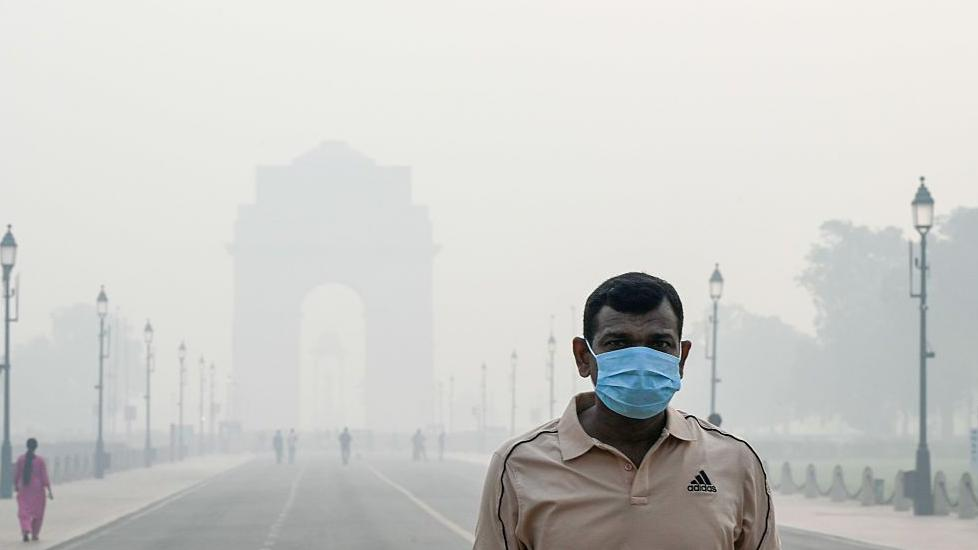
Kathmandu, November 1: Stricter restrictions have come into effect in the Indian capital, New Delhi, from Sunday in an effort to control rising air pollution. Parking fees for vehicles have been doubled, and employees of both government and private offices have been instructed to work from home.
According to officials, the main objective of the new measures is to reduce emissions from vehicles. Vehicles that fail to meet the prescribed emission standards will be barred from entering Delhi. Similarly, demolition work that generates dust and construction activities in open areas have been banned with immediate effect.
According to a statement issued by the office of Chief Minister Rekha Gupta, Delhi’s ‘Winter Action Plan’ came into effect on November 1. The plan includes stringent pollution-control measures, effective enforcement and round-the-clock monitoring.
The Delhi government has urged citizens to comply with official directives and help make the capital’s air clean and healthy. For the past month, the government has also been prohibiting the burning of waste and imposing restrictions on roadside eateries that use coal and firewood for cooking.
However, similar measures introduced in previous years have failed to achieve the expected results in controlling the thick smog and pollution that engulf Delhi between November and January. During winter, falling temperatures cause pollutants to accumulate close to the ground, resulting in higher pollution levels.
The major sources of air pollution in Delhi include vehicle emissions, coal-fired power plants, industrial activities, dust from construction sites and the burning of crop residue left in fields after harvesting in neighbouring states.
According to India’s Ministry of Environment, vehicles account for 23 percent of Delhi’s air pollution during winter. The burning of agricultural residue and other organic materials contributes 20 percent, while industries, including coal-fired power plants, account for around nine percent.
The concentration of fine particulate matter known as PM2.5 in Delhi’s air often exceeds 300 micrograms per cubic metre during the peak winter months. These particles are considered extremely harmful to human health because they can penetrate deep into the lungs. This level is approximately 20 times higher than the daily limit recommended by the World Health Organization (WHO).
Last year, Delhi’s PM2.5 concentration reached as high as 846 micrograms per cubic metre, 56 times the WHO-recommended standard.
Measurements taken on Sunday showed that Delhi’s PM2.5 level stood at 201 micrograms per cubic metre, more than 13 times the safe limit. The pollution level is believed to have declined somewhat in recent days, possibly due to intermittent rainfall.
According to a study published in 2024 in the journal The Lancet Planetary Health, approximately 3.8 million people died in India due to air pollution between 2009 and 2019.

Login to add a comment