







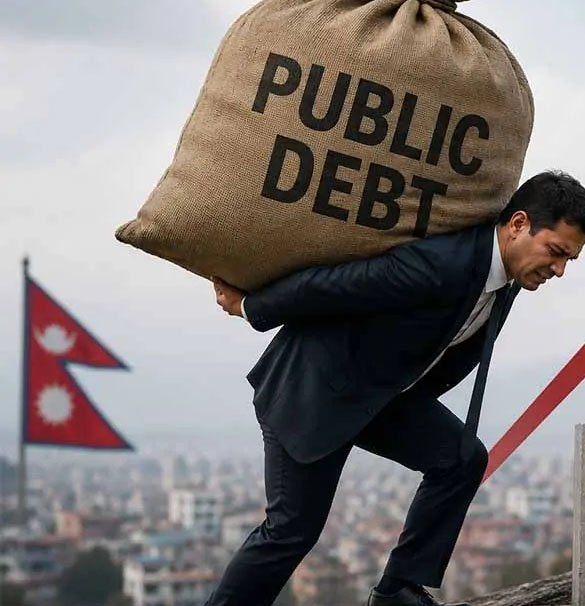
Kathmandu, October 29: Nepal’s public debt has exceeded Rs 30 trillion. According to the Public Debt Management Office, the country’s public debt reached an all-time high of Rs 30 trillion during the first quarter (mid-July to mid-October) of the current fiscal year 2083/84.
By the end of the previous fiscal year 2082/83, in mid-July 2026, Nepal’s public debt stood at approximately Rs 29.81 trillion.
The government borrowed Rs 123 billion during the first three months of the current fiscal year. During the same period, it repaid Rs 77.74 billion in debt.
After recording a gain of Rs 18.16 billion due to exchange-rate movements, the outstanding public debt reached Rs 30.0911 trillion, according to the office. Of this amount, domestic debt stood at Rs 14.10 trillion and external debt at Rs 15.98 trillion.
Domestic debt accounts for 46.87 percent of Nepal’s total public debt, while external debt accounts for 53.13 percent.
Dividing the total public debt of Rs 30 trillion by the country’s population means that the debt burden exceeds Rs 100,000 per Nepali citizen.
According to the office, public debt has reached 45.59 percent of Nepal’s gross domestic product (GDP). Domestic debt accounts for 21.37 percent of GDP, while external debt represents 24.22 percent.
Borrowing Target of Rs 658 Billion, with 18.73 Percent Achieved
The government has set a target of borrowing Rs 658.28 billion in public debt during the current fiscal year. Of this amount, Rs 123.32 billion was mobilised during the first quarter, representing 18.73 percent of the annual target.
The government aims to raise Rs 410 billion in domestic debt over the fiscal year. By the end of Ashoj (mid-October), it had already mobilised Rs 100 billion, equivalent to 24.39 percent of the target.
Against the target of raising Rs 248.28 billion in external loans, the government mobilised only Rs 23.32 billion, or 9.39 percent of the annual target.
The government borrowed Rs 23.84 billion in Shrawan (mid-July to mid-August), Rs 38.10 billion in Bhadra (mid-August to mid-September), and Rs 61.37 billion in Ashoj (mid-September to mid-October).
Nearly Rs 100 Billion Spent on Debt Servicing in Just Three Months
The government spent nearly Rs 100 billion on principal and interest payments during the first three months of the fiscal year. According to the Public Debt Management Office, Rs 98.8735 billion had been spent on debt servicing by the end of Ashoj.
The government has allocated Rs 417.88 billion for debt servicing this fiscal year. By mid-October, it had spent 23.66 percent of the annual allocation.
During this period, the government paid Rs 77.74 billion in principal and Rs 21.12 billion in interest.
Principal repayments on domestic debt amounted to Rs 65.10 billion, while interest payments totalled Rs 17.63 billion. For external debt, the government spent Rs 12.64 billion on principal repayments and Rs 3.49 billion on interest.
During the first three months, the government spent substantially more on debt repayment than on infrastructure development. According to the Financial Comptroller General Office, capital expenditure amounted to only Rs 28.42 billion by the end of Ashoj.
How Much Public Debt Has Nepal Accumulated?
- Domestic debt: Rs 14 trillion 103.1 billion
- External debt: Rs 15 trillion 988 billion
- Total public debt: Rs 30 trillion 91.1 billion
The government’s substantially higher expenditure on debt servicing compared with capital expenditure indicates that it is spending more on managing its liabilities than on productive investment. The 63rd Annual Report of the Office of the Auditor General has identified this as a serious concern.
Experts describe Nepal’s current public debt situation as one in which the country has become indebted before becoming prosperous. Compared with an individual’s financial circumstances, the country risks falling into a debt trap in which new loans must be taken out to repay existing debts.
Nepal’s present situation increasingly resembles this pattern.
How Is Public Debt Continuing to Rise?
According to Ministry of Finance data, Nepal’s public debt has more than doubled over the past decade. By the end of fiscal year 2076/77, public debt stood at only Rs 1.4334 trillion. Since then, the debt burden has increased rapidly, surpassing Rs 30 trillion.
Seven years ago, public debt accounted for just 38.05 percent of GDP. It has now risen to more than 45 percent.
Rising public expenditure, declining foreign grants and the government’s failure to mobilise revenue as expected have contributed to the continuous increase in public debt.
Experts say that borrowing equivalent to GDP does not necessarily pose a risk if the funds are invested in productive projects that increase capital formation and generate sufficient returns to repay the loans. However, Nepal has not been able to achieve this.
A report submitted in 2024 by the High-Level Economic Reform Recommendation Commission, formed by the government, noted that GDP and revenue mobilisation had failed to grow in proportion to the increasing volume of public debt. Consequently, the burden of principal and interest payments has continued to rise.
“If public debt is not properly utilised and fails to generate returns, the likelihood of the country becoming trapped in a debt spiral will continue to increase,” the report stated.
According to the report, the growing obligation to repay principal and interest has left insufficient budgetary resources for essential government responsibilities, including education, health and security.
For this reason, government agencies and experts have repeatedly recommended that borrowed funds be concentrated on projects that create capital assets.
Commission Calls for Strict Ban on Using Domestic Loans for Recurrent and Administrative Expenditure
The National Natural Resources and Fiscal Commission has recommended a strict prohibition on the use of domestic borrowing to finance recurrent and administrative expenditure.
The commission made this recommendation while setting the limits on domestic borrowing that federal, provincial and local governments may undertake during the current fiscal year.
As in previous years, the commission has set a ceiling allowing the federal government to mobilise domestic debt of up to 5.5 percent of GDP for the coming fiscal year.
In its recommendations concerning domestic borrowing, the commission has specifically called for a strict ban on using such funds for administrative and recurrent expenditure.
“Domestic borrowing should be allocated to projects capable of creating employment opportunities, delivering long-term benefits and contributing to capital formation. Its use for recurrent and administrative expenditure must be strictly prohibited,” the commission stated.
According to the commission, net domestic borrowing in fiscal year 2081/82 amounted to only 1.41 percent of GDP.
Because debt-servicing costs have increased, most of the domestic loans mobilised have been used to repay existing debt rather than finance new investment.
The commission believes this trend has prevented borrowing from contributing adequately to capital formation and economic expansion. In its recommendations issued from fiscal year 2075/76 onwards, the commission has consistently urged the government to direct borrowed funds towards capital formation.
However, the Nepal government has not been able to publish details showing the sectors in which domestic borrowing has been utilised. Consequently, the commission has stated that “an analysis of debt utilisation and the implementation of recommendations has not been possible.”
The commission has urged the government to conduct cost-benefit analyses, calculate net present value and assess internal rates of return for projects. Domestic borrowing should be concentrated on profitable projects whose financial internal rate of return exceeds the prevailing cost of capital.
It has also recommended using domestic loans only for social-sector projects with higher internal rates of return.
When identifying, developing and selecting ongoing or new projects financed through borrowing, the government should ensure that the returns generated by their implementation will be sufficient to repay both principal and interest.
The commission has further recommended that domestic borrowing be directed only towards projects that are fully prepared for implementation and are capable of increasing production, generating employment, raising incomes, developing infrastructure and creating capital assets.
All three tiers of government have also been advised to explicitly identify domestic borrowing as a source of financing in the budget documents for individual projects and programmes.
In addition, the commission has called on the Public Debt Management Office to establish an integrated electronic information management, accounting and reporting system covering domestic borrowing by all three levels of government and the country’s overall public debt.
It has also recommended granting the commission access to this system.
Describing domestic borrowing as equivalent to spending future revenue in the present, the commission has advised all three levels of government to prepare and implement domestic borrowing and revenue improvement action plans within the recommended limits. The objective should be to ensure that principal and interest on domestic debt can eventually be repaid from domestic revenue.
Auditor General’s Conclusion: Public Debt Has Not Been Used for Capital Formation
The 63rd Annual Report of the Office of the Auditor General has also concluded that public borrowing has not been adequately used for capital formation.
The report has questioned the use of borrowed funds for recurrent expenditure, including employee expenses, services and consultancy, and office operations.
According to the Auditor General, foreign exchange movements have made the country’s debt structure vulnerable. The report has recommended mobilising financial instruments to manage foreign exchange risks and directing borrowing exclusively towards sectors capable of generating productivity gains.
The Auditor General has also highlighted the persistent shortfall in domestic revenue mobilisation, with total revenue collection amounting to only around 80 percent of the target. This has placed additional pressure on domestic resources.
Referring to the growing burden of debt servicing and the resulting dependence on borrowing to finance other expenditure, the report states:
“The budget should be formulated by keeping recurrent expenditure within desirable limits and allocating borrowed funds to projects that generate returns.”

Login to add a comment