








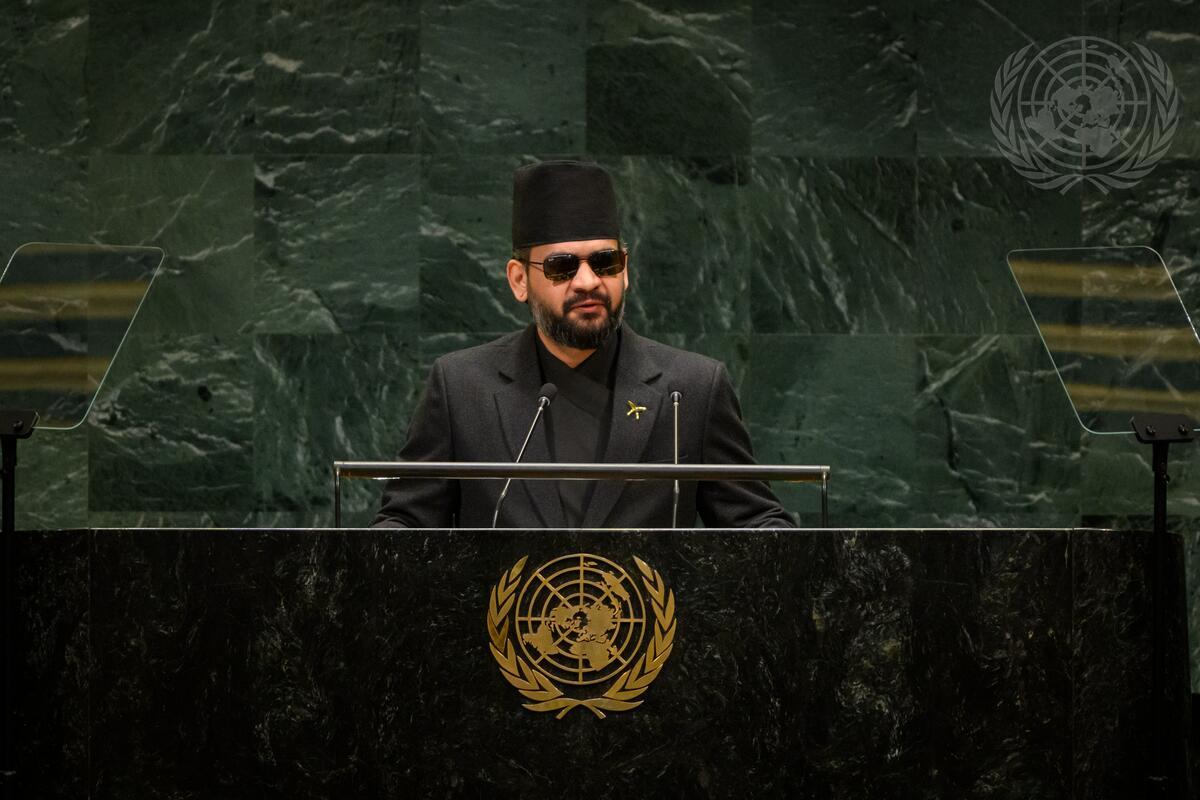
New York, Sept. 25: The floodwaters have receded in parts of the Bhotekoshi and Trishuli valleys, but the lives they swept away cannot be restored. Homes, roads and livelihoods remain to be rebuilt. On Friday, Prime Minister Balendra Shah carried that grief to the United Nations General Assembly in New York and asked the world to see more than a disaster in a distant mountain country.
Addressing the 81st session of the General Assembly, Shah called the Bhotekoshi-Trishuli disaster a warning to the world. The crisis that helped bring it about crosses borders, he said, even if the suffering falls hardest on places least responsible for it.
“Climate change does not recognise borders. Glaciers and floods do not travel with a visa stamped on passports,” he told world leaders.
Shah pressed for climate justice that reaches people before the next disaster, rather than remaining a promise in an international document. Communities should have the chance to build a future, he said, instead of spending their lives rebuilding what floods and landslides take from them.
“The Himalayas are not peripheral to the planet. They are part of the planet’s life-support system,” he said.
Nepal contributes less than 0.1 per cent of global greenhouse gas emissions, Shah said. Yet its people are paying a “colossal price” for a warming world they did little to create. For families along the rivers, that price is counted in missing loved ones, lost homes and fields that may no longer yield a harvest.
The mountains may seem far from the halls where climate decisions are made. Their rivers are not. Shah urged countries to share knowledge and work together across the Himalayan region, proposing that it become “a laboratory of international cooperation” rather than a place where warnings and responses remain scattered.
He also asked the world to move faster when disaster strikes. Aid loses its meaning, he suggested, if people must wait through lengthy procedures while they need shelter and food.
“When the house is burning, we do not ask the family to complete fifty forms. We act,” Shah said.
His appeal reached beyond emergency relief. Shah called for rehabilitation and reconstruction, along with responsibility, reparation and resilience. Farmers, in particular, need access to the resources and technology that will let them keep earning a living as the climate changes.
Turning to the world’s spending priorities, Shah said, “We have built a world with flawless logistics for war and broken logistics for food.” He asked how weapons could reach almost anywhere within 72 hours while farmers still struggled to obtain the means for a decent livelihood.
Nepal, he said, had been “hit by the climate we did not warm and hit again by the wars we did not start.” The words brought his argument back to the people living with those consequences. For them, the measure of the world’s response will be what reaches the riverbanks, farms, and families trying to begin again.
People’s News Monitoring Service

Login to add a comment