







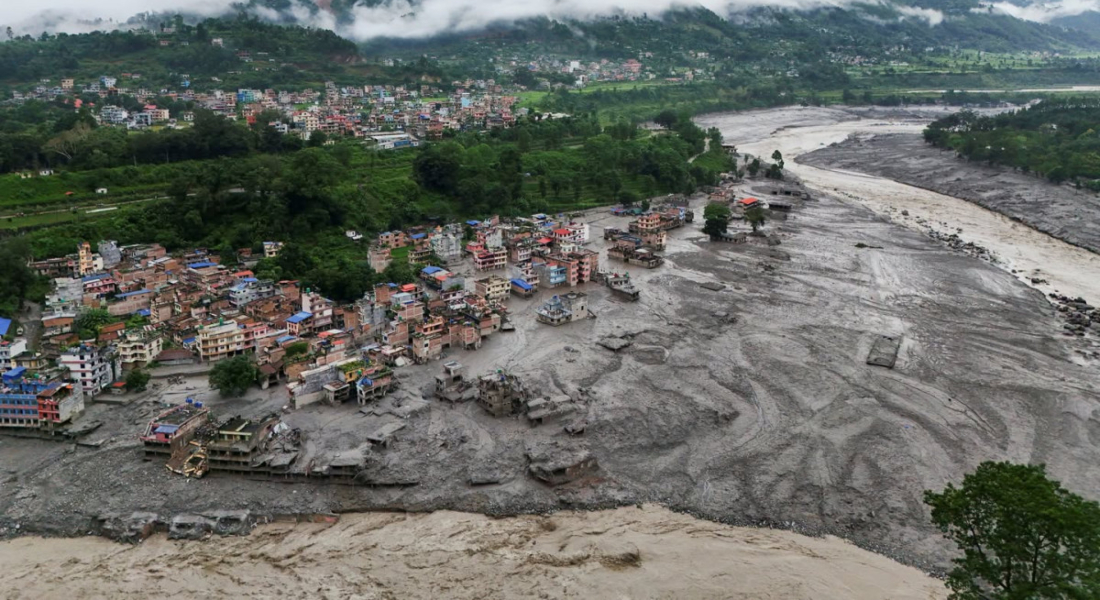
KATHMANDU, Sept 11: Clearing the massive deposits of rocks, soil, sand and wreckage left by the Bhotekoshi flood could cost more than Rs 95 billion, according to a government assessment.
The Rapid Damage and Needs Assessment (RDNA), jointly prepared by the National Planning Commission and the National Disaster Risk Reduction and Management Authority, puts the estimated cost at Rs 95.42 billion for debris clearance, disaster risk reduction and inclusive recovery.
The assessment shows that the flood-generated building debris is valued at Rs 48.24 billion. Around Rs 2 billion worth of soil has also accumulated across affected areas, while removing the soil alone is expected to cost more than Rs 300 million.
A significant portion of the recovery bill will go toward restoring infrastructure and managing river systems. Immediate infrastructure recovery is estimated at Rs 67.42 billion, covering hydropower plants and electricity grids, household renewable energy, roads and bridges, communications, drinking water and sanitation, irrigation, and river management.
The social sector is expected to require another Rs 8.29 billion in immediate recovery costs. This includes rebuilding private homes, public buildings and facilities, as well as restoring education, health and cultural infrastructure.
The productive sector will need an estimated Rs 5 billion for immediate recovery. Agriculture, fisheries, livestock, banking, economic activities and livelihoods are among the areas identified for support.
The government assessment also puts the immediate six-month requirement for debris clearance and disaster risk reduction at Rs 6.60 billion.
Disaster risk reduction measures alone are estimated to cost Rs 947.5 million. Of this, Rs 35 million is expected to be needed immediately and Rs 944 million over the longer term. The planned work includes clearing waterways, managing rivers, protecting settlements, developing catchment areas, controlling riverbank erosion and landslides, restoring irrigation systems and establishing multi-hazard early warning systems.
The assessment estimates that Rs 150 million will be needed during the first six months for inclusive recovery. This will support reconstruction and recovery programmes targeting vulnerable and marginalised communities, women, children, senior citizens, people with disabilities and other groups at risk.
The scale of the task means much of the work will extend well beyond the initial recovery period. The RDNA estimates that only 31.1 per cent of debris removal, including the clearance of building wreckage, rocks, soil and sand, can be completed within six months. Disaster risk reduction and management work is expected to progress even more slowly, with only 0.4 per cent likely to be completed during the same period.
Inclusive recovery and reconstruction, by contrast, is considered achievable within six months.
People’s News Monitoring Service

Login to add a comment