







By Our Reporter
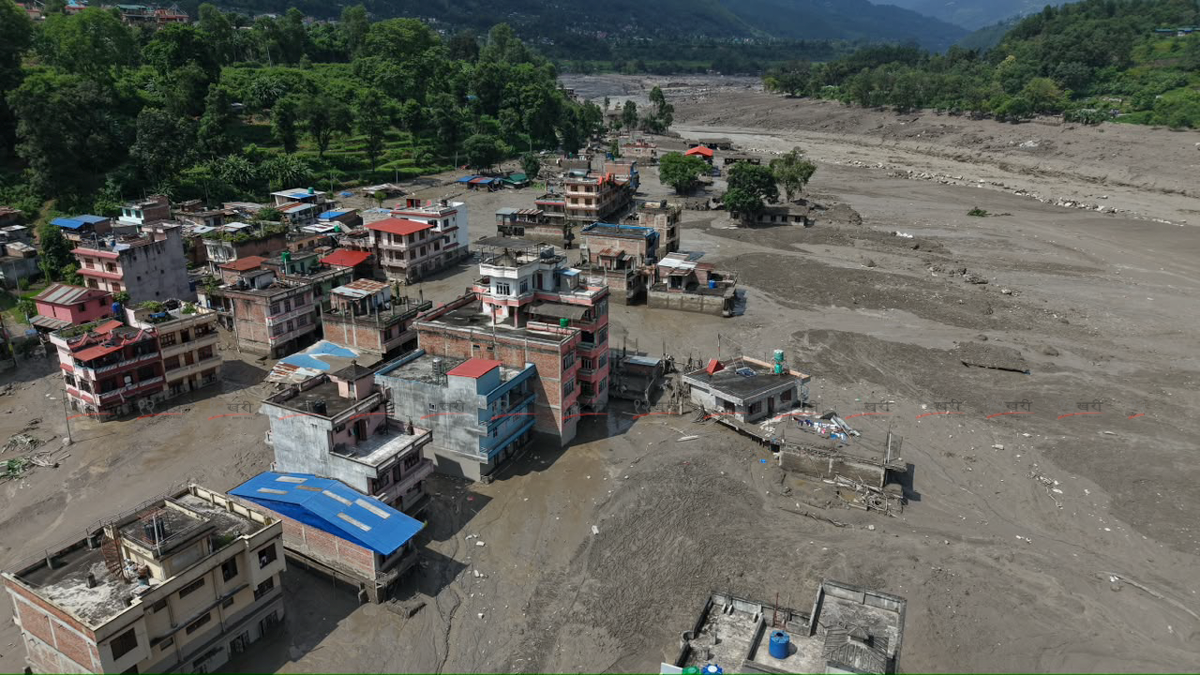
The sympathy voiced by 44 least developed countries (LDCs) with Nepal during the disastrous floods in the Bhote Koshi and Rasuwa regions represents a significant diplomatic opportunity.
However, pity alone will not repair wrecked infrastructure, recompense impacted communities, or safeguard Nepal from more severe climate-related disasters. Nepal must now channel its political backing into a concerted drive for international climate financing, grants, technology, and long-term resilience.
The first stage is to clearly distinguish between three distinct needs: humanitarian relief, rebuilding financing, and climate-related loss and damage. Emergency assistance is needed for rescue, food, housing, health care, and rehabilitation. Reconstruction funding is required for damaged roads, bridges, hydropower projects, houses, schools, and other infrastructure. Loss-and-damage financing covers economic and non-economic damages caused by climate change that cannot be avoided by adaptation or reimbursed by traditional development aid.
Nepal has already sought the United Nations-backed Fund for Loss and Damage Reduction. It should immediately create a detailed and independently verifiable “Nepal Climate Damage Dossier” that documents the disaster’s entire scope. The dossier should include figures for deaths, displacement, destroyed houses and infrastructure, hydropower, tourism, and livelihood losses, environmental damage, and other economic costs. It should also establish, using solid scientific data, the linkages between rising temperatures, glacier and snow instability, permafrost degradation, excessive rainfall, and increasing flood and landslip threats.
This proof is crucial to Nepal’s climate justice claim. Nepal should not approach the international world just as an impoverished country requiring aid. Its stronger contention is that it has contributed little to global warming while suffering disproportionately severe repercussions. According to World Bank data, Nepal’s per capita carbon emissions are a fraction of those of large emitters. The basic issue is thus an imbalance between contribution and impact.
The preliminary estimate of $2.56 billion in economic damages highlights the magnitude of the situation. However, Nepal should not frame this as a singular budget deficit. It should categorise its needs as emergency relief, rebuilding, adaptation, climate-resilient infrastructure, and residual loss/damage. This will enable various international institutions and finance channels to handle diverse requirements.
The statement signed by the 44 LDCs in Timor-Leste might serve as the diplomatic framework for this initiative. Nepal should collaborate with these countries to turn their solidarity into a collective action that demands speedier access to the Loss and Damage Fund, grant-based climate financing, easier funding procedures, and dedicated resources for the most vulnerable nations.
However, Nepal should not rely solely on the Loss and Damage Fund. The scope of the disaster necessitates a more comprehensive finance approach that includes the World Bank, Asian Development Bank, UN agencies, bilateral donors, climate funds, and international insurance organisations. Nepal should seek grants wherever possible and extremely concessional financing when grants are not available, while avoiding extra debt that would exacerbate the country’s economic vulnerabilities.
Hydropower should be a key component of Nepal’s international appeal. Damage to hydropower plants results in more than just a local economic loss. Nepal’s power infrastructure has seen significant investment and is becoming increasingly vital in regional energy commerce. Climate-resilient restoration will therefore safeguard not just Nepalese assets, but also international development investments and South Asia’s developing clean-energy industry.
At the same time, Nepal has to enhance the scientific foundation for its claims. International scientists should be asked to research the specific sequence of events that resulted in the Rasuwa tragedy, including the likely interplay of ice or snow avalanches, rockfall, temporary river obstruction, permafrost degradation, rainfall, and geological instability. Nepal should encourage impartial scientific inquiry rather than making statements that cannot be definitively verified. Credible evidence will help the argument for international climate financing.
The cross-border character of Himalayan calamities necessitates increased collaboration with China. Rather than allowing the issue to become purely geopolitical, Nepal should encourage systematic exchange of satellite images, glacier and river data, avalanche alerts, and other early warning information. A combined Himalayan disaster-risk monitoring approach might save lives while also providing greater evidence for climate adaptation.
Nepal should also tie the Rasuwa tragedy into its existing climate policy. Its Nationally Determined Contribution and National Adaptation Plan have already identified significant adaptation and resilience requirements. The recent crisis demonstrates that these are not distant policy objectives, but rather immediate national issues. Nepal might utilise the crisis to launch the Himalayan Climate Resilience and Recovery Program, which would focus on glacier and permafrost monitoring, early warning systems, robust roads and bridges, safer hydropower, emergency communications, and disaster preparedness.
Nepal’s diplomatic statement must be properly drafted. It should not simply assert, “We did not cause climate change, so rich countries must pay us.” It should also not accuse a specific bordering nation unless there is clear proof. The stronger case is that a changing global climate is causing more perilous circumstances in one of the world’s most susceptible mountain areas, notwithstanding Nepal’s low contribution to past emissions and limited budgetary capacity to bear the consequent losses.
The 44-country statement provides Nepal with political impetus; international media attention offers exposure; scientific data can provide credibility; and current climate plans serve as a policy framework. Nepal need a coordinated national plan that links these factors, rather than another call for pity.
Nepal could depict itself as a frontline Himalayan state facing the uneven repercussions of a global climate catastrophe, rather than an impoverished country in need of charity. The Rasuwa tragedy may serve as a test of whether the international climate-finance system can provide significant assistance to countries who have contributed little to global warming but are suffering an increasingly high price for it.

Login to add a comment