







By Our Reporter
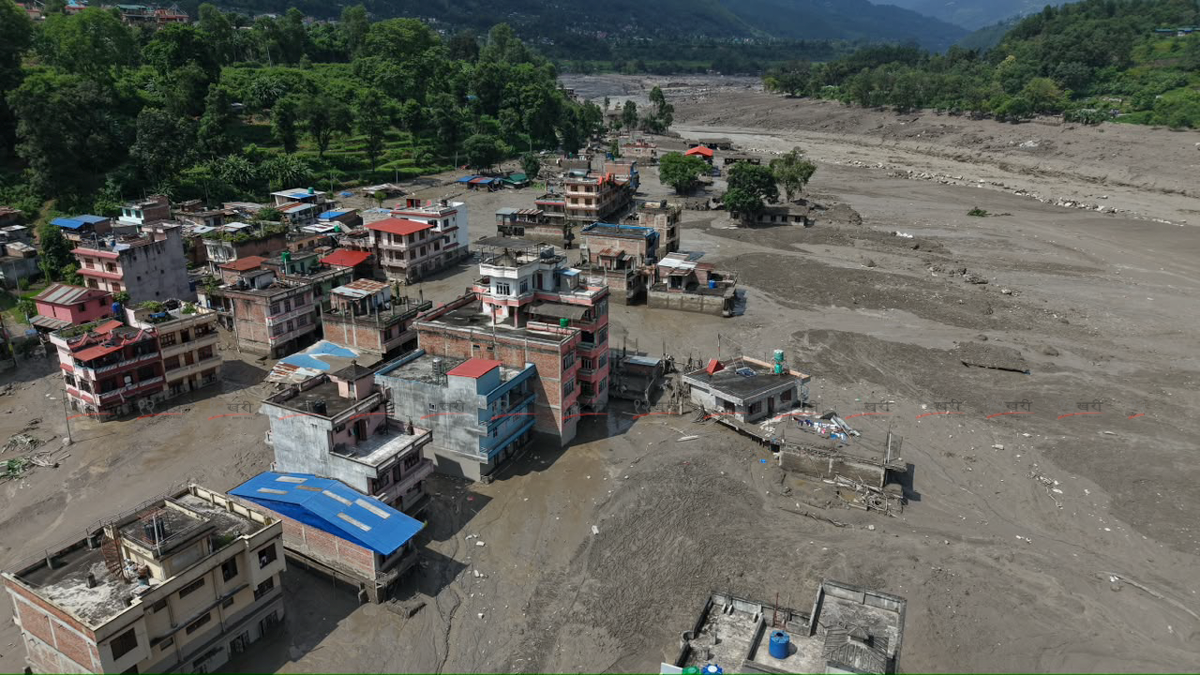
The Bhotekoshi disaster has exposed a weakness Nepal has struggled with for years: when a major crisis hits, there is no shortage of people ready to help, but there is often not enough expertise, equipment or coordination to make that response work as it should.
The scale of the flood has stretched the country’s rescue and relief machinery. Teams are working around destroyed roads, blocked corridors, damaged hydropower facilities and difficult mountain terrain. Some people are believed to be trapped inside hydropower tunnels, where rescue requires specialised technical knowledge that Nepal simply does not have in sufficient numbers. The government has had to bring specialists and equipment from India and China to support the operation.
That should be a serious warning. Nepal’s central disaster management agency, the National Disaster Risk Reduction and Management Authority, has not had a single specialised expert on its staff for about a year. Its only expert, geologist Gangalal Tuladhar, completed his tenure roughly a year ago. Senior divisional engineer Sushil Kumar Shrestha has confirmed the gap.
For a country exposed to earthquakes, floods, landslides, glacial lake outbursts and other mountain hazards, such a gap is difficult to explain.
The problem goes beyond the number of experts on the payroll. It reflects how disaster management is still treated within the state. The authority has Rs 200 million allocated for the current fiscal year, but much of that money goes toward salaries and routine programmes. Former chief secretary Eknarayan Aryal has argued that the agency needs both greater authority and more resources to coordinate federal, provincial and local governments during disasters.
The weakness becomes even clearer when relief reaches the ground. Local representatives in Rasuwa, Nuwakot and Dhading say relief materials are sometimes being sent without adequate consultation with municipalities. The result can be frustratingly uneven: supplies may arrive late in one place, pile up in another and fail to reach communities that need them most.
Gosaikunda Rural Municipality chair Kaisang Narpu Tamang said local governments were not being properly informed about where relief was being sent. Other local leaders have raised concerns about damaged roads, electricity shortages, food, cooking gas, temporary shelters, hospitals and the management of bodies. A dispute in Dhading involving RSP lawmaker Ashika Tamang and local representatives, after relief materials reportedly remained at a ward office for three days, shows how quickly a coordination failure can become a political dispute.
The government has released Rs 67.5 million from the Disaster Management Fund for 15 crisis declared local levels in five districts. The disaster authority has deployed 12 specialised teams, while thousands of security personnel are involved in rescue work. Those efforts are important. But soldiers and police officers cannot be expected to substitute for geologists, engineers, tunnel rescue specialists or other technical experts.
Nepal needs to build that capacity before the next disaster, not scramble to assemble it once lives are already at risk. A permanent roster of specialists should be maintained and kept ready for immediate deployment. It should include geologists, hydrologists, structural engineers, tunnel specialists, drone operators, medical teams and other professionals suited to Nepal’s particular risks. Critical rescue equipment should also be stored in high risk areas rather than kept largely in Kathmandu. When roads are damaged, waiting for excavators, drones, communication systems or specialised rescue equipment to travel from the capital can mean losing valuable time.
Coordination requires the same attention. Every major disaster needs a clear command structure linking federal agencies, provincial governments, municipalities, security forces and local communities. Someone must have a real time picture of what has happened, where help is needed, what supplies are moving and which areas remain inaccessible. Local governments should not have to search for information about relief being sent to their own communities.
Then comes the trade problem. The damage and closure at the Rasuwagadhi Kerung border have forced Chinese cargo toward Korala in Mustang. The alternative route is helping keep some trade moving, but it is already testing Korala’s limited capacity. The Armed Police Force recorded 66 cargo containers at its Jomsom check post by Sunday evening.
That shift will put additional pressure on customs offices, roads, storage facilities and security services. Mustang Customs collected Rs 6.92 billion in revenue in fiscal year 2025/26 and another Rs 290 million in the first month of the current fiscal year. Yet it has only 12 employees against an approved strength of 18.
That tells its own story. A border crossing can suddenly become strategically vital, but the institutions supporting it do not necessarily expand at the same speed. Nepal should learn from that now. Alternative trade routes should be treated as part of national disaster preparedness, not as temporary arrangements activated only when a major crossing fails. Korala and other northern crossings need stronger roads, customs infrastructure, communications, storage facilities and trained personnel if they are expected to absorb traffic during a crisis.
For now, the priority remains rescue, relief and essential services. But once the immediate emergency eases, the government should conduct a serious review of what worked, what failed and why. Nepal does not need another committee whose report eventually gathers dust. It needs practical changes: clear command structures, permanent technical expertise, equipment positioned close to high risk areas, reliable communication with local governments and trade routes that can keep functioning when one corridor is cut off. Bhotekoshi has shown that disaster management is not just about saving lives in the first few hours. It is also about protecting communities, keeping essential services running and preventing a local catastrophe from becoming a wider economic crisis. Nepal cannot prevent every disaster. It can make sure that when the next one comes, the same institutional gaps are not waiting for it.

Login to add a comment