








By Our Reporter
On the surface, the Rastriya Swatantra Party is trying hard to project unity. Party President Rabi Lamichhane insists there is no dispute with Prime Minister and senior leader Balendra Shah. He has dismissed speculation surrounding Shah’s recent remark that he sometimes feels “alone,” saying the party remains united.
Yet the repeated need to deny a rift is itself telling. The RSP has not split into formal factions, but a contest over authority, political direction and control of the government is becoming harder to ignore. At the heart of the unease are two leaders who need each other politically but appear to be developing different views about how power should be exercised.
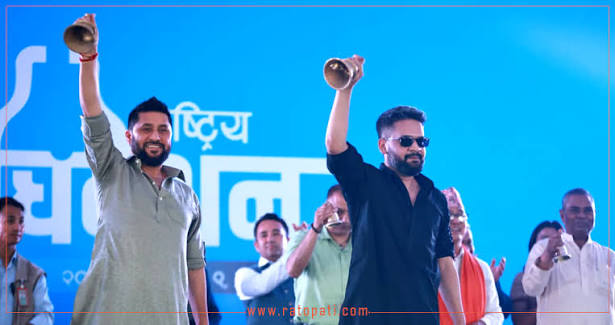
Lamichhane controls the party organisation and remains its president. Shah heads the government and leads the Parliamentary Party. This creates two centres of power within a party that is still relatively young and has not fully developed institutional mechanisms for managing competing interests.
That arrangement was always going to be difficult. One group within the RSP consists of older party faces and leaders who remain close to Lamichhane. Many of them see him as the party’s principal political force, the leader who built its organisation and gave it a distinct identity. They are unlikely to welcome the emergence of an independent power base around Shah.
For this camp, the party president cannot become a ceremonial figure while the prime minister controls the government, Parliament and an expanding network of supporters.
The Shah camp sees the problem differently. Leaders close to the prime minister increasingly believe that the government needs greater room to operate without constant intervention from the party leadership. Their frustration centres particularly on Cabinet management. If reports that Lamichhane has blocked Shah’s attempts to reshuffle ministers are accurate, the disagreement goes beyond personalities. It becomes a direct contest over executive authority. Who decides the composition of the Cabinet, the prime minister or the party president?
That question sits at the centre of the RSP’s current unease. Lamichhane also has reasons to be dissatisfied. He is reportedly unhappy with the government’s performance and has pressed Shah to change his working style. His criticism suggests that the party leadership does not believe the government is moving with the speed or effectiveness expected from a party that came to power promising a break from traditional politics.
The resulting situation is unusual. Lamichhane and Shah are not openly attacking each other. Instead, their supporters are beginning to speak and act on their behalf. Separate consultations, competing political loyalties and complaints about government functioning are creating the outlines of two camps without either side formally declaring one.
That may be more dangerous than an open dispute. A formal faction can be identified and negotiated with. An informal faction can spread quietly through appointments, parliamentary decisions and access to leadership. It can turn routine disagreements into tests of loyalty.
The statute amendment process adds to the concern. The decision to revise rules governing the Parliamentary Party, lawmakers’ conduct and coordination between ministers and MPs may appear like an organisational exercise. But it also raises a deeper issue: how much authority should the Parliamentary Party exercise independently, and how should that authority relate to the party president and government?
The answer could reshape the RSP’s internal balance. The party’s political history makes this particularly sensitive. The RSP rose by presenting itself as an alternative to the established parties, whose factionalism, patronage and leadership disputes had frustrated voters for years. Its credibility depends partly on proving that it can avoid the same habits.
If competing camps begin forming around Lamichhane and Shah, the RSP risks becoming a smaller version of the political culture it once criticised. That explains why political analysts are watching the situation closely. The immediate concern is not an RSP split. Neither Lamichhane nor Shah has much to gain from such a confrontation at this stage. Lamichhane needs Shah to make the government work, while Shah needs Lamichhane’s organisational strength and political legitimacy.
Their alliance remains mutually useful. But political alliances rarely collapse over a single disagreement. They weaken when repeated disputes create mistrust and when supporters begin treating every decision as a contest between rival camps.
The RSP appears to be approaching that point. Public denials may keep the appearance of unity intact, but they cannot settle the underlying question of who holds real power. The next Cabinet reshuffle, major appointment or statute change could reveal much more than another press conference.
For now, the RSP remains one party with two powerful centres. The real danger is not that it has split. It is that the struggle over who ultimately calls the shots is becoming the party’s central political question.

Login to add a comment