







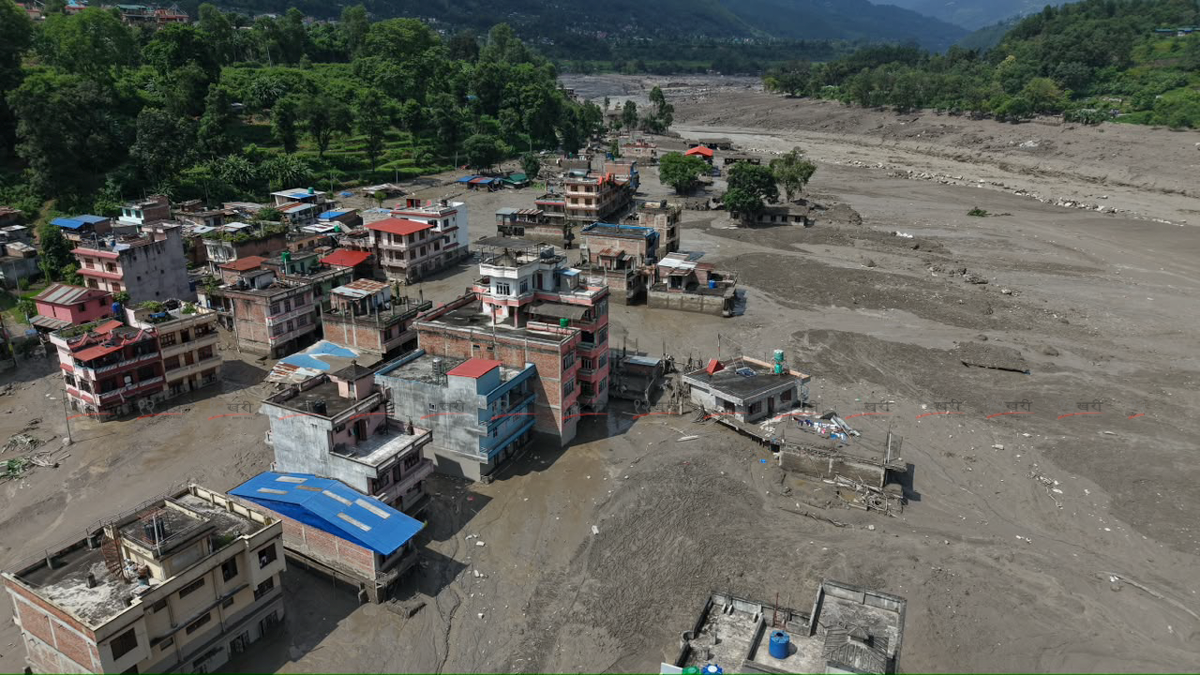
Kathmandu, August 23: The Department of Hydrology and Meteorology has stated that the sudden and devastating flood in the Bhotekoshi River in Rasuwa was not caused by monsoon rainfall or a cloudburst.
According to the department, rainfall of 7 millimetres or less was recorded in the Rasuwa area over the previous 24 hours. Senior meteorologist Min Kumar Aryal said that, based on this, rainfall was not the main cause of the flood. Preliminary scientific studies suggest that the incident may have resulted from a complex “chain reaction” in the Himalayan region.
It is estimated that a massive avalanche carrying snow and rocks blocked the Lende River, forming a temporary natural dam. When the dam subsequently burst, or when water overtopped it, a sudden and massive flood may have surged into the Bhotekoshi river system downstream.
According to glaciologist Rijan Bhakta Kayastha of Kathmandu University, discussions between Nepali and Chinese scientists have also pointed to the possibility that the Lende River was blocked by an avalanche.
Before the flood occurred, an earthquake measuring 4.4 on the Richter scale was recorded in the Tibetan region at 8:37 a.m. on Wednesday. Nepalese disaster-management officials subsequently suggested that the earthquake may have triggered a landslide or avalanche that blocked the river.
Although tremors from an earthquake can cause weakened rocks and snow to fall in steep terrain, it has not yet been confirmed whether the 4.4-magnitude earthquake itself triggered the avalanche.
There is a precedent of a massive avalanche occurring in the Langtang Valley during the 7.8-magnitude Gorkha earthquake in 2015. However, scientists say that further research is necessary to determine the role of this earthquake, as the quake this time was comparatively weaker.
Initially, the event was believed to have possibly been caused by a glacial lake outburst flood. However, no clear evidence has so far been found that any glacial lake burst or drained. According to geologist Ranjan Kumar Dahal, given the enormous volume of water in the flood, the role of a glacier cannot be completely ruled out. However, he said it would be premature to conclude at this stage that the incident was a glacial lake outburst.
Earlier, in July, 2025, a study found that a major flood had also occurred in the Lende–Bhotekoshi system after water suddenly escaped from a supraglacial lake of the Purepu Glacier in Tibet, about 35–36 kilometres upstream from the Nepal–China border, despite limited rainfall.

Login to add a comment