








By Narayan Prasad Mishra
Unity is one of the noblest ideals in human society. Whether among individuals, communities, or political parties, unity can accomplish great things when guided by honesty, justice, and a commitment to the common good. It can strengthen a nation, improve governance, promote development, and advance the welfare of the people.
However, unity is not a virtue in itself. The moral worth of any unity depends entirely on the purpose it serves. Unity established for the benefit of the nation and its citizens deserves praise. Unity established for selfish interests, corruption, or the pursuit of power at the expense of the public deserves condemnation.
We often hear that there is strength in unity. But not every unity is noble. Dacoits, kidnappers, murderers, thieves, and other criminal gangs also unite. They cooperate to commit crimes, divide the spoils, protect one another, and evade justice. Such unity is a curse to society, not a blessing.
Unfortunately, many political alliances formed in Nepal after the restoration of the multiparty democratic system have, at times, followed a similar pattern. Instead of uniting to serve the nation and the people, political parties have repeatedly united to win elections, capture power, divide government positions, reward their supporters, conceal corruption, and shield one another from accountability. Their conduct has too often resembled the unity of criminal gangs rather than the unity expected of responsible democratic political parties. In this context, I once wrote the following sentence in my article titled “Political Alliances and the Betrayal of the Voters” published in People’s Review on April 26, 2022.
Time and again, political coalitions have been formed and dissolved according to political convenience rather than national necessity. Instead of addressing unemployment, inflation, poor public services, corruption, and the country’s slow economic progress, many political leaders have concentrated on preserving their own power and rewarding their loyalists. Public office has too often been treated as an instrument of partisan gain rather than a sacred public trust.
One of the most disturbing consequences of such alliances has been the weakening of accountability. When parties that once accused one another of corruption suddenly become government partners, public confidence naturally declines. Allegations that once appeared serious are quietly forgotten. Instead of ensuring justice, political cooperation often appears designed to shield those in power from legal and moral responsibility.
It is therefore not surprising that many voters have become increasingly disillusioned. The people’s growing dissatisfaction, reflected in recent elections, should be understood as a warning rather than merely a political setback. Citizens expect political parties to compete on principles and to cooperate only when such cooperation genuinely serves the nation.
Today, once again, we hear loud calls for political unity. Familiar slogans of socialism, communism, democracy, republicanism, federalism, secularism, social justice, and national development are once again being presented to the people. These political ideals deserve sincere commitment. Otherwise, they lose their moral force when they are used merely to achieve self-centered agendas.
People no longer judge political parties solely by what they promise. They judge them by what they have done. Fine speeches cannot erase years of poor governance, corruption, nepotism, political instability, and broken promises. The Nepali people have become increasingly capable of distinguishing between genuine public service and political theatre.
Nepal certainly needs unity. But it needs the right kind of unity.
The country needs unity to strengthen democracy, uphold the rule of law, ensure justice, promote economic development, eliminate corruption, improve education and healthcare, create employment opportunities, protect national sovereignty, and build lasting peace. Such unity deserves the wholehearted support of every citizen, regardless of political ideology.
Nepal does not need unity that exists merely to divide ministries, distribute political appointments, silence investigations, conceal corruption, or preserve the privileges of political elites. Such unity benefits only a handful of leaders while imposing enormous costs on the nation.
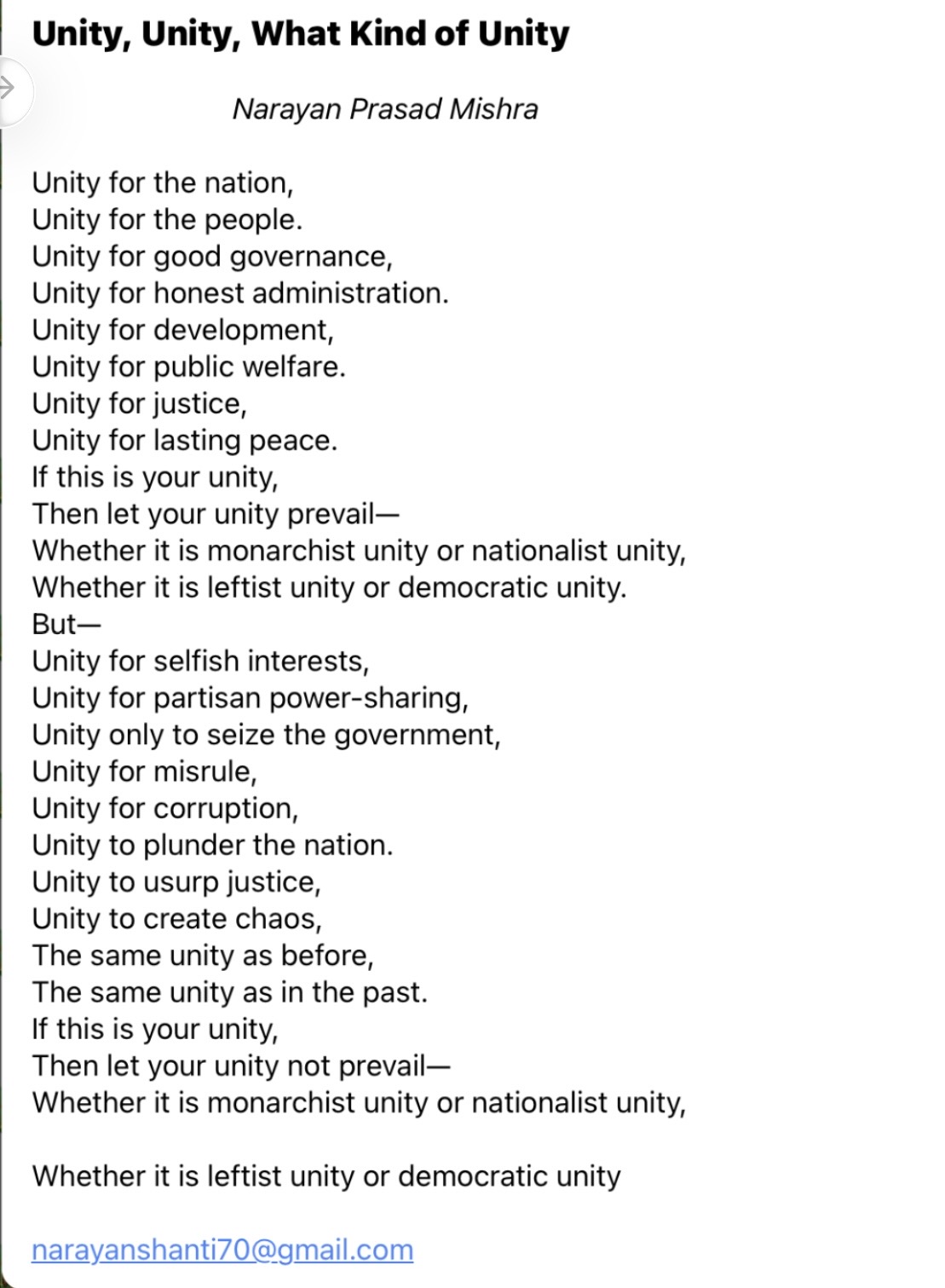
As I reflected on these realities, a poem came to mind. I composed it in Nepali under the title “Unity, Unity, What Kind of Unity?” The poem expresses a simple but fundamental truth: unity is worthy of respect only when it serves the nation, the people, justice, peace, and good governance. Unity that exists to promote selfish interests, corruption, injustice, and chaos deserves neither admiration nor public support.
The poem is presented below in both the original Nepali and its English translation.
एकता, एकता, कुन किसिमको एकता
नारायण प्रसाद मिश्र
देशका लागि एकता,
जनताका लागि एकता।
सुव्यवस्थाका लागि एकता,
सुशासनका लागि एकता।
विकासका लागि एकता,
जनकल्याणका लागि एकता।
न्यायका लागि एकता
शान्तिका लागि एकता
यदि हो भने तिम्रो एकता,
होस् तिम्रो एकता—
राजावादी एकता होस् वा राष्ट्रवादी एकता,
वामपन्थी एकता होस् वा प्रजातान्त्रिक एकता।
तर—
स्वार्थपूर्तिका लागि एकता,
दलीय भागबन्डाका लागि एकता,
सरकार हडप्न मात्र एकता,
कुव्यवस्थाका लागि एकता,
भ्रष्टाचारका लागि एकता,
देश लुट्नका लागि एकता।
न्याय हडप्ने एकता
भाड्भैलो गर्ने एकता।
पहिलेको जस्तै एकता
उहिलेको जस्तै एकता
यदि हो भने तिम्रो एकता,
नहोस् तिम्रो एकता—
राजावादी एकता होस् वा राष्ट्रवादी एकता
वामपन्थी एकता होस् वा प्रजातान्त्रिक एकता।
About the author: A non-partisan writer of several books and numerous articles in Nepali and English; former Chief of the Office of the Tribhuvan University Service Commission, Nepal; and a senior citizen in his mid-eighties.

Login to add a comment