







By Deepak Joshi Pokhrel
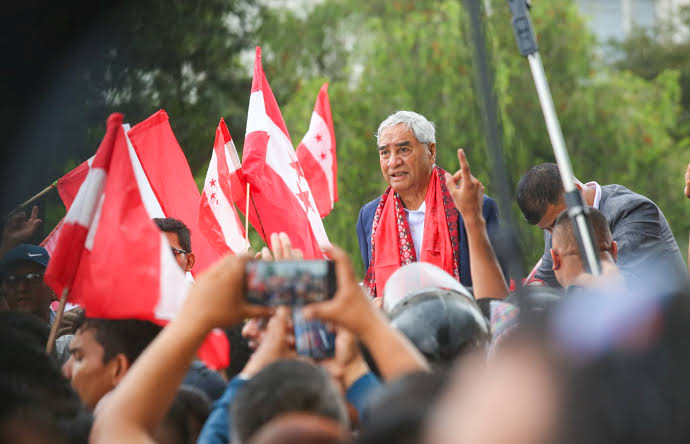
Last Thursday (August 13), hundreds of supporters of Sher Bahadur Deuba, the five-time prime minister of Nepal, reached Tribhuvan International Airport to receive him. Deuba returned to Nepal after a five-month stay in Singapore and Hong Kong for what has been described as medical treatment. The gathering was no less than a gala, with supporters dancing and chanting slogans such as “Long live Deuba!” While escorting Deuba to his new residence, the supporters were seen breaching traffic rules, making a mockery of the law. The no-horn rule was given short shrift as supporters honked their horns. All this took place while law enforcement agencies remained mere mute spectators.
This reminds me of a famous saying attributed to Franz Kafka, the Czech-language novelist and writer: “One idiot is one idiot. Two idiots are two idiots; ten thousand idiots are a political party.” The way Deuba’s supporters welcomed him seemed to corroborate this time-tested saying.
Born on June 13, 1946, in Ashigram, Dadeldhura district, Deuba is the only politician in the country to have become prime minister for five times. After completing his secondary education in Doti, he moved to Kathmandu to pursue higher education. He earned a bachelor’s degree in law and a master’s degree in political science from Tribhuvan University.
Deuba entered politics through the student movement during Nepal’s Panchayat era. He was actively involved in the democratic movement and was repeatedly imprisoned for his political activities, spending approximately nine years in jail during his struggle against the partyless Panchayat system.
He was a founding member of the Nepal Student Union (NSU), the student wing of the Nepali Congress, and became its first elected president. His political career was greatly influenced by senior Nepali Congress leaders, particularly B.P. Koirala, Ganesh Man Singh and Krishna Prasad Bhattarai. Following the restoration of democracy, Deuba emerged as a prominent young leader of the Nepali Congress. He was elected a member of the House of Representatives from Dadeldhura in 1991 and subsequently became home minister in the government led by Girija Prasad Koirala.
Deuba’s political career spans more than six decades. It encompasses the Panchayat system, the restoration of democracy, the Maoist insurgency, the peace process, the abolition of the monarchy, the establishment of a federal republic and the implementation of the 2015 Constitution. This itself is a significant achievement for a leader who has witnessed and played an important role in shaping the country’s democratic institutions.
Despite this, Deuba has remained a controversial figure within the party. Why has he been viewed as a politician with vested interests? Likewise, what has led party sympathisers to perceive him as power-hungry? In addition, why has a leader with significant political experience and contributions to the party repeatedly failed to rise above self-interest?
Deuba became prime minister for the first time in 1995. During his first premiership, he was accused of maintaining an unusually large cabinet, something that was considered inappropriate because it added an additional burden to the country’s fragile economy. Critics argued that the large cabinet was aimed at accommodating his supporters rather than improving governance. Given the political context of the time, this argument cannot be ruled out altogether.
The country witnessed a bloody armed conflict that killed more than 17,000 people and injured many more. By any account, the Maoist insurgency was the most unfortunate tragedy the country had witnessed to that point. Physical infrastructure was destroyed, much of which has still not been fully restored. Conflict victims and their families are still knocking on the doors of the authorities seeking justice, even though the peace process was initiated almost two decades ago.
No sane mind would disagree that Deuba was accountable for mishandling the decade-long armed conflict. The Maoist insurgency was at the centre of the political crisis during Deuba’s second and third premierships. His government initially pursued negotiations and a ceasefire. But after the talks broke down, Deuba’s government imposed a state of emergency and deployed the then-Royal Nepal Army against the Maoists. The move angered the Maoists, who allegedly plotted an ambush to assassinate Deuba, although he survived the attack. In retaliation, Deuba announced a bounty of one million rupees for the capture of Maoist supremo Prachanda.
Within the party, Deuba has often been viewed as a politician who fosters internal feuds and bickering. To put it simply, he has been closely associated with factional politics within the Nepali Congress. The best manifestation of this was the formation of the Nepali Congress (Democratic) under his leadership. Some even argue that the present pathetic position of the Grand Old Party is largely the result of personal rivalries among senior leaders, including Sher Bahadur Deuba, G.P. Koirala and Krishna Prasad Bhattarai, in the past. Although G.P. Koirala and Krishna Prasad Bhattarai passed away long ago, Deuba’s high-handedness within the party has continued to thrive.
On the governance front, Deuba has been criticised for indecisive leadership and coalition management based on patronage. Abuse of authority, allegations of high-profile scams and corruption have been among the major criticisms levelled against his governments. Nepotism, favouritism and patronage have also been alleged to be prevalent during his premierships, particularly in the appointment and distribution of political positions and resources.
In 2002, Deuba faced significant criticism from people across various sectors. This time, the reason was the dissolution of Parliament. Media reports said that Deuba recommended the dissolution of the House of Representatives and called for fresh elections, a decision that critics considered unjustifiable given that the Maoist insurgency was at its peak. As a result, the then-King Gyanendra dismissed him in October 2002, accusing him of incompetence.
Leadership transition has consistently been a contentious issue within the Nepali Congress. Deuba was elected party president for the first time in 2016, defeating Ram Chandra Paudel at the 13th General Convention. A few years later, he was re-elected in 2021 at the 14th General Convention, defeating Shekhar Koirala in the runoff. But what is particularly intriguing is the fact that his second term extended beyond the party’s normal four-year period. What is difficult to understand is why he remained so passionate about retaining power.
Despite repeated calls from the party’s rank and file, Deuba remained adamant and refused to hand over party leadership to the younger generation, thereby delaying leadership transition. When Deuba showed no sign of stepping aside, the party organised a special convention in January 2025. The convention elected Gagan Thapa as party president, replacing Sher Bahadur Deuba.
The pen pusher is not against Deuba, yet, I believe, he does not deserve a heroic welcome after a five-month stay in Singapore for what has been described as medical treatment.
This is an opportunity for Deuba to address the controversies surrounding his past and extend his support to any state-led investigation. Now, it is up to him to decide whether he wants to fade away as another lackluster politician or become a man of history.

Login to add a comment