







By Our Political Observer
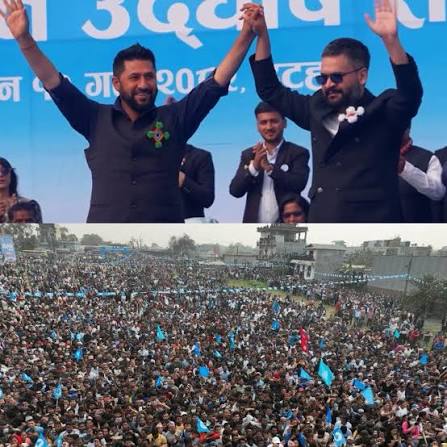
The Rastriya Swatantra Party (RSP) won a massive mandate, 182 seats in the House of Representatives and more than 5.1 million votes, by promising to do politics differently. That is why the growing signs of friction between party President Rabi Lamichhane and Prime Minister Balendra Shah deserve closer attention. Neither has announced a split. Both continue to speak of unity. Yet beneath those assurances, a political cold war appears to be taking shape.
Recent events tell their own story. Shah wrote on social media that “sometimes you have to fight alone,” a remark widely seen as an expression of frustration. Lamichhane, meanwhile, said the party would pull the government back on track if it strayed from the right path. As criticism mounted, the two leaders later met at Baluwatar for 45 minutes to discuss political appointments, ambassadors, ministers and other issues. The meeting may have eased immediate speculation, but it also showed that differences had been building to a point where direct intervention was needed.
The tension is not limited to public remarks by the two leaders. RSP lawmakers have increasingly criticized the government in Parliament and parliamentary committees. Manish Jha questioned the government’s working style and accused the budget of discriminating between the rich and the poor. Ramesh Prasain raised the hardship caused by cooking gas shortages. Tika Sangraula questioned why citizens who pay taxes throughout their lives still struggle to access dignified final rites. Amresh Kumar Singh raised the reported case of an elderly couple from Kavre who jumped into the Sunkoshi River after failing to access treatment.
Criticism from lawmakers of a ruling party does not automatically mean rebellion. An independent minded parliamentary party can, in fact, strengthen democracy. The real problem arises when lawmakers seem to discover the government’s failures in public because they lack an effective internal channel to raise those concerns first. That is where the RSP’s problem appears to run deeper than ordinary political disagreement.
The government’s first 100 days have also exposed several pressure points. Shah faced controversy after telling Parliament that Nepal, too, had encroached on Indian territory in several places. The budget has drawn criticism for doing more for the middle class and business community than for poor and marginalized citizens. Several self-immolation cases, including the death of 25-year-old Ganesh Nepali outside the Department of Passports, have added to public anger over unemployment, poverty and the state’s treatment of vulnerable citizens. Questions over landless settlements and weak public services have further increased the pressure.
Together, these issues have widened the gap between the party and the government. A government can command a strong majority in Parliament and still become weak in practice when its political leadership pulls in different directions. Increasingly, the RSP looks less like a single governing party and more like two power centers trying to shape the direction of the same government.
The roots of this tension appear to go back to the party’s Chitwan general convention. Since then, observers have spoken of a Shah camp and a Lamichhane camp, even though both leaders reject such labels. Lamichhane has instructed party members not to encourage factional identities. But refusing to use a label does not necessarily remove the reality behind it. Two months after the convention, the central committee remains incomplete, office bearers have not been appointed, and questions continue over changes to the party statute.
The provision allowing the party president to remove the parliamentary party leader has made the issue even more sensitive. Shah’s reported complaints that he has not received enough support from the party on Cabinet decisions point to a larger institutional question: who ultimately sets the political direction, the party president, the parliamentary leadership or the prime minister? A mature party cannot leave such questions unanswered.
Economic policy has also revealed contrasting instincts. Lamichhane has warned against keeping the private sector under permanent suspicion, arguing that jobs, investment and production cannot grow in an atmosphere of fear. Shah, on the other hand, has emphasized reviving public enterprises and industries. The two positions do not have to conflict. A government can strengthen public institutions while encouraging private investment. But mixed signals from the top create uncertainty when no common policy framework explains how the two approaches fit together.
Foreign policy presents another sensitive area. Parallel diplomatic activity, including Lamichhane’s visit to India, his planned trip to China and separate engagement by the prime minister’s side, has drawn attention. Nepal cannot afford a situation where different centers within the same ruling party appear to pursue separate diplomatic tracks. Foreign policy requires one clear national direction, not competing political signals.
Reports that senior party leaders or people close to them were placed under surveillance have added another layer of mistrust. Whether every allegation proves true is beside the immediate point. The emergence of such suspicion alone can damage trust within the leadership. The RSP came to power promising a break from the old political culture of intrigue, factional bargaining and backroom maneuvering. If its own leaders begin suspecting one another, the party risks becoming what it once promised to change.
The bigger danger, however, is not an immediate split. It is paralysis. A cold war inside a ruling party can be more damaging than an open conflict because everyone continues to deny the problem while coordination quietly breaks down. Decisions are delayed. Appointments become bargaining tools. Ministers receive mixed signals. Lawmakers criticize from one side while the government moves in another direction.
That is why the meeting between Shah and Lamichhane should not become another round of crisis management. They need a formal coordination mechanism, clearly defined authority and a common policy direction. Disagreement is normal. Confusion is not. The party must also decide whether internal criticism will help improve government performance or become ammunition in a contest between rival power centers.
Lamichhane says the RSP government is like an aircraft passing through turbulence and insists it will reach its destination. Perhaps it will. But turbulence becomes dangerous when the pilots are arguing over the route while passengers are already feeling every jolt.
The RSP’s greatest threat may no longer be the opposition waiting outside Singha Durbar. It is the silent contest taking shape within its own ranks. The party won a historic mandate because voters wanted an alternative. If Lamichhane and Shah allow that mandate to turn into a battle between parallel power centers, the RSP will not be undone by its enemies.
It will slowly tear itself apart from within, one disagreement, one mixed signal and one missed decision at a time.

Login to add a comment