








By Narayan Prasad Mishra
Political slogans have changed in Nepal many times over the past seven decades, but one unfortunate reality has remained remarkably constant. Leaders have come and gone. Parties have split and reunited. Constitutions have been written and rewritten. Political systems have changed from monarchy to constitutional monarchy, from the Panchayat system to multiparty democracy, and finally to a federal democratic republic. Yet the lives of ordinary citizens have improved far less than the promises made in their name.
One striking feature of Nepali politics is the frequent invocation of great personalities. Every political camp claims the legacy of someone it considers a national hero or ideological guide. One invokes B. P. Koirala. Another invokes Ganesh Man Singh. Others invoke Pushpa Lal, Marx, Lenin, Mao, or the kings. Their portraits decorate party offices. Their speeches are quoted on anniversaries. Their names are repeated endlessly during political campaigns.
Yet one must ask a simple but uncomfortable question: Are these names being honored, or merely used?
Too often, they have become political currency rather than moral inspiration. They are employed to win elections, justify decisions, silence critics, reward loyal supporters, and preserve political influence. The ideals for which these leaders struggled are frequently overshadowed by the pursuit of personal power and privilege. In this context, a poem came to my mind, and I composed it in Nepali under the title सबै यहाँ आफ्नो दुनो सोझ्याउने (Everyone Here Feathering Their Own Nest) to express my concern. The poem is presented below in both the original Nepali and its English translation.
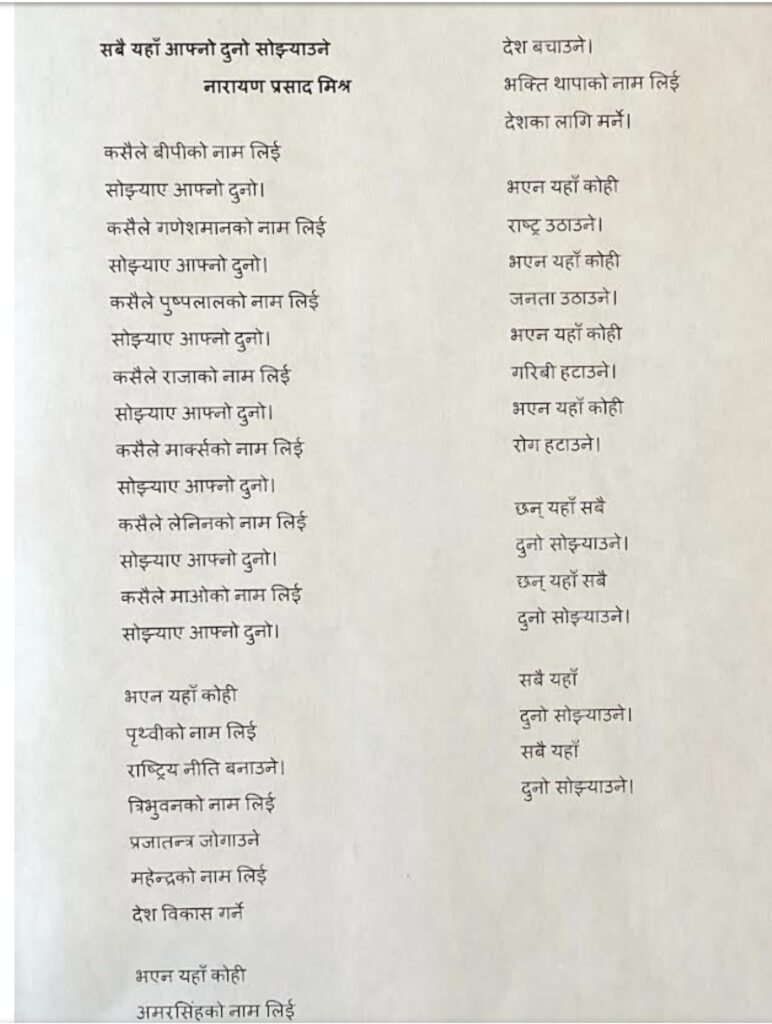
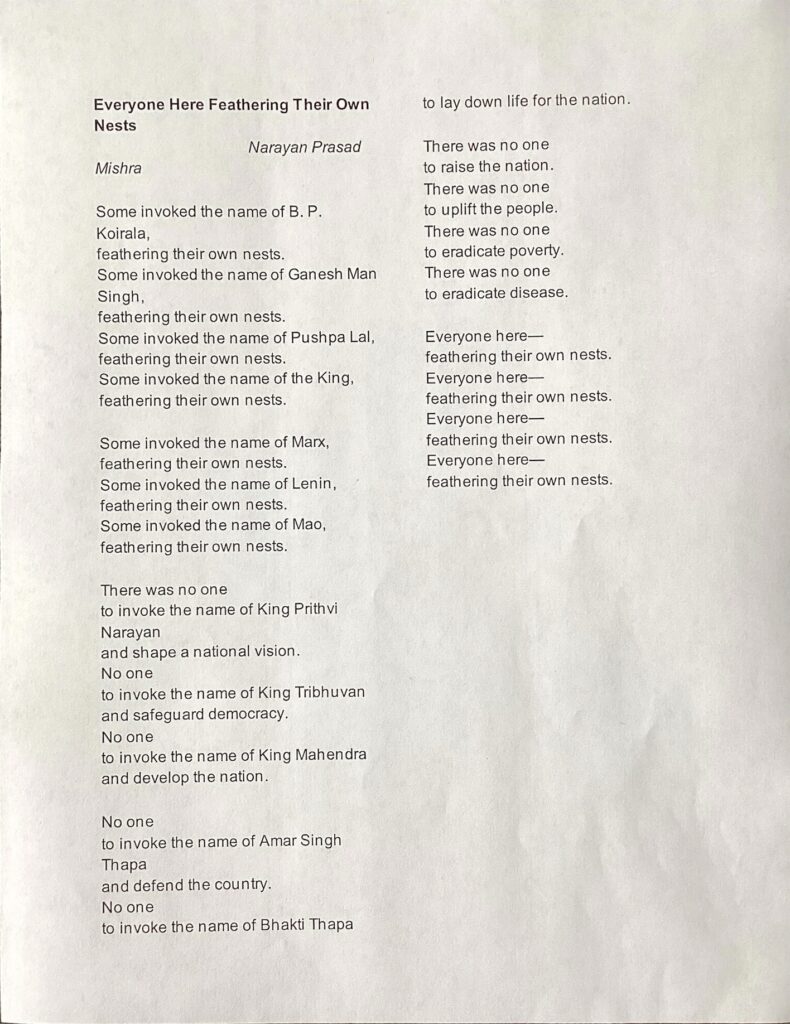
The poem is not directed against any particular party or ideology. It is directed against a political culture in which the names of great leaders become convenient tools for advancing personal interests instead of serving the nation.
The second part of the poem deliberately shifts attention from political slogans to national responsibility. It asks why so few invoke Prithvi Narayan Shah while discussing long-term national policy; King Tribhuvan when defending democratic values; King Mahendra while discussing national development, regardless of differing opinions about his political system; Amar Singh Thapa when speaking of national security; or Bhakti Thapa when speaking of sacrifice for the country.
History should neither be worshipped blindly nor rejected unthinkingly. Every historical figure has strengths and weaknesses. A mature nation studies all of them honestly and learns from each according to the needs of the present. Political maturity lies not in selective remembrance but in balanced judgment.
Unfortunately, modern politics often rewards loyalty to parties more than loyalty to principles. Many politicians appear to believe that changing parties is easier than changing political culture. Coalition governments rise and fall with alarming frequency. Ministries become bargaining chips. Public office is too often viewed as an opportunity to distribute benefits among supporters rather than serve the public interest.
Meanwhile, ordinary citizens continue to struggle with unemployment, rising prices, inadequate healthcare, weak educational standards, poor infrastructure, corruption, and the continuing migration of young people abroad in search of opportunity. These are the real issues that deserve the nation’s attention. Yet they are often overshadowed by endless political calculations.
The poem repeatedly says that everyone is “feathering their own nest.” This familiar English idiom, like the Nepali expression दुनो सोझ्याउने, conveys more than simple self-interest. It describes the misuse of influence, position, or public trust for personal advantage. It is precisely this habit that has weakened public confidence in political institutions.
Democracy cannot flourish where politics becomes merely a competition for office. It flourishes when public office is understood as public service. Likewise, socialism cannot succeed without integrity, monarchy cannot command respect without responsibility, and republicanism cannot earn public trust without good governance. Every political system ultimately depends on the character of the people who operate it.
Nepal today does not suffer from a shortage of political philosophies. It suffers from a shortage of political integrity.
The nation does not need more slogans. It needs more honesty.
It does not need more personality cults. It needs stronger institutions.
It does not need more speeches about sacrifice. It needs leaders who are willing to sacrifice.
The greatness of B. P. Koirala, Ganesh Man Singh, Pushpa Lal, Prithvi Narayan Shah, Tribhuvan, Mahendra, Amar Singh Thapa, Bhakti Thapa, and countless others does not lie merely in their names. It lies in the ideals, courage, discipline, and dedication they demonstrated in serving causes greater than themselves.
The future of Nepal will not be determined by how often we pronounce the names of great leaders. It will be determined by how faithfully we practice the values they represented.
When politics becomes an avenue for personal enrichment, nations decline.
When politics becomes an instrument of public service, nations rise. That is the enduring message behind my poem—and perhaps one of the most urgent lessons I think our country and people must give serious attention to.
About the author: A non-partisan writer of several books and numerous articles in Nepali and English; former Chief of the Office of the Tribhuvan University Service Commission, Nepal; and a senior citizen in his mid-eighties.

Login to add a comment