







By Nirmal P. Acharya
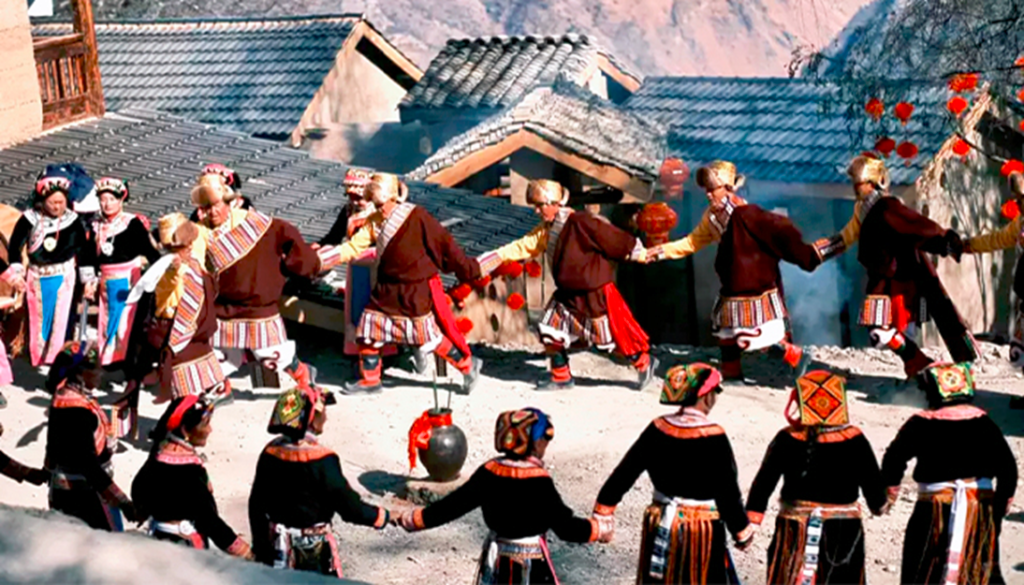
Recently, I visited Lhasa, the capital of China’s Tibet. I felt that Lhasa has become a “City of Guozhuo” — a place where the traditional Tibetan circle dance thrives.
The history of “Gou Zhuo” is very long, dating back to before the 7th century AD. It is usually performed during festivals, weddings and other joyous occasions. The dancers are evenly divided into male and female groups, each forming a circle and dancing clockwise. The male dancers have larger movements, with their arms stretched out like eagles circling; the female dancers have smaller movements, moving in small steps and turning in circles like peacocks spreading their wings, with a graceful and lively style. Many of the movements imitate the forms of animals, such as “Tiger Leaping Down the Mountain” and “Peacock Opening Its Feathers”.
Today in Lhasa, from dawn until late at night, countless Guozhu dancers gather regularly and irregularly in numerous dance venues, dancing passionately.
Among the numerous Guozhuo dance venues in Lhasa, the Zongjialuokang Park behind the Potala Palace is the most popular one.
Here, Guozhu Dance lasts from early morning until late afternoon, and it takes place in different areas at different times.
Morning Session (approximately 07:30 – 10:00): Considered one of the most lively periods.
Morning Session (approximately 09:00 – 11:00/11:30): Happens simultaneously in multiple areas of the park.
Afternoon Session (approximately 11:00 – 14:00): There are travel guides recommending that tourists visit or participate in the gong san dance during this period. It is said that the dance movements during this period are simpler and the atmosphere is light and lively.
Afternoon Session (approximately 13:30 – 16:00): Usually, there are two “sessions” of dancing in the park.
There are five dancing areas in the park. At different locations, different styles of Guozhu dance such as Lhasa, Nagqu and Ganzi can be performed simultaneously.
This is a very large-scale public event with a huge number of participants.
Daily and Peak Times: On a regular day, there are over a thousand people. During peak hours, “a cumulative total of over ten thousand people dance the fruitzuo dance in this park every day”.
Among these organizations, such as the “Zongjialu Kang Senior Fitness Thousand-person Square Dance Team”, they have grown from an initial group of only a dozen people to a current size of nearly 5,000 people.
Every evening at 8 o’clock, the night performance of Guozhu Dance spreads across various parks and open areas in Lhasa. This is the dancing time for the Guozhu dancers who have to go to work during the day.
The participants of the Guozhuo Dance include people of all ages and genders; they come from all walks of life in society: officials, businessmen, small traders, and disabled individuals.
At this point in my writing, I am suddenly struck by a thought. The so-called “Tibet issue” that the West has hyped for decades may no longer be sustainable. Because if, in a city, from morning till night, at dozens of venues, people from all walks of life spontaneously gather to sing and dance together — such a society must be happy and therefore stable, and difficult for the West to subvert. Right now, Lhasa is exactly such a city, where people sing and dance every day.
Is it possible for our Kathmandu to become a city where people sing and dance?

Login to add a comment