







By Our Reporter
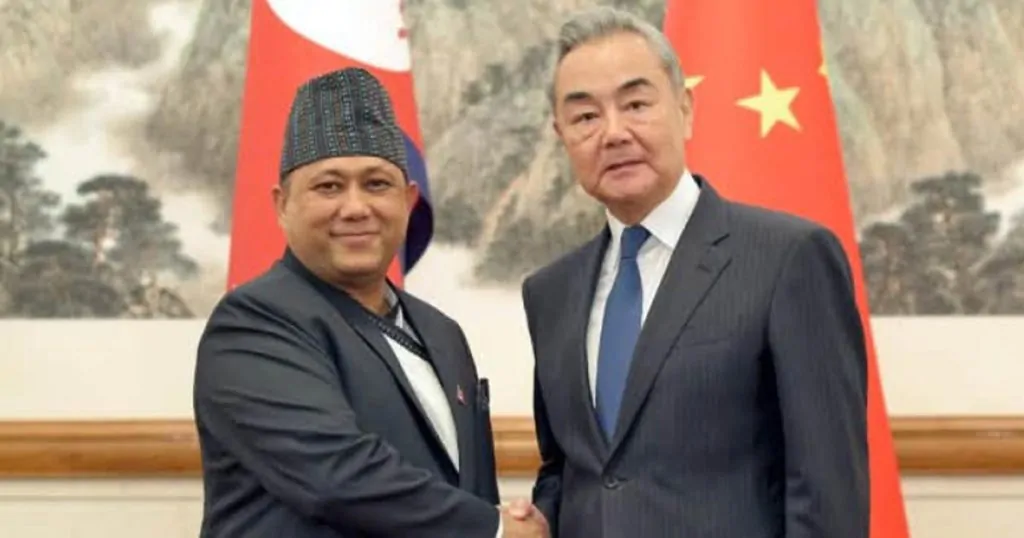
Foreign Minister Shishir Khanal concluded his visit to China on June 17. He traveled to China on June 14 at the invitation of Chinese Foreign Minister Wang Yi, who is also a Member of the Political Bureau of the Central Committee of the Communist Party of China.
According to reports, during their meeting, both ministers expressed satisfaction with the state of bilateral relations.
Following the meeting, Khanal stated through the official social media account of Nepal’s Ministry of Foreign Affairs:
“It was a pleasure to meet H.E. Mr. Wang Yi, Member of the Political Bureau of the Central Committee of the Communist Party of China and Minister of Foreign Affairs of the People’s Republic of China, in Beijing on Monday (June 15). We held comprehensive discussions on the entire gamut of bilateral relations, including connectivity, border management, trade, technology transfer, and multilateral cooperation. We also exchanged views on expanding people-to-people ties and reaffirmed our shared commitment to further strengthening Nepal-China relations for the mutual benefit of our two countries.”
Khanal met Wang Yi in Beijing on June 15 and discussed ways to strengthen bilateral relations, including connectivity, border management, trade, and infrastructure development. Wang reaffirmed China’s support for Nepal’s sovereignty and territorial integrity and expressed Beijing’s willingness to advance high-quality cooperation under the Belt and Road Initiative (BRI), with a particular focus on infrastructure projects such as power grids and highways aimed at helping Nepal become a land-linked nation.
The two ministers exchanged views on expanding people-to-people ties and reaffirmed their commitment to strengthening Nepal-China relations for mutual benefit. China pledged continued support for Nepal in safeguarding its sovereignty, independence, and territorial integrity, as well as in pursuing a development path suited to its national conditions.
Their discussions also covered cooperation in power grids, highways, border ports, and aviation. Nepal reiterated its support for the concept of building a community with a shared future for humanity and expressed support for global initiatives proposed by China. Minister Khanal thanked China for its long-standing support for Nepal’s development and efforts to improve the livelihoods of its people.
Significantly, Foreign Minister Wang reminded Nepal that “a neighbor will always be better than a distant relative.”
Praising Nepal for its firm commitment to the One China policy and its continued support on issues related to Taiwan and Tibet, which China considers core national interests, Wang expressed appreciation for Nepal’s stance.
He also pledged to expand cooperation under the high quality Belt and Road Initiative (BRI), particularly in areas such as power transmission networks, roads, border connectivity and air transportation.
In addition, Wang said China would encourage its companies to invest in Nepal and expressed hope that Nepal would provide a fairer, more transparent and business friendly environment for investors.
He stressed the need for both countries to strengthen cooperation in multilateral forums and work together to safeguard the common interests of developing nations.
Recalling Chinese President Xi Jinping’s visit to Nepal in 2019, Wang said the two countries had agreed to establish a strategic partnership of cooperation featuring friendship for generations and oriented toward development and prosperity. He added that the agreement had provided a shared roadmap for elevating China-Nepal relations to a higher level.
The remark “a neighbor will always be better than a distant relative” underscored China’s commitment to maintaining close relations with its neighboring countries. At the same time, some observers interpret it as a subtle indication that Beijing is carefully watching the foreign policy orientation of Nepal’s current government.
China appears to have little concern regarding Nepal’s relations with India. However, some diplomatic observers believe Beijing remains cautious about what it perceives as the growing influence of the United States in Nepal and the circumstances surrounding the formation of the present government.
According to these observers, China is closely monitoring the government’s foreign policy direction while continuing to engage Nepal through open and friendly cooperation.
During his stay in Beijing, Minister Khanal attended several official events and interacted with members of the Nepali community residing in China.
He also held a bilateral meeting with Liu Haixing, a senior leader of the Communist Party of China (CPC). Their discussions focused on trade, connectivity, ongoing infrastructure projects, and the feasibility of the proposed Kerung-Kathmandu railway project.
In addition, Khanal participated in an investment conference organized by the Nepali Embassy in Beijing to attract Chinese investment and met with Chinese entrepreneurs. The visit was widely viewed as part of Nepal’s effort to pursue a balanced foreign policy and maintain strong relations with both of its immediate neighbors.
Observers note that Minister Khanal had received the invitation to visit Beijing before his trip to New Delhi. Nevertheless, he undertook the China visit shortly after completing his visit to India, reflecting Nepal’s continued emphasis on maintaining diplomatic balance between its two neighbors.

Login to add a comment