








By Narayan Prasad Mishra
It has been more than three decades since the collapse of the Panchayat System in 1990. The person born in 1990 has grown to be 33 years old. So, from this point, that system was experienced only by the people born before that. Others form their opinions about it–good or bad, by hearing or studying, or not experiencing it.
We know by experiencing, hearing, or studying that King Mahendra introduced the Panchayat System by dissolving the Nepali Congress government under B.P. Koirala and the multiparty parliamentary system with his royal address to the nation on December 16, 1962. In essence, the following were the main charges leveled against the then government by the King
- In the name of democracy, the party in government became very self-centered. It used its power only to fulfill personal and party interests by pushing away the nation’s and people’s welfare. Nepotism and favoritism unbearably flourished.
- It crippled the administration of the country by not giving due attention to the laws, rules, and regulations.
- As a result, corruption became rampant, and the government could not maintain peace and harmony.
- The foreign influence and intervention increased.
- People had to bear several problems, and the country could not move forward.
- There appeared to be even more fear and risk for the existence of the country
Before that, a multiparty parliamentary system with a constitutional monarchy existed.
In present-day Nepal, the elected government and the republican system are perfect for the party in power. However, most people are dissatisfied and frustrated with the government and system. The situation was almost the same in 1962. Everything was perfect for the party in government. But others were unhappy then and felt the same way that King Mahendra leveled the charges mentioned earlier. It seemed that by correctly evaluating the people’s dissatisfaction and frustration, King Mahendra took his royal step and dissolved the government and the system. After that, he and his successors ruled the country with the Panchayat System till 1990. We call this period (1962 – 1990) of our history the Panchayat era. Under this system, all necessary factors of democracy–free and fair elections, house of representatives, elected government, etc.- existed.
The only difference is that the person had to stand in the election as an independent individual, as Balen Shah or Harkha Sampang did, as political parties were banned and did not exist. During this period, the parties were considered like fighting street dogs, not cooperating with each other. So, the political parties were banned. That system was created based on King Mahendra’s bitter experience about political parties as fighting dogs, which most people think would be true based on their experience now. People are witnessing this now. The only difference we see now is that they often become one for power sharing for their party’s and followers’ benefit, not for the country’s and people’s welfare. They remain like fighting dogs when there is no chance of power sharing and earning.
By study or experience, we can say that King Mahendra and the Panchayat System are inseparable. They are synonymous. By introducing that system, King Mahendra did a lot to develop the country and the people’s welfare. We had the most noticeable development in creating the country’s infrastructure in various aspects–education, health, administration, roads, factories, science, technology, and reforming social systems with new laws and rules. However, there were limited restrictions on opening associations and organizations and freedom of speech and writing. But it was not as bad as is commonly depicted by multiparty lovers today. One can find the truth by reading critical articles published about the plan and programs, government policy, administration, corruption, education, economy, poems, stories, etc. Of course, the constitution and government protected the monarchy and the Panchayat System, which was partyless. One was not supposed to do anything against them.
I know this not only from reading or hearing about it but also from personal experience as an independent citizen who never worked for the Palace or Panchayat. I never enjoyed any power, positions, or other benefits from that system. In fact, I somewhat suffered and lost a due promotion, which I have previously detailed in my articles titled “Tribhuvan University–My Concern and Suffering -2,” published in People’s Review on June 30, 2021. I never sang or wrote any praises about it. Instead, I courageously wrote poems or articles critiquing the system under a pseudonym whenever I saw points of criticism, driven by my conscience to advocate for reform. When I learned that the culprits involved in the kidnapping of a Marwari businessman of Bhairawa and a campus chief of the Nepalgunj campus in a rape case were both saved from punishment as they were strong supporters of the Panchayat System, I couldn’t tolerate it. I firmly believe wrong is always wrong, regardless of who commits it.
I have been writing articles or poems against wrongdoings in any system–Panchayat, Monarchy, or Republic–with the same belief and spirit. I could write that way because I never aspired for a favor from anyone except justice. Thus, I wrote a poem titled “Panchayati Gita” to express my disapproval of this condemnable issue. The poem was published under a pseudonym in the Naya Nepal Post on October 18, 1984 (Kartik 2, 2041). The poem is also included in my poem collection book, Umliyeka Pidaharu. In the poem, I depicted how proponents of the Panchayat System considered it akin to the holy Gita, allowing even kidnappers and rapists to escape punishment through its praise. The poem harshly criticized the wrongdoings of the Panchayat leaders and the system itself. It also serves as a testament to our (my beloved wife Shanti Mishra and mine) independent, unbiased, and courageous writing in any circumstances. I could not have written it without her consent, as she is my beloved partner. The poem also sheds light on the state of freedom of speech and writing during the Panchayat, which was not as dire as depicted by its opponents.
Poem in Nepali

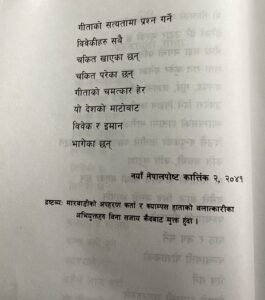 Poem translated into English
Panchayat Gita
In the verses of Lord Krishna’s sacred Gita,
Bhagavad’s narrative, Buddha’s wisdom, Christ’s teachings,
Suppressed, oppressed, and eclipsed,
By the Panchayat Gita, our homeland’s own scripture.
Bearing the advantage of Panchas, guardians of the system,
This Gita unfolds its narrative, birthing sages anew,
Vashistha and Bhardwaj, Balmiki and Bishwamitra,
In our green forests and jungles, a land of meditation.
The Panchat Gita resonates across the landscapes,
Echoing through the recitation, a source of transformation,
Transforming beggars into wealthy lords,
Elevating the uneducated to wise preachers adorned with fame.
On the campus of colleges, amidst daylight crimes,
Rapists, kidnappers, and looters find escape,
Shielded by the mystic aura of the recited Gita,
A shield against the consequences of unrighteous actions.
Yet, this mystical influence casts a shadow,
Clouding the conscience of those who chant and meditate,
Clad in Panchayat attire, cunningly changing colors,
Earning respect and wealth, seizing positions of power.
The enchantment extends beyond riches,
As they claim ownership and consume the nation,
The conscience of the righteous is obscured,
Drowning in a puzzle of rights and wrongs.
Behold the enchantment of this Gita,
From the soil of our homeland, it weaves its spell,
Where conscience and honesty vanish,
Lost to the magic of the Panchayat Gita.
Any system and government worldwide will have some bad actors, flaws, and weaknesses. In other words, no system and government will be without flaws and weaknesses. So, there was no doubt that the Panchayat System and the then government also had some flaws and weaknesses, which my above poem depicts. However, compared to today, it was undoubtedly true that there were not as many irregularities, wrongdoings, corruption, mismanagement, instability, strife, and disturbance. Now, we hear about irregularities and corruption cases almost daily or weekly. Our political parties become one when there is a chance of power-sharing or money-sharing. They stay like fighting dogs without a chance of power sharing and earning.
We also know that any bad system can also function well when its conductors and actors are good and honest. At the same time, any sound system can be bad when its actors and conductors are not good and honest.
However, we have people who think the Panchayat System is the best system among all the systems introduced in Nepal. According to them, our country was much better during that period in all aspects–development and progress, security, peace and harmony, life and living, etc. The Panchayat was the most beautiful system for them.
On the other hand, we have leaders and parties who think that was the ugliest system ever implemented in this country. They have been enemies of the system ever since its birth. Most leaders, followers, and parties who feel this way were in the government before, and even some are in the present government after the fall of the Panchayat System. They are–the Nepali Congress Party, Nepal Communist Party (Maoists), Nepal Communist Party (Unified Socialist), Nepal Communist Party (UML), Janata Samajbadi Party Nepal, etc. Among them, the Nepali Congress Party stands first in the row since they lost power and luxury in 1962 to the Panchayat system.
These parties have been singing against the Panchayat System for the last six decades. They portray it as if there would not be any uglier system than this. They do not hesitate to level charges against the Panchayat, going beyond reality. In this context, I was surprised to hear Ram Hari Khadka, the Nepali Congress parliamentarian, recently said on Christmas Day that the Nepali Christians had to be in prison just because they were Christians during the Panchayat, which was indeed untrue and false. We all know everyone had the right to follow any religion and faith in Nepal during the Panchayat. However, only the forced conversion from one religion to another was strictly prohibited. At the same time, he also said that it would not be justified not to give holidays on Christmas day when the Hindus enjoy holidays in their festivals, intending to show the injustice done to them by not giving a holiday by the Panchayat. That logic is also not reasonable, as no country can give holidays to all the faiths that exist in the country–major or minor. If we do this, the country will be the country of holidays, not for work as they are doing these days. The other faiths–Hindus, Muslims, or Buddhists do not get holidays in the USA, as the Christians enjoy a holiday on Christmas. What would he say about this?
Similarly, I frequently hear from proponents of multiparty systems that there was no freedom of speech and writing. They portray it as if our mouths and hands were tied during that time. The publication of my poem mentioned above proves otherwise; although I published it under a pseudonym, I exercised caution.
Merely labeling someone as ugly doesn’t make you beautiful or handsome. Similarly, portraying someone as unattractive doesn’t change their beauty if it exists. True beauty requires effort and action. Regardless of the political system—single-party, multiparty, or republican—it must cater to the people’s needs and the nation’s development and welfare. This viewpoint is independent; I don’t adhere to the Panchayat or Republic Systems. Truth speakers transcend systems; they are committed solely to truth and God, seeing only what is true.
Multiparty advocates should acknowledge that a large number of people in the country are recognizing and stating that the old Partyless Panchayat System holds more beauty than the current Republic System, based on comparisons of the outcomes they generated concerning the country’s development and the welfare of its people. Therefore, instead of exaggerating the flaws of the Panchayat System, supporters of multiparty systems should focus on extracting positive lessons for improvement from the non-partisan system if they seek the country’s and its people’s welfare.
The views expressed in this article are the author’s own and do not necessarily reflect People’s Review’s editorial stance.

Login to add a comment