







- Taiwan Defies Mainland China
- Middle East Crises
- Ukraine War

By Shashi P.B.B. Malla
China’s Least-Favoured Candidate Wins Taiwan’s Presidential Election
The 19 million voters of Taiwan have spoken – loud enough for Beijing to hear. On Saturday, Lai Ching-te [aka ‘William Lai’] of the ruling Democratic People’s Party (DPP) defeated his two rivals – Hou You-ih of the nationalist Kumintang and Ko Wen-je of the Taiwan People’s Party — to become Taiwan’s next president over China’s vociferous objections.
Meanwhile, the DPP is set to lose its majority in Taiwan’s Legislative Yuan.
The vital question is: What do a DPP presidential victory and a divided legislature mean for Taiwan’s external relations with China and the United States?
What will be China’s Reaction?
According to the Atlantic Council’s world-wide experts:
- Beijing is in no mood to celebrate this democratic exercise in what it considers to be a breakaway province. Wen-Ti Sung predicts that the victory of the Taiwanese ‘William the Conquerer’ will be met with rhetorical attacks, economic sanctions, and “an intimidating show of force through military exercises and gray zone security maneuvers.”
- China-based media companies have been attacking Lai and the DPP throughout the presidential campaign says Kenton Thibaub, purchasing ads on Facebook to push the narrative that “a vote for Lai would lead Taiwan down the path of war.”
- Now that Lai has won “we can expect Beijing to enact consequences on Taiwan” says Kenton. “Economic coercion, increasing tensions in the security sphere, and strategic deployment of the narrative that DPP and US actions are destabilizing the Asia-Pacific region and leading to conflict are sure to follow.”
- After Lai takes office in May, Hung Tran expects Chinese misinformation campaigns on “legislation to authorize money to purchase arms from the United States.”
How is the DPP expected to govern?
- The victorious DPP has indicated it will “double down on US-Taiwan ties,” according to Wen-Ti Sung. The Biden administration is reportedly sending an unofficial delegation
- But the loss of the DPP’s legislative majority presents challenges for the incoming government, says Wen-Ti Sung. “If it can overcome the constraints imposed by Taiwan’s internally divided government will be better able to negotiate with Beijing from a position of strength.”
- If the DPP is able to reach across the aisle, Wen-Ti Sung predicts, Lai’s government will “have a better shot at rebuilding a working (albeit cold) relationship” with China and “reopening lines of communication between Beijing and Taipei, which is essential for stabilizing the region.”
- Lai won a plurality, but not a majority of the vote, Hung Tran points out, and the DPP lost its parliamentary majority. This reflects a tension in Taiwan’s politics: “most voters in Taiwan cherish their de facto independence and freedom but want to see an easing of tension with China.”
Could a Chinese Response affect the Global Economy?
- As China considers its next moves, a maritime blockade could be “a less risky, more implementable, and thus preferable option for China” as opposed to an outright attack, Hung Tran points out.
“As Taiwan is a vital part of global commerce,” particularly when it comes to semiconductors, even a partial blockade would “add another headwind to the global economy,” he adds.
- That headwind would come on top of a potentially expanding war in the Middle East, among other concerns.
Hung Tran notes that the World Bank recently issued a “dismal” estimate of only 2.4 % percent global growth this year, “completing the weakest first half of a decade since the 1990s.”
- “Taken together, these global geopolitical risks would reinforce the downside risks” that the economy could perform far worse, Hung adds.
The United States, which is bound by its laws to provide Taiwan with the weapons needed to defend itself, had pledged support for whichever government emerges, reinforced by the Biden administration’s plans to send an unofficial delegation made up of former senior officials to the island shortly after the election.
Taiwan’s high-stakes election is seen as having ‘real and lasting influence on the geopolitical landscape,’ said Gabrielle Reid, associate director with the global intelligence consultancy S-RM.
“The outcome of the vote will ultimately determine the nature of ties with China relative to the West and will have strong bearing on the state of play in the South China Sea,” she said (AP/Associated Press, Jan. 14).
Thus the DPP has transformed Taiwan into a democratic bastion against Chinese hegemonic power. Now it is promising a mix of change and continuity.
The vote could reshape the complicated, risky balance of power between Taiwan, China and the United States.
Gaza War: Has Israel Gone Too Far?
Escalation in the Middle East
 The human and infrastructural devastation in the Gaza Strip has been difficult to watch and to condone.
The contentious question is whether it has been warranted.
As Israel continues its war against Hamas in retaliation for the Gaza-governing terrorist group’s horrific October 7 massacres of Israeli civilians, the Jewish state stands accused – in a case brought by South Africa in the International Court of Justice at the Hague – of pursuing genocide against Palestinians.
One of America’s leading public intellectuals, Indian-American Fareed Zakaria considers the charge invalid, arguing “there is no systematic effort to exterminate Gaza’s population. [If there were, given the vast disparity in power, Israel would surely have killed many more than 23,000 people, though that number is, of course, staggering high. The death toll figure comes from the Hamas-run Health Ministry in Gaza.] Genocide is an incendiary accusation that should not be used loosely” (CNN/Fareed’s Global Briefing, Jan. 12).
Nevertheless, unguided bombs and troubling public statements by Israeli officials, including Prime Minister Benjamin Netanyahu, raise disturbing questions.
“Israel is a democracy and an open society,” Zakaria writes in his Washington Post, “and precisely because of that it will one day have to ask itself whether it acted appropriately in the heat of its anger and sorrow after Oct. 7. Friends of Israel should help it ask those questions now, so that it does not look back on this episode with shame and regret.
Yemen: At War With the Houthis
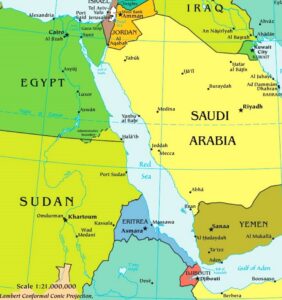
Locked in a years-long civil war with Yemen’s Saudi-backed government, Yemen’s Iran-backed Houthi militants have instigated a regional conflict in recent weeks by obstructing shipping through the Red Sea and its choke point the Bab El-Mandab Strait.
The Houthis claim ostentatiously that this is in retaliation for Israel’s war against Hamas.
Having warned of “consequences” in a joint statement issued by an international coalition rallied to oppose the Houthis in the Red Sea, the U.S. and UK have now carried out airstrikes on Houthi targets in Yemen.
The strikes prompted words of caution from Washington Post writer Jason Rezaian, who writes that the “Middle East is as tense as it has been in recent memory,” as the war in Gaza threatens to become a regional conflagration. “A carefully modulated reply to Houthi aggression is justified at this point. But President Biden should ensure that this response does not spiral out of control. A wider war would be calamitous.”
A day before the US and UK struck, a Foreign Affairs essay by Alexandra Stark had warned against striking.
Stark had written: “Because the Houthi attacks could have serious consequences for global commerce, the United States is under substantial pressure to respond militarily. But instead of retaliatory strikes, the U.S. should favour a diplomatic approach. The Houthis may be recent entrants into international newspaper headlines, but they have been challenging the United States and its Gulf partners for two decades. And the use of force against the Houthis in the past, whether by former President Ali Abdullah Saleh’s regime or by a Saudi-led effort to reinstate the government the Houthis overturned in the mid 2010s, has merely allowed the group to refine its military capabilities and portray itself as a heroic resistance movement bolstering its legitimacy at home.”
Viewing the strikes more favourably, The Economist writes under the headline “America fights back” that the US has reasserted itself to restore “maritime order” at a time when the world’s seas face political and military turmoil: “The escalation in the Red Sea is mirrored by maritime mayhem elsewhere. The Black Sea is filling up with mines and crippled warships; this year Ukraine hopes to eject the Russian navy from Crimea, its base since Catherine the Great. The Baltic and North Seas face a shadow-war of pipeline and cable sabotage. And Asia is seeing the largest build-up of naval power since the Second World War, as China tries to coerce Taiwan into unifying and America seeks to deter a Chinese invasion. After Taiwan’s election on January 13th, tensions there could soar. These vents are not a coincidence, but a sign of a profound shift taking place on the planet’s oceans.”
The United States carried out a fresh strike Saturday on a Huthi rebel target in Yemen, the US military said, after the Iran-backed militants had warned of further attacks on ships in the Red Sea, in solidarity with the Palestinians in Gaza.
There were heightening fears that Israel’s war with Hamas could engulf the wider region (AFP/Agence France Presse, Jan. 13).
However, Fabian Hinz, a research fellow at the London-based International Institute for Strategic Studies (IISS), discounted the risk of escalation ‘as big players like Iran are keen on avoiding a regional war.’
Can Putin Afford His Ukraine War?
By most accounts, the Russian economy has survived President Vladimir Putin’s war on Ukraine.
Despite a US-led effort to punish Russia’s state finances and national economy with sanctions, Russian GDP is expected by some economists to grow this year.
“Key sectors of Russia’s economy are adapting and in some cases completely rebounding from unprecedented international sanctions imposed over the war in Ukraine,” Bloomberg reported in November. Russia’s financial technocrats have received plaudits for successfully navigating rough waters.
But not all is well. Alexandra Prokopenko argues in a Foreign Affairs essay that strong economic indicators are “symptomatic of overheating”.
Prokopenko identifies economic problems in Russia that suggest “Putin is facing an impossible trilemma…He must fund his ongoing war against Ukraine, maintain his populace’s living standards, and safeguard macroeconomic stability.”
War spending has artificially propped up Russian output, Prokopenko writes.
Inflation in Russia currently sits at 7 % percent; interest rates at 16 % percent; and continued borrowing at that rate Russians expect inflation to continue.
Putin may ‘splash’ even more government spending into the economy before the spring election, feeding the sugar high even further.
Prokopenko’s broader point: “With the war unlikely to end soon, the financial and economic costs will mount and are likely to bite Russia several years from now. This process could be speeded by a major global recession or a slowdown of the Chinese economy [ or both ], which would hit Russia hard because of its heavy dependence on revenues from commodities exports. The specter of a bitter economic hangover looms large unless a new and sustainable Russian economic model emerges.”
The writer can be reached at: shashipbmalla@hotmail.com
The views expressed in this article are the author’s own and do not necessarily reflect People’s Review’s editorial stance.

Login to add a comment