








By Deepak Joshi Pokhrel
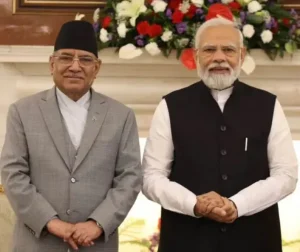
There is a saying that there are no permanent foes and friends in politics. The once bed-fellows can turn into fiercest enemies and vice versa. This time tested old adage has been aptly proved by our incumbent Prime Minister Pushpa Kumar Dahal popularly known as Prachanda.
Prachanda was once a Maoist guerilla. Under his leadership, the former rebels waged a decade long armed conflict against the state demanding, among others, the abolition of monarchy and turning Nepal into a democratic republic. The conflict came to an end with the signing of the comprehensive peace accord in 2006 paving the avenues for lasting peace and sustainable development. Two years later, the election to constituent assembly was held in which Maoist secured a resounding victory. Prachanda was elected the first Prime Minister of Federal Democratic Republic of Nepal
Right from the day one of emergency, Dahal relentlessly fulminated against ‘expansionist’ India. Even after joining the mainstream politics, he continue to thrive on anti- India sentiment. As a matter of fact, he rose to prominence riding on the plank of anti-India sentiments. He even visited China as the first Prime Minister of Federal Democratic of Nepal in departure from tradition where India has been the first port of call for most previous leaders after assuming the office of PM. New Delhi was taken aback as it had provided him shelter while Prachanda was underground during the decade long armed insurgency. Shiva Shankar Mukherjee, then Indian Ambassador to Nepal, even went on to say that Prachanda was playing China card against India.
As prime minister, Prachanda also called for a review of all bilateral treaties with India, including the 1950 India-Nepal friendship treaty that puts bilateral ties on a special footing. Bilateral ties seemed to hit a nadir after the Prachanda government in 2009 decided to sack Nepalese army Chief Rookmangud Katawal, who was seen as close to India. India came to Katawal’s defense, and Dahal had to leave office in a huff. This antagonized Dahal who vowed fights against the undue interference of New Delhi.
Katawal’s sacking was stayed by then Nepalese President Ram Baran Yadav but Prachanda blamed India. And when he was replaced as prime minister by Madhav Kumar Nepal, Prachanda reportedly said he believed it had been engineered by India. More recently, in January 2016, during the protests against the constitution, Prachanda charged India with “bullying” Nepal using various Nepali political outfits against the landlocked Himalayan nation.
Soon after he realized that it was blunder on his part to antagonize the southern neighbor. A clever and an opportunist Prachanda came to the conclusion that he will never climb atop Nepal’s political tree if he does not obey the southern neighbor. With an objective to mend fences, he was meeting the Indian bureaucrats and spies abroad. During the meeting, he hinted that Nepal needs India in its pursuit for rapid economic growth and lasting peace. What a U-turn.
In the post constitution promulgation, Oli emerged as a national hero as he refused to bow down to Indian imposed embargo citing political dissatisfaction. Since then, India wanted to keep Oli out of power. The 2022 general election resulted into hung parliament with neither the Nepali Congress, the largest party, nor the CPN-UML, the second largest, in a position to govern on their own. Dahal put forth his bid.
New Delhi was putting its weight behind Prachanda-Deuba coalition and backed Prachanda led government though it was still reluctant to do business with him given his past anti-India sentiments. But, New Delhi was mindful of the fact that Prachanda was better option than Oli who was seen close to China. By that time, Dahal had worn the heart of New Delhi which is why he is now the Prime Minister.
But it was not an easy affair for Prachanda to please New Delhi. He has earned this faith the hard way. To start with, he has refrained from signing agreements of long-term import with China, especially under the Belt and Road Initiative (BRI) that India views with suspicion. He projected himself as a good friend of India through his frequent visit and subsequent meeting leaders both ruling and opposition. During his recent China visit, the two countries inked a dozen deals, but none under the BRI. The BRI project implementation plan, which he was supposed to sign in Beijing, was indefinitely shelved.
While visiting China which India was observing closely, he gave the impression that it was a just goodwill visit and nothing more. The one-time India-baiting guerilla leader seems to have realised that in the new South Asian geopolitical landscape, it is impossible to ‘balance’ India and China, whose relations have not been the same since the 2017 Doklam border standoff.
According to Rakesh Sood, another former Indian ambassador to Nepal, “From all accounts, Prachanda is wiser today than in 2008-09. He now publicly acknowledges that it was a political mistake. He too had blamed India for his debacle but now has his task cut out to restore bilateral ties.
Once India’s bête noire, Pushpa Kamal Dahal ‘Prachanda’ has morphed into perhaps New Delhi’s most trusted leader in Nepal. With this, the universally accepted adage’ there is no permanent foes and enemies in politics” has been further validated one more time.
The views expressed in this article are the author’s own and do not necessarily reflect People’s Review’s editorial stance.

Login to add a comment