







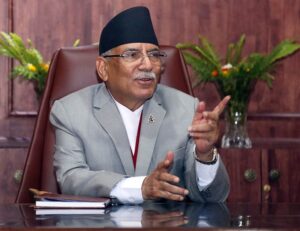
 Prime Minister of Nepal Pushpa Kamal Dahal – one of the most complex politicians in South Asia, whose biography can form the basis of an adventure novel: General Secretary of the United Communist Party of Nepal (Maoist), commander of a revolutionary group during the civil war that lasted from 1996 to 2006, when he fought underground and even received the political pseudonym Comrade Prachanda (Grozny), and then, after the fall of the monarchy, the head of several governments of the country (from August 2008 to May 2009, from August 2016 to May 2017 and from December 26, 2022 to the present). A former rebel, and today a well-known statesman for the first time agreed to meet with a representative of the Russian press. In an exclusive interview with TASS, Comrade Prachanda said that socialist ideas should evolve in the XXI century, that he is striving for the resumption of direct flights between Nepal and Russia and why he wants to personally meet with Vladimir Putin.
– You were the leader of the Maoist rebels for many years, even took the name of Prachanda (Fierce) . And today you are the head of the Nepalese government. How did this happen, why did the citizens of Nepal support your movement and continue to trust your party until now?
– To begin with, I want to say that it is very interesting and important for me to give an interview to TASS. I know that TASS is a very reputable and respected agency.
Answering your question, I would like to note that Nepal has known a lot of twists, ups and downs in its politics, but in the end we were able to come to a consensus with various political parties. When I was at the head of the revolution, we became the voice of the economically and socially backward, oppressed population, which was oppressed by the then government, feudal and autocratic monarchy. And people supported our movement because we raised the problems that they had suffered for so many years, suffered from absolute monarchy, the kingdom of autocracy. Therefore, we have received massive support, mainly in rural areas.
At the same time, we were leading a political movement. We have been in dialogue with all political parties represented in Parliament. Seven parties then also united against the autocratic monarchy. We have come to a historic understanding, called the “12-point agreement”, which created an atmosphere of consencus and provided conditions for a comprehensive peace agreement. And within the framework of this document, we participated in the elections to the Constitutional Assembly.
Peace was concluded in exchange for agreeing to hold these elections, which was accepted by all political parties. And we managed to win the majority of seats in the Assembly. And then I got the opportunity to lead the first government of federal democratic Nepal, which in a very short time went from revolution to a peace agreement, and from it to elections to the constitutional Assembly.
There is some miracle in such a transition from monarchy to democracy! And people supported us. I want to emphasize that even now there is a coalition government in power in the country, I head a cabinet in which several parties participate. I would like to note that this is a unique peace process, which was successful thanks to the efforts of internal forces, which ensured a gigantic political transformation that continues in this country.
– Has the transition to ordinary political life affected your worldview? Or can we say that you are continuing your struggle in a new place – as the head of the Government of Nepal? How do you see the future of Nepal’s political system?
– As Marxists, we believe in the philosophy of dialectical materialism. According to our philosophy, a concrete analysis is needed in specific circumstances – which is the basis of materialism. Vladimir Ilyich Lenin was aware of the inadmissibility of dogmatism and fanaticism, because we must understand the dynamics of political changes taking place around the world, in the region and in the country. And responding to them, we must build our policy.
Lenin in general had a very great influence on me! Analyzing the political nature of development in the world and in the region, we realized that we also have to change. Therefore, we have moved from armed struggle to a peaceful process, a competitive political system. We overthrew the feudal monarchy and included in the social processes those who had previously been oppressed, this has become the main feature of our constitution. Now we pay special attention to economic development. Only then will the changes take root and settle in the country. I hope that the only possible future of the country is peace, stability and prosperity. And we are doing everything possible to ensure them.
– The world has changed. Is there a place for the ideas of socialism and communism today? How do you see the world in the future?
– The world really does not stand still. The achievements of science and technology have led to a revolution in information technology, all this has completely changed the situation around the world. At the same time, a new global geopolitical polarization has also occurred. Now we see conflicts between Russia and Ukraine, Palestine and Israel.
At the same time, as you know, Nepal is located between two Asian giants – India and China – and this is a very sensitive geopolitical situation for us. Certain contradictions are observed between China and the United States, China and India. Even India and the USA can see the regional situation in South Asia differently. Very complex processes are taking place here.
For our part, we adhere to progressive nationalism, we adhere to socialist ideas. Based on the situation that has developed in the XXI century, we cannot follow the fanatical, dogmatic path defined in the XIX century, in the XX century. We must change in accordance with the changes in the world. We must analyze the situation in the world and learn from it. Now we need a new strategy, a new policy and a new vision.
I studied the history of the USSR and tried to understand the dynamics of the Russian revolution led by Vladimir Ilyich Lenin, studied many of his articles and works. I also followed the events in Russia in the 1980s and 1990s. We tried to make sense of it. My attention was also attracted by changes in China, changes in public administration. We tried to analyze all this in order to move forward.
– You stressed that Nepal is locked between two giants – India and China. How do you build relations with these states, taking into account the complex nature of their relations with each other?
– Historically, the basis of Nepal’s foreign policy has been non-alignment. We strive for a balance in foreign policy in the direction of India and China, based on the interests of our independence and ensuring the basic needs of our people. And now we continue to adhere to the policy of independence and non-alignment.
Two months ago I visited India and found a good understanding with its leadership there. Then I was in China, Beijing, where I also met the understanding of the Chinese leadership. Then I was at the session of the UN General Assembly in the USA, and there we tried to achieve a better understanding of issues related to the development of Nepal. That is, we strive for a balance in foreign policy.
At the same time, on the world stage, we support the oppressed, those who deserve independence. We support Palestine, we have always supported the Palestinians, and at the session of the UN General Assembly I tried to convince the world community that both Israel and Palestine, both states should be recognized by the international community. As Marxists and Communists, we have also achieved a certain mutual understanding with countries of socialist orientation.
– How stable is the current situation in Nepal? Can we say that the formation of the country’s political system has been completed? I know that recently there were mass protests in Kathmandu by supporters of the monarchy.
– Every revolution causes a counter-revolution. The classes overthrown by popular revolutionary movements are trying to achieve a return to power. This is the law of history!
We have overthrown the authoritarian feudal monarchy, and I am sure that its time has passed and it is impossible to return to the past. Although such attempts are being made, some people want to return. I believe that Nepal’s political system will be stable, federalism and a democratic republic will stay with us for a long time. At present, having achieved political stability, we must engage in economic development. Stability and economic well-being are interrelated.
– You mentioned the importance of economic development to maintain stability. What needs to be done to develop Nepal’s economy? Which industries are the most promising?
– Foreign direct investment is important for us now, so we are trying to create a favorable atmosphere for them and remove obstacles for investors and economic development. We are a predominantly agrarian country, so we pay special attention to agriculture and the agricultural industry.
Nepal also has a huge potential in hydropower – thanks to the abundance of fast mountain rivers. During my last visit to India, we agreed that Nepal would supply the Indian side with 10 thousand MW of electricity for 10 years. There is an agreement on the supply of our electricity to Bangladesh. All this creates a favorable environment for the development of hydropower.
The tourism industry, which has great prospects, remains a significant sector for us. Buddhist shrines are located in Lumbini in our country (according to tradition, Buddha was born in this place and it is a place of pilgrimage for tourists and Buddhists from all over the world – approx. TASS) and the highest peak in the world, Everest, which we call Sagarmatha. Historical monuments, beautiful nature. Nepal traditionally attracts visitors from many different countries.
– How would you characterize Nepal’s relations with Russia? How satisfied are you with the state of Nepalese-Russian relations?
– The history of relations between Russia and Nepal is a history of mutual understanding and good partnership at different levels. Hundreds of Nepali students have studied in your country, who have made a great contribution to the development of our country. You have provided great assistance in the creation of infrastructure and modernization of agriculture, and in other areas, both during the Soviet period and later. There are no problems between our countries.
But we are very concerned about the not yet fully realized potential of economic partnership and transport connectivity. It really bothers us. I discussed this issue with the Russian Ambassador to Nepal, Alexey Novikov, and we talked about how to create an atmosphere for economic cooperation, ensure connectivity, first of all, this concerns air communication, the restoration of direct flights from Russia to Nepal. We also discussed other areas of economic cooperation, cooperation in education, agriculture, and infrastructure projects.
We are very interested in large-scale projects in the field of hydropower. As you know, we are preparing a report on the prospects for the construction of a hydroelectric power plant in the lower reaches of the Karnali River – the Karnali Chisapani project, it will be able to produce 10.8 thousand megawatts. We especially need significant funding and assistance for such structures. We are also ready to cooperate in the construction of roads and tunnels. Here we need the experience and technology that we know Russia has.
We would also like to see more Nepali students in Russia. All this is our priority, especially the creation of a favorable atmosphere for cooperation.
– Did you mention the possibility of resuming direct flights between Moscow and Kathmandu?
– We have to start the process of restoring direct flights. There are no problems on our side!
It is known that after the start of the Russian-Ukrainian conflict, some countries see difficulties in relations with Russia, but in our case there are no problems.
I also want to say that we feel the need for a high-level visit. After Russia was visited by the head of the National Assembly of the Parliament of Nepal (Chairman of the upper house of the Federal Parliament of Nepal “Rashtriya Sabha” Ganesh Prasad Timilsina visited Russia at the head of a parliamentary delegation on April 19-25 this year – approx. TASS) we are waiting for the return visit of the Speaker of the Russian parliament. Such a visit would help stimulate economic cooperation. During such a visit, there could also be a discussion of the long overdue issue of resuming direct flights. But, unfortunately, this visit was postponed. We hope for a high-level visit, which is extremely necessary. Including, perhaps, a visit at the highest level.
– So you are inviting Vladimir Putin to visit Nepal through our agency?
– I will be glad to see Vladimir Putin in Nepal. At the same time, I am ready to go to Russia myself!
I met with President Putin in India when the BRICS and BIMSTEC summits were held in Goa at the same time (the summit took place in 2016 – approx. TASS), I was there as prime minister during my second term. But, unfortunately, it was not a bilateral meeting, but a conversation within the framework of a collective discussion. I am sure that a high-level visit between our countries will allow us to make significant progress in all areas.
– What about the economic problems caused by the pandemic and the conflicts that are currently in an active phase? Is Nepal far from these problems, or do they affect it as well?
– The Coronavirus pandemic has had an extremely negative impact on us. Which, however, we have already overcome. If we talk about challenges, we consider climate change to be a serious threat to us. Glaciers in the Himalayas are melting, which seriously affects the lives of the local population. Therefore, we call on the international community to support us.
I intend to take part in the upcoming UN Climate Change conference in Dubai soon. I intend to declare there that we have the right to financial assistance to combat the effects of climate change. The climate must remain in the spotlight, not only for Nepal, but also for the entire region, and to a certain extent, for the whole world. We especially feel these changes – the glaciers of the Himalayas are melting day by day!
I would like to meet with the Russian delegation at this forum in Dubai, if it arrives there.
– What is your attitude to Western sanctions against a number of countries, including Russia? Can the position of Western states affect our bilateral relations?
– This is a very sensitive issue for us. We remain faithful to the policy of non-alignment, we stand for the solution of all problems peacefully through negotiations. We understand both the position of the West and the approaches of Russia, as well as the point of view of China. But speaking for one side against the other is a difficult issue for Nepal. Due to our geopolitical location and the general socio-economic situation.
– This interview is the first interview of the Nepalese leader to the Russian media for a long period. What would you like to say to the Russians?
– Russia has a very glorious history, its representatives have given so much for the development of mankind. We tried to learn from examples from Russian history. And now this respectful attitude remains the same. We respect the Russian people. I would like to wish Russia and its citizens well-being and prosperity.

Login to add a comment