








* Biden Endangers Thaw in Sino-American Relations
* Gaza Turmoil Continues
* Turning Point In Myanmar?
*Ukraine Claims New ‘Foothold’ in South

By Shashi P.B.B. Malla
Sino-American Relations
US President Joe Biden and Chinese President Xi Jinping met for four hours on the margins of the Asia-Pacific Economic Cooperation (APEC) forum in San Francisco, discussing a wide range of issues from Taiwan to the South China Sea, the wars in Ukraine and the Middle East, economic relations, military-to-military communications, artificial intelligence, and the opioid epidemic.
The scope of the agenda reflects the perilous state of the world and the importance of a functional US-China relationship to addressing international challenges or at least ensuring they do not get worse (Council on Foreign Relations/Asia Unbound, Nov. 15).
However, viewed from another perspective, the low expectations that both sides set for the meeting is a stark reminder that the world’s two largest economies disagree on nearly all of the most consequential issues.
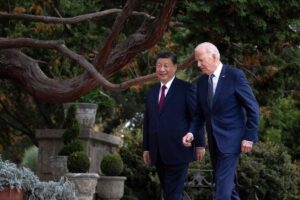 China’s President Xi Jinping signaled a marked shift in tone for China on the United States, but with US President Joe Biden’s off-the-cuff ‘dictator’ comment on Xi, there is wild speculation whether it can last.
Chinese leader Xi presented an amicable China ready to improve ties with the United States in a landmark meeting with Biden last week Wednesday, marking a noticeable shift in tone for Beijing as it looks to minimize friction with Washington.
Whether that shift is of a lasting nature for the contentious relationship will be put to an immediate test, however, by comments made by Biden during a solo press conference after the meeting.
There, the President reiterated his view that Xi is a “dictator”, after being asked by a reporter whether he stood by a comment saying as much this past June (CNN/Simone McCarthy, Nov.16).
At that point, Beijing ‘reacted with vitriol’, with the remark seen as casting an unnecessary shadow over tentative progress in advancing dialogue between the two sides following a highly successful visit from US Secretary of State Antony Blinken [who was captured on tv wincing when Biden made the controversial remark – out of time, place and situation].
When asked about Biden’s latest outburst at a Chinese Foreign Ministry briefing last Thursday, a spokesperson called it actually mildly “extremely erroneous” and an “irresponsible political maneuver, which China firmly opposes.”
What Is Expected Next In Gaza?
Israel is getting close to destroying Hamas’s “military system” in northern Gaza, according to an Israel Defence Forces (IDF) officer.
But the vital question is, how long will the fighting continue?
US President Joe Biden – perhaps the most important international backer of Israel – said last week that the war will end when Hamas can no longer attack Israeli civilians. Biden also said he believes the war will not end “until there’s a two-state solution” (CNN/Fareed’s Global Briefing).
Israel, for its part, appears to be pressing on, turning its attention to southern Gaza.
The Financial Times writes of leaflets reportedly dropped by Israel in neighbourhoods in southern Gaza, warning Palestinians to flee.
Israel Defence Minister Yoav Gallant has suggested the war will continue for “many months – and will include both the north and south” of the Gaza Strip. “We will dismantle Hamas wherever it is.”
The fight in northern Gaza is almost over, The Economist writes, noting that international pressure is mounting for Israel to stop its campaign. Meanwhile, the newsmagazine writes, the question of Gaza’s postwar future looms over that of when fighting will end.
Arab leaders have called for a ceasefire repeatedly, and The Economist notes that “some Western leaders have begun to echo that demand. Emmanuel Macron, the French president, called for a ceasefire in an interview with the BBC…Talks are taking place about a pause in the fighting in exchange for the release of some of the hostages. A less brutal war could ease that pressure” on Israel to stop fighting and on international leaders to support a ceasefire.
Fewer Palestinian civilians have died in recent days, the magazine writes, “as there is almost no one left in the north (of Gaza). That could buy Israel more time to continue its ground campaign. So would a greatly expanded humanitarian effort. Israel must also consider what comes next in Gaza…For now, Hamas has lost its ability to rule. It may also have lost the support of the people it once governed.”
Two States for Two Peoples
At the Middle East Institute last month, Paul Salem took a long view, suggesting – as President Biden has – that a two-state solution and a broader settlement of the Israeli-Palestinian conflict will be necessary to end the current war in Gaza.
“In the long term, this conflict is between two people struggling over whether and how to share the small piece of real estate that they both call home,” Salem wrote.
“In this broader context, there is no military solution, only a political one. President Joe Biden made it clear that there can be no return to the status quo ante of October 7, but rather there must be a way forward toward negotiating and something resembling a two-state solution. And now unlike in previous decades, there is a receptive neighbourhood of Arab states eager to engage and provide support and assurances in that direction.”
Many are calling for a serious, renewed statehood effort and reforms to Palestinian leadership.
In a Washington Post op-ed last week, King Abdullah II of Jordan called a two-state solution a moral necessity, lamenting the collapse of the peace process initiated by the 1993 Oslo Accords [and pointing to Israel’s expansion of settlements in the West Bank as dashing hopes of a Palestinian state].
At Foreign Affairs last month, former Palestinian Authority Prime Minister Salam Fayyad urged Israel and the Palestinian Authority to open a path for a durable postwar political future in Gaza.
“With the encouragement and backing of Arab countries,” Fayyad wrote, reforms to the Palestinian Authority “could offer a credible way forward.”
Myanmar: Are the Generals Stumped?
As the civil war [the junta against the rest of the country] continues to simmer in Myanmar, opponents of the ruling junta have made significant gains in recent weeks.
Myanmar Junta’s War Against Rebels Displaces Millions
The United Nations Secretary-General Antonio Guterres has expressed his deep concern over the escalating conflict in Myanmar.
According to the UN, the number of people displaced by the domestic fighting has reached two million, and the secretary-general has appealed to all sides to protect non-combatants and open access to humanitarian aid (BBC, Nov. 17).
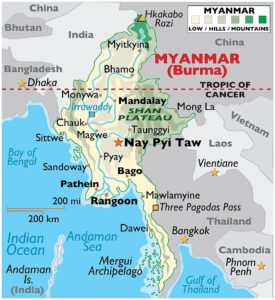
The striking success of an alliance of three ethnic armed groups in Shan State in driving the army and police out of large areas along the border with China has emboldened other opposition forces around Myanmar.
In Kayah State, south of Shan State along the border with Thailand, ethnic Karenni insurgents, who already control much of the state, are attacking the main town of Loikaw and have already captured the university on its outskirts.
Volunteer People’s Defence Forces (PDFs) – the militias formed by local activists after the suppression of peaceful protest back in 2021 – have launched their own attacks to take advantage of the military’s setbacks in Shan State and keep up the pressure of the ruling junta.
In Sagaing, where PDFs in the villages have been waging a desperate struggle against the military, they have recently taken the town of Kawlin, and are attacking the strategically important town of Tigyaing on the Irrawaddy River. PDFs are also very active around Myanmar’s second-largest city of Mandalay.
The junta has also lost much of the border with India. Ethnic Chin insurgents dominate their own state, and recently captured the border town of Rikhadar.
Further south, the Arakan Army, one of the best-armed of the ethnic insurgent groups, has ended its ceasefire and begun attacking army and police posts there.
Another large ethnic force, the Karen National Union in south-eastern Myanmar, is also stepping up operations against military positions along the vital trade route to the Thai border. There are now even regular attacks on the army in Tanintharyi, the southernmost state.
All these armed groups are outgunned by a military equipped with Russian and Chinese-made aircraft, helicopters and heavy
But the greatly-expanded scale of the armed resistance has left Myanmar’s military rulers badly over-stretched.
And the army is reported to be suffering from low morale and recruitment difficulties. In recent battles entire units have chosen to surrender, or flee.
However, military analysts are not convinced that the military regime which seized power nearly three years ago is likely to collapse.
But if the opposition can keep up the pressure, and keep improving its coordination, elements within the junta may conclude that they need to start negotiating with their opponents. This is something the coup-leader General Min Ang Hliang has so far refused to consider.
A Turning Point?
At the World Politics Review, Frida Ghitis [a regular contributor to CNN and The Washington Post] suggests the war may have reached a turning point.
“Whether or not the October battles constituted a watershed moment that will inevitably lead to the junta’s defeat, there’s no question that the military’s position has been gravely weakened,” Ghitis concludes.
“That could make this an auspicious moment for diplomacy. The next surprise in the Myanmar civil war could come from China, where the quickening momentum of the Myanmar rebel forces seeking to overthrow a despised, Beijing-allied regime is sure to be a subject of great interest.”
Ukraine: Out of the Morass?
Ukraine, a country buffeted by relentless Russian attacks, is in dire need of a morale boost.
In recent weeks, the country’s audacious, dauntless and heroic resistance has receded from the headlines amid the Israel-Hamas war in Gaza.
The much-heralded counteroffensive has yielded only incremental gains.
And above all, the crucial support in Washington appears to be drying up, if not wavering.
However, now there are reports that Ukrainian forces have gained a foothold on the left bank of the Dnipro River in southern Ukraine, marking a potentially significant advance for Ukraine across a natural defensive barrier for Russian forces (CNN/Nathan Hodge, Nov. 16).
In a recent interview with The Economist, Ukraine’s C-in-C General Valery Zaluzhny had acknowledged that Ukrainian forces had failed to achieve a major breakthrough of layered defensive lines.
Ukraine had launched a broad counteroffensive along the frontlines in the country’s east and south earlier this summer, but made only incremental gains and recaptured relatively small settlements.
Ukraine’s advances were slowed by minefields and fortifications that had been prepared in advance by Russia.
In contrast, Ukraine successfully struck Russian warships based in the Black Sea and launched headline-grabbing drone strikes deep inside Russian territory – operations that Kyiv generally does not comment on – the front lines have remained relatively static.
The writer can be reached at: shashipbmalla@hotmail.com
The views expressed in this article are the author’s own and do not necessarily reflect People’s Review’s editorial stance.

Login to add a comment