








By Deepak Joshi Pokhrel
Surely, India has garnered global attention with the successful completion of the G20 Summit held in Delhi a few days ago. The Delhi G20 summit has clearly sent the message that India is emerging — be it economically, militarily, or in the realm of science and technology. The Delhi Declaration — which is the outcome of several intensive negotiations, identified climate change as a threat to economic growth, especially for low- or middle-income countries that require better climate mitigation and adaptation strategies. the Delhi Declaration reads, “We commit to accelerate the full and effective implementation of the 2030 Agenda for Sustainable Development”. However, given the rapidly changing global geopolitics, it seems like a daunting challenge.
Chinese President Xi Jinping and Russian President Vladimir Putin did not take part in the event though they were represented by his Prime Minister Li Qiang and Foreign Minister Sergei Lavrov respectively. Speculation was rife regarding the absence of Chinese and Russian presidents who have been seen as important geo-political partners. Some argue that growing animosity between India and China is the outcome of the Chinese President’s denial to attend the event while others say that China was very much mindful of the fact that the summit will come up with some initiative as an alternative to China-led Belt and Road Initiative and Shanghai Cooperation Organization.
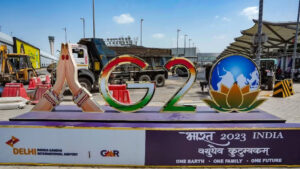 On the other hand, the Ukrainian President was not invited to the event. Right from the beginning of its presidency, India consciously chose to insulate G-20 from the pressures generated by the war in Ukraine. It refused to invite President Volodymyr Zelensky of Ukraine to the New Delhi summit. By doing this, it has pleased its long-standing ally Russia. However, knowingly or unknowingly, it has antagonized the West, especially the USA which was expressing its willingness to strengthen its ties and relationship with India.
India is entering a period of strategic opportunity (or what PM Modi calls an Amrit Kaal (the perfect time to start a new venture). The country is projected to be the fastest-growing economy this year. India also expects to benefit from the US-China rivalry. But can India leverage these developments to offer an alternative model of global governance?
The G20 Summit has no doubt helped India to strengthen its ties and relationship with the West from economic and political perspectives. But it has to pacify its BRICS members on the other hand. While India has been trying to project itself as a close ally of the West through forums such as Quadrilateral Security Dialogue and EU-India trade, the overwhelming members of the BRICS are anti-West countries. How India will seek to square this will be one of the key challenges in post G-20 Delhi summit.
Following the successful hosting of the G-20 summit, India is also at high risk of being estranged from a forum with a high composition of anti-West countries. At present the globe is multipolar with the US, China and Russia eyeing to realize their global ambition to influence politically. With BRICS, India has projected itself as a close ally of Russia but it has distanced itself from America which can be seen as its partner in its journey to become a power to reckon with.
Many political scientists say that summit may sour its relationship with neighbors’ next doors in days ahead. The much-vaunted communique showed that consensus across so many governments can mostly be achieved only on paper. How else can one describe a declaration that refers to the war in Ukraine, but won’t mention who is waging it! This needs a convincing explanation and India could face the music in the upcoming days if it fails to do so.
A separately negotiated India-Middle East-Europe Economic Corridor was unveiled during the summit. It has the potential to be an effective counter, though comparatively limited in scope, to the ambitious BRI. There is a reason to believe so. At present, China’s relationship with the Middle East has three dimensions: economic, international political, and domestic/regional security concerns. China’s trade with Middle East countries has increased multifold in recent times making them very good partners in terms of trade and economy. This growing bonhomie could pose a grave threat to realizing the India- Middle East-Europe Economic Corridor.
While the Modi-led government has been hailed across the globe for the successful completion of the G-20 Summit in New Delhi, some internal vocal critics of Modi are coming down heavily on him. They say that the Modi-led government deliberately deferred its presidency bringing it closer to the 2024 general election. According to them, the government wanted to capitalize on the event and woo the voters. Their arguments cannot be rejected altogether given the proximity of the event to the general election scheduled for April-May 2024
From a geopolitical perspective, the G-20 summit has definitely laid the foundation upon which India can counter its enemies next door. It has provided a platform to showcase its strength in bringing the world’s powerful leaders under one roof to support it in its fight against terrorism. It has clearly sent the message saying that it would be stupid to take India casually.
But how India will move ahead hereafter remains to be seen. Whether it will continue to support its long-standing ally — Russia — covertly or join hands with Europe and the US to counter the growth of China. The globe will certainly observe it very closely. Admit it or not, India will certainly walk on the tightrope in the G20 Summit.
The views expressed in this article are the author’s own and do not necessarily reflect People’s Review’s editorial stance.

Login to add a comment