







Given Nepal’s worsening condition, apathy is not an option for the security forces

By Bihari Krishna Shrestha
THE NIGER AND GABON COUPS
On 26 July 2023, a coup d’état occurred in the Republic of the Niger, a landlocked Sahelian country in North Africa, when the country’s presidential guard detained president Mohamed Bazoum, and the presidential guard commander general Abdourahamane Tchiani went on to proclaim himself as the president of the National Council for the Safeguard of the Homeland. Analysts cite the rising cost of living and perceptions of government incompetence, as well as Bazoum’s plans to replace the head of the presidential guard, General Abdourahmane Tchiani as possible triggers for the coup.
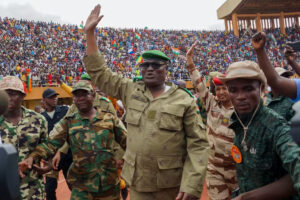
The Niger coup supported by commoners. Photo: Internet
On its heels, another coup happened in the West African country, Gabon, on 30 August 2023. It came shortly after the announcement that incumbent president Ali Bongo Ondimba had won the general election for the third time held on 26 August. However, allegations of electoral fraud and irregularities immediately emerged from opposition parties and independent observers, casting doubt over the legitimacy of the election results that were announced in the middle of the night on state television without prior notice.
A military spokesperson speaking on behalf of the “Committee for the Transition and Restoration of Institutions”, mentioned “irresponsible, unpredictable governance” that had led to “a continuous degradation of social cohesion, risking pushing the country into chaos”.
Since independence from France in 1960, Gabon has primarily been ruled by the Bongo family, starting with President Omar Bongo in 1967 and, following his death in 2009, by his son. Ali Bongo Ondimba was re-elected in a controversial election in 2016 whose official results from the family’s native province had shown Bongo receiving 95.5% of the vote on an alleged 99.9% turnout, “an improbable result sparking widespread protests.” Under the rule of the Bongo family, the country had been plagued by accusations of corruption and nepotism.
INTERNATIONAL OUTRAGE VERSUS JUBILANT PEOPLE IN SUPPORT
While the country’s former colonial ruler with deep investment interests in the region, France, and other international powers such as the US, UN and its immediate regional grouping, ECOWAS (Economic Community of West African States) denounced the coup and demanded immediate restoration of the democratically elected governments, the people themselves were reportedly jubilant, with thousands of them converging on the streets “to cheer the generals.” In the case of Niger in particular, The Guardian observed, “The outpouring sheds light on why many in Niger have in part welcomed the end of democratic rule that they associated with endemic corruption, economic hardship and limited freedom of expression.”
MANY PARALLELS WITH NEPAL
Unlike in Africa where military coups have come at regular intervals– in Niger, the recent one is the fifth military coup d’état since the country gained independence from France in 1960 — Nepal has seen only one yet, in 1960, led by King Mahendra with the Nepal Army supporting the monarch then. However, the conditions that lately led to the coups in the two African countries are very much present and growing in our country too: brazen and massive corruption cases in particular, the three major ones lately being the LalitaNivas land scam, the Fake Bhutanese Refugee scam and several cases of massive gold smuggling in which the top politicians in and out of the government are seen to be the masterminds.
Other parallel conditions that triggered the African coups include nepotism, never-changing corrupt and ageing politicians at the helm, election fraud and hopeless and irresponsible management of the economy that have made life terribly hard for the people in Nepal too.
Despite such hopelessness, in the case of Nepal too, there is no lack of foreign distractions, like ECOWAS in Africa in a way. For instance, just recently, US Senator Chris Van Hollen, on visit to Nepal stated, “Given Nepal’s status as a young and vibrant democracy, we are eager to strengthen our existing relationship and partnership while bolstering both political and commercial ties. In view of the situation in Niger and Gabon, what could that assurance possibly mean for Nepal? This is probably known as Killing with Kindness. Enough of foreign support for Nepal’s corrupt thugs.
Not that people are taking the situation lying down. In the last general election, for instance, a large number of independent candidates were elected mainly in the major urban centers, first unleashed in Kathmandu by the election of an independent candidate, Balen Shah as mayor of the capital city, leading the phenomenon to be known as the “Balen effect”.
The Balen effect, or visceral antagonism of the people against the corrupt political thugs in the parties, was most in evidence in the election and re-election of former popular, rebellious TV anchor, Rabi Lamichhane, otherwise, a dubious character himself. When he announced that he would contest against none other than the former Maoist Supremo, Prachanda himself in his own constituency in Chitawan, the former “Fierce One” had to take to his heels for this existential threat and ended up showing up, contesting and winning from the rural hinterland of Gorkha.
Lamichhane’s own first overwhelming election win was invalidated on grounds of his having illegally contested the election without a valid citizenship certificate. In any other country, he would have been seen as a persona non grata for all the times to come. But not in present day Nepal and Chitawan. His anti-establishment image was so compelling that he won the same election the second time with even more expanded majority.
RAJA AAU, DESH BACHAAU

A rally demonstrating national flags and urging the King to return to save the nation.
Besides, there is also a non-political rebellion in the making. While former King Gyanendra remains the most popular, politically significant person in the country today, one comes across a frequent chorus of this slogan Raja Aau, Desh Bachaau or Oh King, Please Come and Save the Country. This has been a rallying call among many people for a long time now. There are even important people giving seemingly definitive times lines when the King would come on board and the army bring him back to the palace.
It is said that there are some eighty different monarchy restoration groups operating in the country. The only problem that has held them back is that they have not been able to come under a common flag. The king himself does not seem to be actively encouraging them, except blessing them occasionally with a healing smile and a few soothing words.
Similarly, the army too has said or done nothing yet that would even remotely suggest that they plan to intervene.
PEOPLE HOLD NEPAL ARMY SACROSANCT
In the recent past, UML’s MP Bimala Rai Poudel had blurted out an uncomplimentary comment on the Nepal Army. Similarly, Rastriya Swatantra Party’s MP Swornim Wagle suggested that the army should be downsized. While it was never known what motivated the former for her abrupt, out-of-season utterances, the latter had based his argument on the nation’s pressing need for cost-cutting, completely oblivious to the fact that vast sums of nation’s wealth was being pushed down the drain by the total corruptibility of the huge army of corrupt politicians devouring Nepal’s scarce resources all over the country under a poorly designed federalized system that nobody wanted and was imposed by a nearby predatory foreign power and their Trojan Horses in Nepal.
The two upstart politicians were given their well-deserved dressing down not only by fellow parliamentarians but by people from all walks of life. They seem to have learnt their lesson. Neither of them has opened their mouth since on anything.
In any case, it is clear that people in general hold the Nepal Army as the last bastion of hope for protecting them and the nation and bringing them back from the brink of total collapse towards which the community of corrupt politicians, or more appropriately, a conglomerate of thieves, dacoits and murderers, are relentlessly driving the nation.
PROFESSIONALISM IN NEPAL POLICE: MORE OF SSP MANOJ KCs AND AIG SHYAM GYAWALIs
These outstanding police officers have been at the forefront in the prosecution of important offenders in the fake Bhutanese refugee scam under which people in the highest echelons of government such as sitting ministers, their advisors, secretaries etc. had been party in defrauding the gullible people who were willing to cough up millions of rupees in bribes in order to make it to America in the garb of Bhutanese refugees. People were bought into this implausible scheme and trusted the scammers because these highly placed officials were involved. But once it became apparent that it has been a case of blatant fraud, the victims went to Nepal Police with their complaint.
Unfortunately, unlike in other countries, most in the police force suffer from the notoriety of being corrupt themselves and willing to act only at the behest of these corrupt thugs in power. While there were many complaints, they were not acted upon because high officials were involved.
But SSP Manoj KC turned out to be a different, duty-bound professionally-inspired policeman, then, head of the Kathmandu district Central Investigation Bureau. One fine opportune morning he apprehended the scammers, got their statements, and got the due processes of law taking its course.
At a later stage, the ball got to the table of AIG Shyam Gyawali. He too took similarly bold steps and ended up apprehending and incarcerating the former Home Minister Bal Krishna Khand, otherwise a very powerful NC leader. He and many others are now cooling their heels behind bars just now due to their outstanding sense of professional commitment and daring against all odds.
But, as the media reports go, Arzu Rana Deuba, wife of the NC president, is also eligible to be arrested on the same grounds of having received part of the fraud money of which Khand stands accused. So, under the pressure of the notorious Deuba couple, Prime Minister Pushpakamal Dahal, the former Maoist supremo and also referred to as the Fierce One, has obliged the corrupt thugs by transferring both SSP KC and AIG Gyawali from their positions.
But the point here is that our security forces are not totally devoid of professionalism and professional commitment to act against all adversity.
THE SECURITY FORCES MUST TO TAKES STEPS TO AVERT THE NIGER AND GABON STORIES FROM PLAYING OUT IN NEPAL
It is clear that people are not going to remain quiet at the limitless indiscretion of the thugs at the helm. And the security forces would not like to be drawn into the task of controlling the uncontrollable mobs in the street that could possibly erupt. As a matter of fact, the ten-year-long Maoist killing spree, erroneously called Maoist insurgency that cost the nation thousands and thousands of innocent lives and much more could have been nipped in the bud, had the security forces taken measures more seriously and on time. History seems to be repeating itself all over again. The onus of responsibility once again lay at the doorstep of our security forces. It is time for the police and army to come together and chart out ways and means to avert the possible play of Niger and Gabon stories in this pristine Himalayan enclave, Nepal.
The views expressed in this article are the author’s own and do not necessarily reflect People’s Review’s editorial stance.

Login to add a comment