







Review of World Affairs

By Shashi P.B.B. Malla
The leaders of the BRICS group of nations met last month in Johannesburg, South Africa amid major shifts in the international geopolitical order.
The group which owes its name to the initials of its five member states – Brazil, Russia, India, China and South Africa – held its annual summit without much fanfare or huge expectations.
The BRICS hasn’t really lived up to expectations over the years.
When it was formed in 2009, the group was expected to reshape the global economy and create a new financial order to help the developing world (BBC).
Its success can be described at best as moderate, but its importance can’t be overstated.
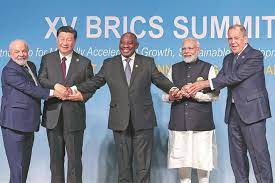 BRICS nations have a combined population of 3.23 billion and their combined GDP is more than US $ Dollar 23 trillion.
‘The BRICS may seem irrelevant because it hasn’t really moved the needle forward on its long-standing efforts to usher in viable economic alternatives to the US-led existing system,” says Michael Kugelman, deputy director at the Wilson Center think-tank in Washington,D.C.
But he adds that writing the BRICS off would be a mistake because of its collective economic might,” even though it often tends to punch below its weight.
Is a new bloc emerging to rival US dominance?
The announced expansion of the five-nation BRICS club of emergent economies was described as “historic” by Chinese President Xi Jinping, but it is not clear how far the countries’ common interests stretch.
The growth of BRICS “will further strengthen the force for world peace and development,” the president said while addressing the leaders gathered at a conference centre in South Africa’s commercial hub, Johannesburg.
Steve Tsang, director of London’s SOAS China Institute (School of Oriental & African Studies), says though the BRICS members do not have much in common on the surface, President Xi was trying to show his fellow bloc members that they all want a similar future: none of them want to live in a Western dominated world.
Professor Tsang noted further: “They can find an alternative direction of development without having to accept the conditionalities imposed by the democratic Americans and European powers.”
‘Building Partnership’
The host South African President Cyril Ramaphosa, beamed as he made the announcement about the new entrants.
“We value the interest of other countries in building a partnership with BRICS,” he said.
He went on to say that more countries would join in the future after the core nations agreed on criteria for membership.
Russia’s Virtual Participation
Russian President Vladimir Putin joined by video link from Russia because of the danger of being arrested over alleged war crimes in Ukraine.
In his remarks, he once again took aim at Western powers, saying their “neo-liberalism” posed a threat to the traditional multipolar world where no one country or bloc dominated.
Without naming names, it was clear who Putin was speaking about: the United States.
And though the super-power was not at the meeting, the US was talked about, or referenced, quite a bit.
The White House National Security Advisor Jake Sullivan attempted to play down the bloc’s expansion plans.
BRICS Expansion: A Threat to US Dominance or Sheer Optimism?
The economic bloc is set to expand with the admission of six new countries: Argentina, Ethiopia, Iran, Saudi Arabia, Egypt, and the United Arab Emirates (UAE).
This expansion aims to enhance the economic heft and global influence of the BRICS bloc, countering the influence of the US and Western allies. The expansion is significant in increasing trade share and political representation for member nations.
The expansion also raises questions about the group’s political ambition and its ability to represent the interests of the Global South effectively (Cryptopolitan).
On paper, the expansion of BRICS appears optimistic, but it entails inherent complexities. The decision-making process within such a diverse group is enviable fraught with difficulties.
New members could exacerbate one of the bloc’s weaknesses: a struggle to execute stemming from the consensus-based decision-making process. With 11 members instead of five, it will be even more difficult to reach a consensus. Or as C. Raja Mohan describes it, to turn “soaring rhetoric on global issues into concrete, practical outcomes” (Foreign Policy/South Asia Brief, Aug. 30).
Prior to this expansion, the bloc had to contend with divergent foreign policy and economic objectives.
The inclusion of nations with diverse economies and geopolitical stances has the potential to exacerbate these problems.
In an attempt to reshape the global world order and provide a counterweight to the United States and its allies, the BRICS group announced the admission of six new members.
However, the bloc’s vision remains unclear. This lack of clarity threatens the group’s ability to attain unity and influence.
With its expanded membership, the BRICS bloc has the potential to reshape global economic discourse. However, this potential is offset by inherent challenges stemming from member nations’ diverse economic objectives, geopolitical connections, and historical conflicts.
To genuinely challenge Western dominance and the supremacy of the US dollar, BRICS will need more than expansion; it will also need cohesion, a clear vision, and time.
A considerable number of more than 40 countries have demonstrated their inclination towards becoming members of the BRICS grouping or association [ It is definitely not an alliance, which is a formal agreement between two or more states to collaborate together on perceived mutual security issues ].
A subset of 16 nations has formally submitted applications for membership, including Algeria, Cuba, Indonesia, Palestine, and Vietnam.
China’s Ambitious Vision
China’s plans to reshape the global power dynamic were starkly evident when it spearheaded the expansion of the BRICS bloc.
It is attempting to usher in a changing landscape of economic powerhouses.
With a staggering 47 % percent of global population and 37 % percent of its GDP, the BRICS has positioned itself as a formidable counterweight. The tangible advantages are not just limited to numbers (Cryptopolitan).
The new behemoth bloc controls the majority of the world’s oil and gas resources and is richly endowed with a plethora of other natural assets. This is not just about economics; it’s about creating a seismic shift in the global power dynamic.
China’s audacious push isn’t solely aimed at the G-7. The international financial institutions are in the crosshairs too. Dominated for decades by the Western countries and Japan, the World Bank and the International Monetary Fund (IMF) might soon face an overhaul.
Beijing is advocating for a broader representation of emerging markets and developing nations, even in leadership roles. It’s a significant departure from tradition, where the World Bank has been led by an American and the IMF by a European.
The United Nations is another focus for reform. The UN, central to global governance in China’s view, has been pressed to reconsider its Security Council’s representation.
Presently, it’s limited to five permanent members, with China and Russia among them, and ten non-permanent members. Both BRICS members Brazil and India, along with other developing nations, are clamoring for a stronger presence at the top.
However, these new developments raises some fundamental questions.
All countries of the world are developing one way or another – whether in the social, economic, political or scientific spheres.
But in the economic sense, it would be inappropriate to consider Russia, China, India and Brazil as belonging to the “developing countries”. They belong, in fact, to the emerging economies.
In the geo-political sense, the first three are also great powers, and cannot belong rightly to the so-called “Global South”. Neither are they non-aligned.
BRICS Expansion & India
More members may grant China added influence on the global stage, but it also means more influence for BRICS itself. This is in India’s interests because it champions the causes of the Global South and contributes to multipolarity, two foreign policy priorities for New Delhi.
Half of the new members are top Indian partners: Egypt, Saudi Arabia, and the United Arab Emirates.
Moreover, most of the additions are from the Middle East, a growing arena for India’s engagement because of energy and trade interests and broader geopolitical considerations.
In fact, India has solidified its position because it enjoys strong ties with the Global South, largely because of its historic role as a leader of the Non-Aligned Movement during the Cold War.
It has been granted more clout with a set of nations with which it is keen to expand relations.
However, in a snub to Narendra Modi, Xi will be absent from the G-20 gathering this weekend. It could also be a sign that China in unwilling to confer more influence on its southern neighbour that boasts one of the fastest growing major economies while China’s slows.
In addition, Sino-Indian relations are worsening. India has protested after Beijing released a map that claims the north-eastern state of Arunachal Pradesh and the Aksai Chin plateau in Ladakh as Chinese territory.
Xi could as well be showing solidarity with Russia’s President Putin who is also not attending (Reuters, Sep. 4).
In addition, Xi may be fearing domestic threats to his personal control and that of the Chinese Communist Party (NYT, Sep. 5).
Emerging New World Order?
BRICS countries oppose the US-led unipolar world and would like to decentralize power in the global system.
In an interview with the German newsmagazine Der Spiegel, the eminent South American political scientist Matias Spektor (professor in Sao Paulo, Brazil, visiting fellow in Princeton), noted that BRICS leaders represent a different world order – one that is not centered on the US or the West, but has different centres. There is deep belief that multipolarity is a better deal (Aug. 28).
At the same time, Spektor concedes that history suggests that when there are many centres of power, the risk of conflict and war tends to increase. Multipolarity can only provide stability if there is an effective concert of great powers in place.
The Global South wants maximum flexibility. It doesn’t want to blindly follow the West nor do they want to tie themselves up with China. Consequently, many countries refused to side with Ukraine following Russia’s invasion of the country.
Whether such a strategy of “hedging” can be sustained depends on internal factors in the individual countries.
There is no doubt that Putin broke a fundamental rule of international law. That is why most countries of the Global South [ including Nepal ] also voted against Russia in the UN General Assembly.
At the same time, the Global South sees no fundamental difference between Russia’s behavior and the invasion of Iraq by the US without UN authorization.
As a matter of fact, the 25 strongest countries, which can be attributed neither to the West nor the Sino-Russian bloc, already surpass the economic output of the EU.
However, on a global scale, these countries’ interests diverge too greatly.
There is no concerted movement in the Global South to reform the UN Security Council, the World Trade Organization (WTO) or the IMF for starters. Even the BRICS bank based in Shanghai is not centred on values.
According to Spektor, there is no moral authority in the Global South that can be compared to the Non-Aligned Movement (NAM) of the 1950s and ‘60’s and its fight for self-determination.
The writer can be reached at: shashipbmalla@hotmail.com
The views expressed in this article are the author’s own and do not necessarily reflect People’s Review’s editorial stance.

Login to add a comment