







By Nirmal P. Acharya
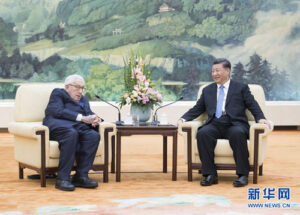
On July 19, Dr. Henry Kissinger, a centenarian, traveled thousands of miles to China.
Fifty-two years ago, Dr. Henry Kissinger, then National Security Adviser to the President of the US, flew from Pakistan to the Himalayas for a secret visit to Beijing and started the process of normalizing Sino-US relations.
Fifty-two years later, China and the US are engaged in a fierce game. The US has launched a trade war, a technological war, a financial war, and a public opinion war on the issue of Xinjiang while launching a color revolution in Hong Kong and promoting “Taiwan independence” in Taiwan. None of this has shaken China. Then the US Secretary of State, Treasury Secretary, and climate envoy were consulted rather than invited to visit China in succession, while the US defence secretary’s request to meet his Chinese counterpart was rebuffed. It was against this backdrop that Kissinger, a centenarian, travelled a long way to visit China.
In response, one of the comments that can be seen in the Chinese media is that Kissinger’s visit to China is intended to “persuade surrender.”
There is some truth to this. “Neither China nor the US can afford a confrontation between them,” Kissinger told Chinese leaders in Beijing. However, from the media, there is no evidence that Kissinger has made the same admonition to American leaders, so it can be judged that his admonition that “we cannot afford the consequences of confrontation between the two countries” is mainly aimed at China, and it smells of “persuasion”.
I think Kissinger’s willingness to go to China to “persuade them to surrender” marks the beginning of a new phase of the Sino-US game, that is, from the stage of the US attack and China defence to the stage of strategic stalemate.
With the Sino-US confrontation entering the stage of strategic stalemate, the Sino-US struggle around the MCC will also enter a new stage. In response to the frequent visits to Nepal by important US officials to implement the MCC, Wang Xiaohui, Secretary of the CPC Sichuan Provincial Committee, and Yuan Jiajun, member of the CPC Political Bureau and secretary of the CPC Chongqing Municipal Committee, also followed.
The strategic stalemate between China and the US has provided favorable conditions for Nepal to implement the “interpretative declaration” of the Parliament on the MCC. Where the MCC violates the interpretative Declaration of the Nepali Parliament in the process of implementation, Nepal can and should prevent it.

Login to add a comment