








* American Democracy Under Attack
* Sudan Truce Amid Civilian Scepticism
* Zelensky’s Gambit: Ukraine’s Counteroffensive Starts

By Shashi P.B.B. Malla
US Politics: Trump, the Republican Party & the Future of American Democracy
Donald Trump in Legal Jeopardy
Former President Donald J. Trump is facing criminal charges in federal court, after an investigation into his handling of classified [secret] documents after leaving the White House at the end of his tenure.
He may go on trial and could be sent to prison.
Many Americans [ and very many more around the world ] may feel exhilarated by this prospect, since justice may finally be done.
Such a development has not happened in the history of the United States.
And as the New York Times columnist Damon Linker has written: “Trump’s legal jeopardy shouldn’t blind people to the political jeopardy that now confronts the nation” (June 10-11).
The United States today is a deeply divided nation domestically and highly polarized politically. One can almost say that it is divided into two mutually exclusive and warring tribes.
On the face of it, American legal processes establish and maintain legitimacy by the appearance of impartiality.
However, Trump’s longstanding claim is that he’s the victim of a politically motivated witch hunt by progressives, elitist establishment, ‘the deep state’, Democrats in power – what have you.
The unfortunate part is that Trump’s sizable, ardent Republican followers believe him unquestionably, and most of his primary opponents in the presidential race add fuel to the fire by supporting this line of attack.
Match-Up with Biden also Hazardous
Many Democrats could argue that what’s good for Trump in the primaries [ pre-election competition among candidates to nominate the final challenger ], will be terrible for him in the general election.
But the fact remains that in the “era of stark partisan polarization and intense negative partisanship” (Damon Linker), nothing is certain.
It’s not plain sailing for Joe Biden with persistently low approval ratings whose advanced age has become an election issue even with Democratic voters.
Thus, anyone who becomes one of two major party nominees has a definite shot at winning the White House.
The vicissitudes of the American presidential electoral process, including the volatility of the final Electoral College, makes the outcome highly unreliable.
God help America – and the world – if Trump [ the Evil Incarnate, like his admired Vlad ] is again elected as the most powerful man on the earth!
Truce & Fighting Among Sudan’s Warring Factions
The fighting among the warring factions of the regular army and the militias of the Rapid Support Forces (RSF) are now about to enter the third month (AFP/Agence France Presse, June 10).
This is because both factions are convinced that they can still gain the upper hand, and because so much – money and prestige – is at stake.
A 24-hour ceasefire took effect today between Sudan’s warring generals – Abdel Fattah al-Burhan and his former deputy Mohamed Hamdan Daglo — but, with fears running high it will collapse like its predecessors, US and Saudi mediators warn they may break off reconciliation efforts.
Civilians trapped in the battlegrounds in greater Khartoum and the flashpoint western region of Darfur are desperate for relief from the continuing bloodshed but, at the same time, deeply skeptical about the sincerity of the rapacious generals.
“The situation is catastrophic in parts of Darfur,” said Toby Harward, the coordinator for the UN refugee agency. “Its people are living in a dystopian nightmare where there is no law and order” (NYT, June 13).
Multiple truces have been agreed and broken since fighting erupted on April 15.
Washington had slapped sanctions on both rival generals after the last attempt collapsed at the end of May, but to no avail.
Clearly more rigorous and effective methods are needed.
Sudan specialist Aly Verjee, a researcher at Sweden’s University of Gothenburg, said he saw little reason why this truce should be honoured any more than its predecessors.
Verjee said: “Unfortunately, the incentives have not changed for either party, so it’s hard to see that a truce with the same underlying assumptions, especially one of such short duration, will see a substantially different result.”
Toll of the Fighting
Upwards of 1,800 people have already been killed in the fighting.
Nearly two million people have been displaced, including nearly half a million who have sought refuge in neighbouring countries, the United Nations said.
The Saudi and US mediators said they “share the frustration of the Sudanese people about the uneven implementation of previous ceasefires.”
These mediators have clearly failed in their endeavor, and the international community has also not succeeded in proposing an accountable and enduring response to the ongoing fighting.
Evidently, the ‘way of ceasefires’ has led to a dead end, and a more robust response – perhaps from other actors is needed.
The African Union and the United Nations could get their act together and send heavily armed ‘UN Peace-Keeping Forces’ to the country as soon as possible.
This is all the more pressing since the cul-de-sac has complicated the coordination of international efforts to deliver emergency relief to the 25 million civilians that the United Nations estimates are in dire need.
The European Union (EU) is willing to pay Tunisia 900 million Euros in order to prevent refugees and asylum-seekers from entering the European continent.
A better strategy would be to help suffering people from Africa – like in Sudan – to stay in their own countries. This also entails taking more interest and action in African conflicts – including conflict management and conflict resolution.
The EU is just taking the easy way out by taking short-term measures – physically preventing refugees from crossing the Mediterranean Sea with cash benefits for some North African (authoritarian) states; instead of seeking long-term measures – such as a quick and lasting solution of the ongoing Sudan conflict.
Finally Ukraine’s Counteroffensive Begins
Ukraine’s long-awaited counteroffensive has finally started – not in spring, but early summer. Its armed forces now have a window of opportunity of about four months until autumn to throw out the Russian invaders – ‘Ruskies go home!
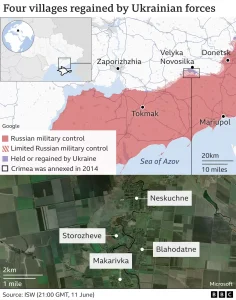
Ukraine says it has liberated four villages in the south-east of the country in its first victories (BBC, June 12).
It was during the previously unannounced visit of Canadian Prime Minister Justin Trudeau on Saturday – his second to Ukraine since Russia’s brutal invasion in February last year – did it become clear that Ukraine’s attacks on Russian positions were well under way.
Ukraine’s military reported intense fighting with Russian forces on a broad front.
Russian forces had previously pummeled Ukraine with missiles and drones overnight resulting in deaths and damage to a military airfield.
Putin’s Reaction
A day earlier, Russian President Vladimir Putin expressed his view that Ukrainian forces had started their long-expected counteroffensive and were suffering “significant losses” (AP/Associated Press, June 10).
Putin, of course, left unsaid that he had ordered the explosion of the Kakhovka Dam on the Dnieper River days earlier in order to delay and hamper that very Ukrainian attack.
Breach of the Kakhovka Dam
The premediated destruction of the Kakhovka Dam has forced thousands of people to flee flooding.
It also sharply reduced water levels in a reservoir used to help cool the Zaporizhzhia Nuclear Power Plant, Europe’s largest, upstream of the Dnieper River.
Employees of Energoatom, the Ukrainian nuclear agency, were still working at the power plant, although it remains controlled by the Russian military.
Energoatom said that there was ‘no direct threat’ to the Zaporizhzhia due to the dam breach but had shut down the final reactor due to greatly reduced cooling water, and also because of shelling near the site that has damaged overhead lines connecting the plant to Ukraine’s energy system.
Fast-moving Disaster, Slow-moving Ecological Catastrophe
The willful destruction of the Kakhovka Dam by the Russians has quickly resulted into a fast-moving disaster that is swiftly evolving into a long-term environmental catastrophe affecting drinking water, food supplies and ecosystems reaching into the Black Sea (AP/Associated Press, June 11).
The short-term hazards can even be seen from outer space – tens of thousands of parcels of land flooded, and more to come.
For every flooded home and farm, there are fields upon fields of newly planted grains, fruits and vegetables whose irrigation canals are drying up.
Hundreds of thousands of fish were left gasping on mud flats.
Fledgling water birds lost their nests and their food sources.
Countless trees and plants were submerged.
If water is life, then the draining of the Kakhovka reservoir creates an uncertain future for southern Ukraine that was an arid plain until the damming of the Dnieper River 70 years ago.
Experts say the long-term consequences will be generational.
Ukraine’s Deputy Foreign Minister Andrij Melnyk called the destruction of the dam “the worst environmental catastrophe in Europe since the Chernobyl disaster” [ the meltdown of the atomic power plant in the north near the border to Belarus ].
The Stakes of an Ukrainian Victory
Paul Krugman, a Nobel Laureate in Economics, is of the opinion that the stakes in Ukraine are very high (NYT, June 7).
If Ukraine’s counteroffensive succeeds, the forces of democracy will be strengthened around the world, not least in America [ Donald Trump and the “Putin wing” of the Republican Party has long admired Russia’s authoritarian regime and its intolerance ].
If Ukraine fails to trounce the Russian occupying forces, it will be a disaster not just for Ukraine but for the world.
The world’s dictators and strongmen will be encouraged.
Western aid to Ukraine may dry up.
Putin may finally achieve the victory most people expected him to win in the war’s first few days.
He may achieve his neo-imperialist agenda – a new evil empire.
The brave people of Ukraine will have suffered and endured in vain – an unimaginable and terrible prospect.
But the Ukrainians have made a bold and brave start and it does indeed seem to be the beginning of the end of Russia’s infamous occupation of Ukraine, and also an inglorious termination of Vlad’s neo-imperial ambitions.
The writer can be reached at: shashipbmalla@hotmail.com

Login to add a comment