







By Our Political Analyst
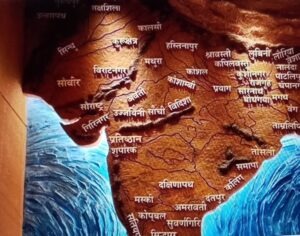
Kathmandu, 10 June: Indian minister for external affairs S. Jaishankar has attempted to play down the political significance of a mural in India’s new parliament building that is in fact a map purporting to show the territory of Akhanda Bharat (Greater Bharat) that includes present-day Afghanistan, Pakistan, the Maldives, Sri Lanka, Myanmar and Nepal.
Jaishankar did so by suggesting that the mural was essentially a depiction of the boundaries of the cultural influence of ancient India and should not be viewed via a political lens. Incidentally, PM Prachanda, while attempting to quell opposition to the same in parliament, after his India visit, has also explained that his Indian counterpart, PM Narendra Modi, has assured him that the mural was a cultural art form, sans political import.
It may be noted that PM Prachanda did not visit the new Indian parliament during his recent Indian trip, as confirmed by Foreign Minister N.P. Saud in Biratnagar the other day.
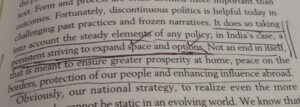
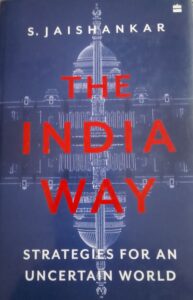
While vigorous objections were raised over the Akhanda Bharat mural in Nepal, Pakistan and Bangladesh, what needs to be noted is that a very different picture emerges from a reading of Jaishankar’s book, “The India Way”, wherein he explains that India needs a bolder approach to foreign policy that has been the case in the past – one that is “appropriate for a civilizational power that seeks to reclaim its place on the world stage.”
In the chapter, The Dogmas of Delhi, for example (p. 73), Jaishankar emphasizes that India needs to tackle challenges to past practices by “a persistent striving to expand space and options. Not an end in itself, that is meant to ensure greater prosperity at home, peace on our borders, protection of our people and enhancing influence abroad.”
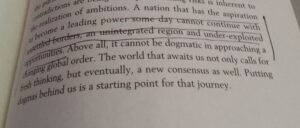
While Jaishankar’s ardent desire that India should “expand space and options” is uncomfortably redolent of Hitler’s persistent strive for ‘Lebensraum’ (or, living space) – at the cost of the then Soviet Union – another excerpt (p.105) of the same chapter is worth mulling over, in the context of India making it a point to install, and robustly defend, the controversial mural depicting Akhanda Bharat, discussed above.
It goes: “A nation that has the aspiration to become a leading power someday cannot continue with unsettled borders, an unintegrated region and under-exploited opportunities.”
The political significance of the Akhanda Bharat mural in the new Indian Parliament thus cannot be wished away. After all, a parliament is a wholly political institution – not a cultural one.

Login to add a comment