








 By Nirmal P. Acharya
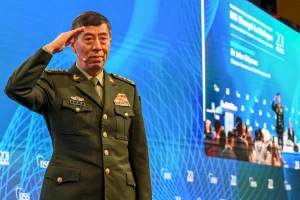
Last week, Chinese defense minister General Li Shang-fu denied a formal meeting with his American counterpart, US defence secretary, Lloyd Austin, at the 20th Shangri-La Dialogue in Singapore.
In my observation, China’s behavior at the Shangri-La Dialogue signaled a shift from defensive to an offensive military posture toward the US in the Asia-Pacific region.
First, on the eve of the Shangri-La Dialogue, China sent a J-16 fighter jet to intercept an American reconnaissance plane, the RC-135, which was conducting close surveillance over China, and its exhaust caused the American plane to sway. To this end, the US once again proposed contact and talks with the Chinese military, but the Chinese side explicitly refused.
Second, Chinese Defense Minister General Li’s speech at the conference was offensive and judgmental. He began by asking, “Who is trying to disrupt the Asia-Pacific? Who is the source of trouble?” He continued, “Where the hand of hegemony is extended, there will be no peace. A major power is prone to unilateral sanctions, coercion by force, color revolutions and proxy wars. Mess up a region and then walk away, leaving a mess behind.” Li also criticized the Indo-Pacific strategy. “The ‘Indo-Pacific strategy’ is an attempt to NATalize the Asia-Pacific by drawing lines from ideology, building exclusive military alliances with imaginary threats, kidnapping other countries in the region and promoting conflict and confrontation,” he said.
Finally, of course, there is the question of Taiwan. “The Chinese military will defeat the attempt to separate Taiwan and will not hesitate a bit,” Li said.
On June 3 an American destroyer and a Canadian frigate sailed through the Taiwan Strait. According to reports, the Chinese vessel was hurtling towards the US vessel, which slowed down and changed course when it came within 150 yards.
With that said and done, the pattern of military confrontation between China and the US in the Asia-Pacific region is clear.
The MCC is part of the US Indo-Pacific strategy and this is officially announced by the US. Although our authorities have denied this, the MCC agreement stipulates that it is not subject to the management, audit and jurisdiction of Nepal. What is the significance of the Nepalese government’s unilateral denial?
If the MCC suddenly shows military action against China as required by the Indo-Pacific strategy, it will put Nepal at a big risk.

Login to add a comment