







By Our Reporter
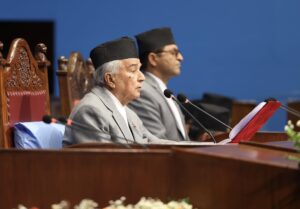
The government has announced to formulate of the sixteenth periodic plan (a five-year plan beginning from the next Fiscal Year 2024/25) with a long-term vision of socio-economic transformation following the framework of an egalitarian and socialism-oriented economy in its policy document for the coming fiscal year unveiled by President Ramchandra Paudel in the joint session of the Federal Parliament on Friday.
The government also pledged to restructure the National Planning Commission (NPC) and develop it as a central agency for policy, planning and monitoring.
“Fiscal federalism will be effectively implemented, and fiscal transfers will be made based on expenditure needs and revenue capacity. Such transfers will be linked to the performance of the respective sub-national government,” read the policy document.
Strict control on revenue leakage and receiving remittance through formal channels was the policy of the government.
Arrangements will be made to prevent a liquidity crunch in the market and the availability of idle funds at the provincial and local levels, according to the policy and programmes.
According to the new policy document, development projects will be completed within the stipulated time, cost and quality. The budget will be allocated only for projects that have completed all the stages of project preparation.
“Priority will be given to the implementation of national pride projects and transformative projects.,” read the document.
Similarly, the policies and programmes have prioritised making the national security system effective and reliable by developing and expanding the digital security system of the country.
The security agencies will be empowered by using modern technology to control all types of criminal activities including terrorism and organised crime, financial crime, loan sharks, violence, cyber-crime, and drug trafficking.
The government has aimed at bringing all newly built prisons in the country into operation within five years to ease the overcrowding situation in the prisons.
Similarly, the government has planned to establish a separate high-level judicial administration reform commission to make justice faster and less costly.
Similarly, intensifying and implementing the anti-corruption campaign, the policy of zero tolerance against corruption more strictly at all levels and structures of the state are included. Likewise, the National Vigilance Centre under the direct supervision of the Prime Minister will be activated by providing the necessary manpower and technology to address the complaints of the people, it read.
The policy document has also given priority to mitigating the effects and impacts of climate change.
It also aimed to develop Pashupati and Lumbini shall be developed as hubs for spiritual study and conservation.
The government has also aimed to brand Nepal as a tourism destination with natural and cultural beauty that is “for everyone, everywhere and every time”.
It has reiterated its commitment to building an international airport at Nijgadh when the government has failed to bring two newly built airports into operation.
There are other commitments in the 188-point policy document.
However, the document has drawn criticism not only from the main opposition party but also lawmakers from the ruling parties. UML chair KP Oli termed it confusing and demanded it is rewritten while the lawmakers from ruling parties termed it traditional and the Rastriya Swatantra Party said it was the copy-paste of previous policy documents.

Login to add a comment