







By Durga D. Poudel, Ph.D.
The Great King Prithvi Narayan Shah (1723-1775 AD) from Gorkha led the grand campaign for the creation of modern Nepal. His campaign unified small states known as “baise chaubise rajyas” in the Gandaki and Karnali regions, three Malla kingdoms in Kathmandu Valley, three Sen states in the south-eastern Terai, and the kingdoms of Mustang and Gorkha. King Prithvi declared the creation of modern Nepal on September 25, 1768 AD. He moved the capital from Gorkha to Kathmandu. The regional geopolitical environment during King Prithvi’s reign was very tense and fragile due to the internal disputes and wars among the baise chaubise rajyas and the expansion of the British East India Company in the eastern provinces of India. Realizing the need for a unified large nation to protect the region against the British East India Company, King Prithvi initiated the campaign of national unification by conquering Nuwakot in 1744 AD, just one year after ascending to the throne of Gorkha in 1743 AD. King Prithvi continued Nepal’s unification campaign until his death in 1775 AD. After King Prithvi, his daughter-in-law, Queen Rajendra Laxmi, continued the expansion of unified Nepal with extraordinary courage. King Prithvi’s son, Bahadur Shah, who was the guardian of King Rana Bahadur Shah from 1785 to 1794 AD, was able to fulfill his father’s dream of national unification by expanding Nepal’s territory three times its current size. Nepal’s territory expanded from the Sutlej River in the west to the Teesta River in the east. Large stretches of current northern India were within Nepal’s territory. Because of various reasons including the growing Gorkha Empire and the rejection of the British in Nepal, the British East India Company launched a full-fledged war against Nepal in 1814 AD. Nepal was attacked from five different locations consisting of over 24,000 British soldiers, heavily equipped with arms and ammunition. This was a huge challenge for Nepal as the nation was still in the process of consolidating newly acquired territory as well as improving governance and the military. Despite being very small in size and poorly equipped compared to the British forces, the Gorkha army fought the wars bravely on all fronts. The Anglo-Nepal war ended with the British-crafted Sugauli Treaty in 1817 AD, and took almost one-third of Nepal’s land into India. Following the Sugauli treaty, Nepal fell under British political influence. No foreigners could be hired as advisors by Nepal, and no foreign embassies were allowed to be stationed there.
From 1847 to 1950 AD, the monarchy was controlled by the Rana rulers, who developed good diplomatic ties with the British. The Ranas even supported the British in the First and Second World Wars by sending thousands of Nepalese troops. To establish a democracy in Nepal, King Tribhuvan left the palace with his family on November 6, 1950 AD, and went to the Indian Embassy. Prince Gyanendra was left behind when the King left his palace. Subsequently, the Rana regime declared Prince Gyanendra as the King of Nepal on November 8, 1950 AD when he was just three and half years old. On November 10, 1950 AD, India sent two aeroplanes to Kathmandu and brought King Tribhuvan and his family to India. Then, the Nepali Congress declared an armed struggle against the Rana rule. On February 12, 1951 AD, the Rana, Nepali Congress, and Indian Government agreed to the “Delhi Samjhauta”. Accordingly, King Tribhuvan returned to Nepal on February 15, 1951 AD, and declared democracy in Nepal that ended 104 years of the Rana rule on February 18, 1951 AD.
Following the 1990 people’s uprising in Nepal demanding multiparty democracy, which was launched on February 18, 1990 AD, King Birendra lifted the 30-year-old ban on political parties and announced a multiparty democracy with a constitutional monarchy on April 8, 1990 AD. The Nepali Congress leader, Krishna Prasad Bhattarai, led the interim government. The 1990 Nepal Constitution was promulgated on November 9, 1990 AD, which was accepted by all political parties and the public in the country. Part 1, Article 4 of the 1990 Constitution declared Nepal as a Sovereign Hindu Constitutional Monarchical Kingdom, thus, constitutionally declaring Nepal as the only Hindu state in the world. It was expected that this new constitution would unite all Nepalese under the multiparty democracy, enhance national integrity, and accelerate economic growth. Unfortunately, it did not happen. Instead, Nepal fell into a devastating 10-year-long Maoist War. While King Birendra showed remarkable benevolence to the country through grassroots development, stayed tough against foreign intervention, declared multiparty democracy and remained firm on multiparty democracy, most of the political parties started spreading baseless criticisms, false rumors, and propaganda against the monarchy in Nepal. As a result, the Maoist War began in 1996 AD and lasted for 10 years. It claimed 17,000 lives, much loss of property, economic devastation, coercion and disappearance of many people. It left the Nepalese society traumatized and extremely divisive. The deep-rooted fear of coercion, abduction, killing, and intimidation during the war still has not been removed from the minds of Nepalese. Of the reported 63,718 cases with the Truth and Reconciliation Commission, only 3,787 cases had gone through preliminary investigation by the middle of 2023 AD.
The Royal Palace massacre that occurred on June 1, 2001 AD was an inhumane and unbelievable tragedy for the Nepalese royalty. King Birendra and his family members, as well as many others who were present at the family gathering in the Palace, were killed. The whole world was shocked by this tragedy. This unfortunate incident has left a very deep scar on Nepalese minds, and the common people still demonstrate full respect and deep sympathy for King Birendra and his family. There were some political parties and their leaders who advocated for republican order and who condemned and criticized the Nepalese monarchy as feudal power. Most common citizens believed monarchy was a symbol of unity and the protector of Hinduism. King Gyanendra ascended to the throne in 2001 AD. As Nepal had gone through the Maoist war for 10 years, the immediate task for King Gyanendra was establishing law and order in the nation and restoring peace. As the political complexity worsened, King Gyanendra dismissed the parliament that was elected in 1999 and appointed Sher Bahadur Deuba as the Prime Minister on 26 July 2001 AD. Due to rising political complexities, on May 2002 AD, Prime Minister Deuba requested that the King dissolve the parliament and hold fresh elections. Accordingly, King Gyanendra dissolved the parliament on Wednesday, May 22, 2002 AD and declared fresh elections to be held on November 13, 2002 AD. On October 4, 2002 AD, King Gyanendra dismissed the Deuba government because PM Deuba failed to hold the election scheduled for November 13, 2002 AD, and had requested the postponement of the general election. A new government was formed under the premiership of Mr. Lokendra Bahadur Chand in October 2002 AD which lasted until June of 2003 AD. This was followed by PM Surya Bahadur Thapa’s government which lasted from June 5, 2003 to June 4, 2004 AD. On June 4, 2004 AD, Deuba was reappointed as Prime Minister by King Gyanendra. However, the nation continued going through an extremely fluid political situation. On February 1, 2005 AD, King Gyanendra dismissed the Deuba government for the second time and took the nation under his direct rule. There were widespread protests against the King’s direct rule.
The 12-point Delhi agreement between the Maoists and the Seven Party Alliance (SPA) on 22 November 2005 AD, in New Delhi, India, is the most important political agreement in the past 20 years. However, it has raised serious questions about the national integrity of Nepal. The 12-point agreement signed in New Delhi included: 1) Ending of the autocratic monarchy, 2) Reinstatement of the 1999 parliament, 3) Election to Constituent Assembly by having UN or a dependable international body for arm monitoring of Maoists and Royal Nepal Army and to ensure free and fair Constituent Assembly (CA) election, and 4) Communist Party of Nepal-Maoist (CPN-Maoist) accepting multiparty democracy, returning seized lands and properties by the Maoists, not repeating the past mistakes by both the political parties and the Maoists, respecting human rights and freedom of the press, boycotting the Municipal and the Parliamentary Polls set by the Nepal Government, launching people’s movement, and taking actions against the guilty parties. Having this agreement in Delhi was an open blow to the national integrity of Nepalese society. It shows that Nepalese political parties and their leaders were not capable of making major political decisions by themselves on Nepalese soil. The impact of the 12-point Delhi agreement on Nepalese society is going to last for a long time and could even be amplified in the years to come if not corrected. In April 2006 AD, Jana Andolan II (People’s Protest II) started, and it eventually caused the King to reinstate the 1999 parliament through a televised national address on April 24, 2006 AD. On May 18, 2006 AD, the reinstated parliamentary government severely stripped the King’s power, and, to the surprise of most Nepalese citizens, Nepal was declared a secular state. Through the amendments of the interim constitution, again to the surprise of most Nepalese, the Seven Party Alliance (SPA) and the Maoists declared Nepal a federal nation. The “Comprehensive Peace Agreement, 2006”, which was signed by then Prime Minister Girija Prasad Koirala and Maoist Chairman Pushpa Kamal Dahal, alias Prachanda, on November 21, 2006 AD, concluded the 10-year Maoist War. Several provisions included the promulgation of the “Interim Constitution of Nepal 2006”, which would be exercised until the new constitution would be written through the future Constituent Assembly. While some people gave the benefit of the doubt to the Maoists expecting that they would develop the country and give equal rights to disadvantaged people, it was not clear to many Nepalese that the Maoist war had directly targeted the 1990 Constitution of Nepal, which had embraced multiparty democracy, the constitutional monarchy, and a Hindu state. The Maoist war created several problems including a lack of law and order, political instability, increasing unemployment, degradation of natural resources, massive outmigration of rural population, congestion of the cities, economic problems, and increased foreign activities that threatened national independence and sovereignty. After completing the CA election on April 10, 2008 AD, the parliament voted against the Monarchy and declared Nepal a republican state on May 28, 2008 AD. On June 11, 2008 AD, King Gyanendra briefed the press stating that he accepted the CA’s decision. King Gyanendra declared that he had no property outside Nepal, asserted that he loved Nepal and Nepalese people, and did not want to leave Nepal. He left the Narayanhiti Palace for his temporary residence in the Nagarjun Palace, ending the 240 years of the monarchical institution in Nepal.
Stating Nepal as a “yam between two boulders”, King Prithvi proclaimed Nepal as a non-aligned nation more than 247 years ago. The very geopolitical situation of Nepal between two emerging global powers, China and India, prohibits Nepal from taking the side of any power bloc. Nepal’s foreign policy very well resonates form the basic teaching of Sanatan Hindu Dharma- Vasudeba Kutumbakam, meaning, the whole Vasudha (the whole Earth) is one family, and life is an opportunity to serve your own family and this whole world. Nepal is one of the 23 founding members of the Non-Aligned Movement (NAM), which was established in 1961 AD with the purpose of not aligning a nation with any power bloc in the world, following the cold war between then USSR and the USA. There are 120 countries in the NAM forum. The relevance of NAM for a small country like Nepal is even more important today as a new multi-polarized world is emerging.
Nepalese society consists of diverse ethnicities, religions, languages, cultures, traditions, and music and food festivities. Ethnic communities are scattered across the country from the flat land of the Terai to the rolling mid-hills and the majestic Himalayan region. Nepalese society is a multicultural and multiethnic society in which hundreds of ethnicities coexist in harmony and show a great deal of mutual respect. Similarly, there are more than one hundred languages spoken as a mother tongue in Nepal. King Prithvi correctly said in Nepali that “Nepal Char Jaat Chhattis Barnako Sajha Fulbari”, meaning, Nepal is a common garden of four castes and thirty-six ethnicities. Hinduism is followed by 81.3% of the total population. Buddhism, Kirat and Islam are followed respectively by 9.0%, 3.0%, and 4.3% of the total population, and the rest include other religions such as Christianity. There is a strong tolerance among the various religious groups and ethnicities in Nepal.
Nepal is endowed with vast natural resources including water, forest, minerals, medicinal and aromatic plants, and wildlife. More than 6,000 rivers and streams, fertile land of the Terai, cultivable land in the mountains, highly productive natural pastureland in high altitude areas, and mineral reserves are valuable natural assets of the country. Forests and wildlife include additional natural resources which could be utilized for sustainable economic development. Nepal is blessed with unique climatic conditions. One can experience tropical to alpine and tundra climatic zones in a short distance of 300-400 km from south to north. Nepal is a destination for tourists worldwide. Being located between two large countries, China and India, Nepal has unique opportunities for foreign trade. As China and India are currently the second and fourth largest economies in the world, Nepal needs to be able to take advantage of these growing economies. Despite vast natural resources and large neighborly markets, Nepal is struggling with many challenges including food security and nutrition, healthcare facilities, law and order, corruption control, employment generation, economic development as well as environmental and climate concerns. Poverty is rampant and more than four million families are landless.
Political instability has become a major problem in Nepal. Nepal has witnessed twenty-eight governments in the past thirty-three years. Political instability has seriously hindered the economic development of the country. There is a massive outmigration of Nepalese youths for education and employment outside the country as well as the devastation of agriculture, rampant corruption, and an increase in foreign debt due to slow economic growth and poor financial conditions. Political parties are continuously engaged in power struggles, thus ignoring developmental activities. For these reasons, I urge the Nepalese people to adopt the following roadmap:
Fostering patriotism in the country.
Nepalese politics is dominated by the principles and philosophies that either closely match with the southern neighbor India (i.e., multiparty democracy, Westminster parliamentary system, and federalism) or the northern neighbor China (i.e. communism). Three large political parties in Nepal include the Nepali Congress, the Communist Party of Nepal (Unified Marxist-Leninist) and the Communist Party of Nepal (Maoist Center). Also, there are several small/emerging political parties involved in governance. Political parties have failed in giving political stability to the country as evidenced by twenty-eight governments in the past thirty-three years. They have failed to deliver much-needed basic education, health services, electrification, employment, environmental quality, drinking water supply, and food security. Therefore, it is urgent to foster strong patriotism and develop a political governance system which is compatible with Nepalese society. It will advance Nepal on all fronts including political stability, economic development, education, health, employment, food and water security, energy supply, industrialization, environment and climate security, and protection of the national sovereignty and integrity. There is a widening income gap between the haves and the haves-not in society. We need to give high priority to the employment generation, as well as free education, healthcare, and drinking water. There is a need to safeguard national sovereignty and territorial integrity, promote national identity, enhance pride, and protect democracy and people’s rights.
Initiating discussion about the implementation and effectiveness of incorporation of secularism, federalism, and proportional electoral system in the 2015 Constitution of Nepal. Cultural freedom, traditions, values, and norms practiced by the majority of the population must be recognized by the state. Nepal has 761 governmental entities in three tiers; federal, provincial, and local, with symmetrical power sharing. It is clear now that there is a heavy burden, especially for the local and provincial governments, to exercise their exclusive power. Because of the inability of the federal government to frame necessary policies, laws, and standards, the concurrent powers shared by the three-tier governments have not been exercised over such aspects as price control, quality monitoring of essential goods and services, drugs and pesticides, social security and employment, industrialization, poverty alleviation, education and health, agriculture, clean drinking water supply, fertilizer and seed, irrigation, and disaster management. Similarly, instead of representing marginalized communities, women, Dalit, Madhesi, Muslims, indigenous people, and backward regions, the proportional electoral system has favored the representation of the creamy layer, rich people, and the relatives of top political party leaders. It has not been accessible to the truly marginalized and vulnerable groups due to nepotism, corruption, and lack of direct contact with political leaders. Nepalese society is looking for an inclusive, meaningful, and practical political system that would safeguard national sovereignty, promote democracy, cultivate national integrity, support accelerated economic growth, generate income and employment, and enhance social justice. According to the Constitution of Nepal, the governments at the federal, provincial and local levels are responsible and accountable to the respective parliaments, and the parliamentarians are responsible and accountable to the people. However, in practice, the governments have been ignoring the parliamentary processes. Therefore, there is an urgent need for a constitutional amendment so that a government is directly responsible and accountable to the people through a directly-elected Prime Minister.
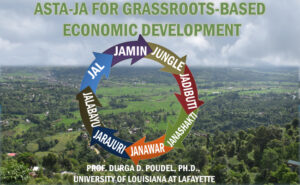
3) Adopting the Asta-Ja Framework for self-reliant development, accelerated economic growth, environmental and climate security, and fast-paced socio-economic transformation. The Asta-Ja Framework is an all-encompassing and unifying planning and management tool for the conservation, development, and sustainable utilization of natural and human resources in Nepal. The Asta-Ja Framework contains eight elements, Jal, Jamin, Jungle, Jadbuti, Janashakti, Janawar, Jarajuri and Jalabayu. The Jalabayu constitutes the pivotal element in Asta-Ja. The eight principles of the Asta-Ja Framework offer guidelines for its implementation. These eight principles are, 1) Community awareness, 2) Capacity-building, 3) Policy-decision making, 4) Interrelationships and linkages, 5) Comprehensive assessment of Asta-Ja resources, 6) Sustainable technologies and practices, 7) Institutions, trade and governance, and 8) Sustainable community development. Asta-Ja relates to the strong asta concept of Vedic society. In the Vedic society, prosperity is manifested by eight Laxmi (the Goddess of wealth and happiness) called Asta-Laxmi. Asta-Laxmi includes the Adi Laxmi, Dhanya Laxmi, Dhana Laxmi, Santana Laxmi, Gaja Laxmi, Vijaya Laxmi, Dhairya Laxmi, and Bidhya Laxmi. The Janshakti is the key element that any government has to emphasize for its development. There are many asta concepts in the Vedic Hindu society including Astachirinjibi, Astanga Yoga, Asta Murti, Asta Dhatu, and Asta-Vinayak. For its practical application as a planning tool, I have developed an Asta-Ja Log Frame which consists of an eight-by-eight matrix of Asta-Ja and the principles of Asta-Ja. The Asta-Ja Framework is a grassroots-based planning and development approach for prosperity and environmental sustainability.
4) Adopting Nepal Vision 2040, which I developed considering Asta-Ja resources and the current socio-economic challenges of the country. The Nepal Vision 2040 aims to elevate Nepal to the par of a developed nation by 2040. It identifies nine strategies for accelerated economic growth and the fast-paced socio-economic transformation of Nepal. They are: 1) Achieve food self-sufficiency, 2) Rely on renewable energy resources, 3) Attract thirty million tourists annually, 4) Export organic foods, medicinal and aromatic plants, and other products, 5) Control corruption, 6) Develop infrastructure, 7) Enhance community resiliency, 8) Provide social services, and 9) Conserve, develop, and utilize Asta-Ja resources.
Nepal is an agricultural country. Nepal is endowed with more than 4.26 million hectares of agricultural land with diverse agroecological conditions giving possibilities for year-round production of crops in the country. Nepal’s mountains act as natural barriers to the spread of crop pests and diseases giving a competitive advantage for organic agriculture and seed production. In recent years, Nepal’s agriculture is experiencing a serious downward spiral showing low crop productivity, land degradation, abandonment of agricultural lands, and increasing dependence on foreign countries for food supply. It is odd in a country where 69 per cent of the total population is engaged in agriculture that food self-sufficiency is such a great problem. I have identified five drivers for sustainable food self-sufficiency. They include: 1) Sustainable commercialization of smallholder mixed-farming system, 2) Incentivized individual farmers, trader, supplier, and agro-entrepreneur, 3) Pro-poor market, 4) Strategic public investment in infrastructure, and 5) Comprehensive policies and programs, rules and regulations, and trade agreements. For food self-sufficiency and agricultural sustainability in Nepal, it is critical to protect agricultural land, enhance farm productivity, provide farm services, and establish facilities for the collection, processing, storage and distribution of agricultural products. The government must guarantee the purchase and price of agricultural produce. It is also necessary to design and implement environmentally sound agricultural practices and give high priority to agricultural research and development. Crop yields must be increased through adequate irrigation facilities, high-yielding varieties, timely availability of necessary agricultural inputs, and appropriate crop production technologies. Food storage facilities and controlling food losses during storage will also significantly add to food self-sufficiency.
We must accelerate the generation of hydropower and start utilizing electricity and alternative energy such as solar, wind, and biofuel for domestic and other uses. Emphasis should be given to the total electrification of the country.
To accommodate 30 million tourists annually, Nepal needs more than 1.5 million beds with about 4,800 star and 39,400 non-star hotels. There will be tremendous growth of trekking agencies, including tourists and trekking guides. The vast Himalayan range with beautiful Mountains and the Terai landscape can serve as a major tourist destination for the world. Along with conventional tourism, Nepal must focus on eco-tourism and religious tourism.
Located between two large countries, India and China, Nepal has great opportunities for the production and export of high-value products including organic products, medicinal and aromatic plant products, bottled drinking water, electricity, and other high-value commodities. Nepal’s unique agroecological zones, naturally isolated production belts, smallholder and mixed farming production systems, and the existence of traditional knowledge for agricultural production all favor organic agriculture. Nepal should declare both the Mountainous and Himalayan regions as organic production belts in the first phase and then the whole nation later. Nepal can serve the world as a global refuge for organic agriculture.
Corruption includes several monetary and non-monetary forms, including bribery, fraud, embezzlement, extortion, favoritism and nepotism. Corruption has infested almost all sectors of the country including public, political, private, judiciary, civil service, police, army, and NGOs. Major reasons for uncontrolled corruption in Nepal include failure in the implementation of anti-corruption measures, inadequate laws and regulations, and the lack of institutional enforcement capacity. In addition to the successful implementation of anti-corruption measures, converting Nepal into a digital economy and a strong presence of anti-corruption institutions and authorities across the nation will help in corruption control. Additionally, financial transactions through bank checks, money orders, or bank transfers will help control corruption.
Infrastructural development such as the construction of roads, airports, irrigation canals, ropeways, hydropower stations, and the establishment of agro-industries incur heavy expenditures. However, such projects directly influence local communities through employment opportunities, market access, and the production of goods and services. Unprecedented delay in the completion of construction projects has become a major problem in Nepal. Along with some administrative hurdles, rampant corruption, impunity, political malpractices, negligence, and construction syndicates are responsible for the delayed completion of construction projects. I suggest increasing the total number in the Nepal Army to three hundred thousand and relying on Nepal Army for the construction, supervision, and maintenance of large construction projects and other large-scale developmental initiatives. Such projects may include large hydropower, transportation, bridges, reservoirs, irrigation, mining and extractions, flood control, land rehabilitation, civil aviation, or diversion dams. The private sector can be involved in medium to small-size projects.
Community resiliency entails building those that are less vulnerable to the impacts of natural disasters such as earthquakes, floods, hurricanes, tornadoes, landslides or climate change. Increased investment in infrastructure such as communication systems, early warning systems, flood control, evacuation routes, etc., income diversification, and community capacity-building is necessary for developing resilient communities against natural disasters and climate change impacts.
Nepal has many complex issues and challenges in the social service sector mainly education, health, drinking water, support for vulnerable groups, and pollution control. Streamlining the Nepalese education system so that it comes within the reach of every citizen while advancing to a higher level of education and research is a critical task. A high degree of disparity exists within the Nepalese population regarding health services mainly due to remoteness, lack of infrastructure, lack of health services facilities, socio-cultural traditions, and gender relations. Many women, children and other vulnerable groups are in dire need of help with food, nutrition, clothing, education, health services, and other necessities. Old citizens in these poverty-stricken groups are seriously lacking basic social services. Trafficking of young women is another major social problem in Nepal. Children of war victims, the handicapped, and the disadvantaged population need immediate help. Similarly, there is a large landless population in the country who need help. A large population living in the slums, landless people, disadvantaged populations due to the caste system and other differences, and populations living in geographically remote and isolated areas need governmental support for basic education, health, employment, food, shelter, and income generation.
Nepal should give high priority to sustainable utilization, conservation and development of Asta-Ja resources. There has been massive degradation of agricultural resources due to soil erosion, deforestation, land use changes, and soil fertility decline. Programs such as soil and water conservation, forest conservation, reforestation, and conservation of medicinal and aromatic plants are necessary for the overall development of a natural resource base in the country. Spring rejuvenation, rehabilitation of degraded Chure lands, reforestation of degraded areas, and stream bank reinforcement include additional conservation programs that the nation needs to implement immediately. Global warming, climate change impacts, chemicals and pesticides in the environment, soil and water pollution, food contamination, and environmental degradation are major environmental and public health problems in the nation. Different approaches for Asta-Ja conservation, development and utilization include community involvement, collaborative undertakings, private businesses, or governmental initiatives. For the best utilization and conservation of Asta-Ja resources, Nepal must immediately launch large-scale training programs leading to widespread income generation and resource conservation activities across the nation.
We must give high priority to education and the development of Janasakti (human resources). With the development of Big Data and Artificial Intelligence (AI), human society has entered another interesting phase and has a challenging path to follow, the 4th industrial revolution. With the involvement of AI in the automatic operation of production factories, manufacturing, or other service sectors such as disease diagnosis, weather forecasting or driving a car automatically, the new world order will be much different than what we have seen in the 20th century. This phase of Intelligent Automation (IA) will more efficiently utilize natural resources, affect the lifestyles of people as they will be working more on computers than outside environment, and displace many service jobs including medical and security because more robots will be taking over these professions. This revolution will have unforeseen consequences and impacts on our societies and the planet. It may have a positive impact if these innovations are used from a nature-friendly perspective, whereas it may be very counterproductive if these technologies develop into pandemics, social disorders, loss of human cognitive capacity, and other unforeseen and unintended consequences. While AI and automation will revolutionize the developed world and those societies in developing countries that can afford and have access to these technologies, poor countries and those that have no basic infrastructures for the digital world will continue to be left behind. Societies that are technologically disadvantaged or are struggling with natural and human resource limitations will not be able to utilize these revolutionary innovations in their societal development. The divide will be devastating unless carefully addressed ahead of time. In order to prepare the Nepalese society for the fourth industrial revolution, Nepal must give high priority to telecommunications infrastructures, education, research, and development in the areas of AI, Big Data, 3-D Printing, nanotechnology, biotechnology and other cutting-edge technologies and disciplines. Our educational system must promote self-realization, self-actualization, and self-consciousness among our students and Nepalese society, thus developing educated and motivated citizens for nation-building.
I would like to appeal to my fellow Nepalese citizens to cultivate patriotism, initiate discussion about the implementation and effectiveness of secularism, federalism, and proportional electoral system, adopt the Asta-Ja Framework, and implement the Nepal Vision 2040 for prosperity, pride, and national integrity in Nepal.
The writer is the founder of the Asta-Ja Framework

Login to add a comment