








By P Kharel
Ram Chandra Poudel being elected as the country’s third president will not instil any sense of hope let alone confidence in the Nepalese people, barring hard-core activists of the ruling hydra-headed dispensation. Aggravated conditions are emerging for meaningfully sweeping changes in this long-suffering country’s political landscape.
What was for several years thought to be improbable now seems to be well within a robust reckoning. Most of Nepal’s mainstream political parties desperately, but vainly, try to dismiss any suggestion to this effect as an exercise in futility.
“Former” King Gyanendra’s statement on Democracy Day (February 19) created a chilling stir in political parties drenched in rampant corruption while infusing a sense of confidence in sections seeking relief from the misrule and mismanagement unleashed in the past decade and a half.
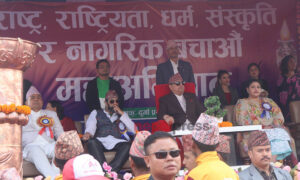 Saner minds have described the statement as a dignified and powerful portrayal of the mess the nation and its people are relentlessly undergoing—all in the name of “loktantra” [People’s Rule]. The carrot-and-stick content stressed the need for “working together” while, at the same time, making it plain that the “former” king could not remain mute and inactive over the deteriorating conditions any longer.
Recent cascades of political twists and turns indicate the scripting of motions heading for a frontal attack on the array of anomalies and rampant corruption that has created a posse of looters making the most through their proximity to the leaders in power.
NINE PINS: In the world’s 20 oldest independent states—and the oldest in South Asia—governments have tumbled like nine pins. After the foreign-engineered 2006 political shift, as many as a dozen governments have come.
“Former” King Gyanendra’s latest visit to India is no surprise. He is learnt to have held meetings with “very senior” Indian leaders. In the past 15 years, he has been to various cities. Every meeting was marked by meetings with local senior ministers or federal ministers. When the Indian Congress was in power, Prime Minister Manmohan Singh met him at least twice; so did his party leader Sonia Gandhi.
Indian Prime Minister Narendra Modi has also almost invariably held meetings with the dignitary from Nepal. In Lucknow and Orissa visit, the local media reports addressed him as “His Majesty the King of Nepal”.
CONVECTION: During the initial years, whenever the issue of reinstallation of the institution of monarchy came up during talks with leaders from India and China, the “former” King’s standard response was “Monarchy will return through the same way it went”.
Likewise, he was China’s state guest thrice after Nepal was declared a republic. During the three trips, he met with the host country’s senior leaders in ascending order of rank and influence, culminating in a so-far deliberately not declared meeting with President Xi Jinping.
During his state visit to Nepal in October 2019, Xi wanted to pay a return call on him at the latter’s Nirmal Niwas residence. But the hosts suggested it might “not be appropriate now”. Beijing interpreted the response as “advice” from foreign forces. In any case, Xi sent a senior member of his entourage to call on Sire Gyanendra, even as President Bidya Devi Bhandari was hosting a state dinner in Xi’s honour.
It is learnt that during his regular trips to Bangkok—at times also extended to the city-state of Singapore, representatives from foreign agencies, including those in the guise of INGOs, call on him for consultations. The Thai royalty also receives him and “former” Crown Princess Himani for quiet meetings.
Normal Niwas retains its tradition of regal aura, and is busy meeting with representatives from various foreign quarters. Some meets are held in a third-party venue serving as a red herring to avoid unwanted prying eyes and ears.
TURNCOAT: Nepali Congress leader and five-time Prime Minister Sher Bahadur Deuba, today, unabashedly rubs shoulders with Prime Minister Pushpa Kamal Dahal, who he once declared a terrorist and tagged a price over the Maoist’s head to lure potential bounty hunters into action.
Meanwhile, imperious till a month ago, Maoists overnight looked impaled by their self-doubts and fear of “betrayal”. Their “democratic” and “socialist” partners in the power-sharing game issued a joint statement that sounded like a challenge to the supreme court over a writ petition registered at the land’s highest court of law the other fortnight. The petition wants crimes committed during the Maoist war to be addressed.
The gulf between monarchists and neo-monarchists in the last few weeks is narrowing, as leaders of various groups are expressing solidarity for the cause they uphold, i.e., scrapping of federalism, religious secularism and the republic. They call for restoring the 1990 Constitution as a basis for sweeping changes in the state structure and governance for political stability in a better Nepal.
CONSENSUS: Communist leaders like Narayan Man Bijukchhe, Netra Bikram Chand and CP Mainali are said to agree with the ongoing restore-the-king movement for ending the prevailing instability and culture of impunity. The campaign, organised by business entrepreneur and former UML Central Committee member Durga Prasai and launched by “former” King Gyanendra in Jhapa has been drawing large crowds along with sharing stage space with former Minister Keshar Bahadur Bista, noted senior advocate Bal Krishna Neupane and another senior advocate Dr Surendra Bhandari, among others.
In the latest development, Prasai has made amends for his earlier snide remarks by publicly issuing an appeal for the Rajendra Lingden-led Rastriya Prajatantra Party’s support. RPP has 14 seats in parliament.
Amid all this is reiterated consensus between Nepal’s two giant neighbours that prolonged instability in the landlocked, corruption-ridden and misgoverned neighbour could create disturbing situations for both of them. They concluded that the US-led West is making its proactive and aggressive presence increasingly and visibly felt, of late.
What goes next should be unveiled in the ensuing weeks, if not days.

Login to add a comment