







 By Our Reporter
Nepal is all set to get a new President by Thursday evening. The new President will be the third in-person and fourth in a row after Nepal was deceitfully declared a federal republic in 2008.
Ram Baran Yadav of the Nepali Congress became the first President after the Constituent Assembly election held in 2008. After he completed his term, Bidya Devi Bhandari of the CPN-UML became the President for two terms—once during the transitional phase from October 28, 2015, to March 2018 and she was reelected to the post on March 13, 2018, for a full term of five years.
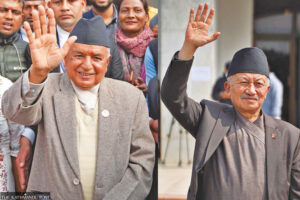
Now Ram Chandra Paudel of the NC and Subas Nembang of the CPN-UML are in the race for the top ceremonial post. If the present coalition of eight plus one parties which have supported Paudel remains intact till Thursday, he is likely to become the new president as the eight parties have a comfortable majority.
Lawmakers of the House of Representatives (273) and National Assembly (59) and provincial assembly members (550) are voters in the presidential election. In total, 882 voters will cast their votes in the elections. The total vote weightage for the election is 52, 786 and the eight parties have 31, 516 vote weightage.
The CPN-UML has a 15,281 vote weightage. Both the Rastriya Prajatantra Party (with 2,210 weightage) and Rastriya Swatantra Party (with 1,501 weightage) have not decided as to whom they will vote for. And if all three parties and independent candidates vote for Nembang, as claimed by the UML leaders, he will get 20, 598 votes, which is short of over 6,000 votes to get elected. However, the UML leaders are optimistic that many voters from Janajati will vote for Nembang and he will win.
And if RPP which advocates for the restoration of monarchy decides not to participate in the president’s election, Nembang will lose the chance of getting elected. The RSP which is willing to join the government can vote for Paudel at the last moment. As such, Paudel is almost sure to become the new President of Nepal.
Coincidentally, both Paudel and Nembang are former Speakers. Moreover, Paudel is the senior most leaders among the contemporary leaders active in party politics. He is the most experienced leader of Nepal. Nembang too has led the CA that drafted and promulgated the constitution. He is popular among the leaders. Had KP Sharma Oli floated his name as the new candidate of the UML before the rift between him and Prime Minister Pushpa Kamal Dahal ‘Prachanda’, not only Nembang could have been a common candidate of the previous coalition but also the coalition could have survived. But Oli forwarded Ishwar Pokharel and others in the top post, which shocked Prime Minister Prachanda prompting him to end the coalition with the UML in two months.
When both Paudel and Nembang are experienced politicians, they are often blamed to be soft towards foreign powers. While Paudel is said to be close to the Indian leaders, Nembang is known as an instrument of the EU for introducing federalism, secularism and republicanism in Nepal. It is widely believed that Nembang inserted the provision of secularism in the interim constitution in 2007 at the advice of the EU even without informing the then Prime Minister Girija Prasad Koirala. He was also criticised for supporting Oli’s move to dissolve the House of Representatives in 2020 and 2021.
Supreme Court registers case against PM Dahal
A writ petition making Prime Minister Pushpa Kamal Dahal Prachanda a key defendant was filed in the Supreme Court on Tuesday, two days after the SC allowed to register the case.
The writ petition was registered and the SC has fixed the preliminary hearing of the case for Thursday when the election of the new president is scheduled.
Advocate Gyanendra Arhan and others filed the petition against the PM claiming that the statement made by Prachanda about three years ago had attracted the jurisdiction of the criminal justice system.
PM Prachanda, who is also the chairman of the CPN-Maoist Centre, had led the decade-long Maoist insurgency. Speaking at a public function in Kathmandu, Prachanda had made a statement that he was ready to take responsibility for the killings of 5,000 people during the decade-long insurgency, the writ petitioners have claimed in the petition.
A division bench comprising justices Ishwor Prasad Khatiwada and Hari Phuyal issued an order last Friday to register the petition, which was initially rejected by the SC administration.
However, the Maoist Centre and the parties which were formed by breaking the mother party Maoist Centre have strongly objected to the move.
After the SC was permitted to register the case on Friday, the Maoist Centre and other parties created by breaking it seemed terrified by the decision. On Tuesday, all the former Maoist leaders came together and decided that the filing of a case against PM was against the Comprehensive Peace Accord. From Dr Baburam Bhattarai to Netra Bikram Chanda ‘Biplab’ to CP Gajurel attended the meeting held at the Prime Minister’s official residence and strongly criticized the move made to register a case against PM Prachanda.
Not only the Maoists but also those in the new alliance have objected to the SC decision. They opposed the move against the incumbent PM as the incidents that occurred during the conflict were a matter of transitional justice and an integral part of the Comprehensive Peace Agreement signed between the government and the Maoists in 2006. They have also demanded early settlement of transitional justice-related issues.
However, when the governments formed after the CPA did pay little attention to sorting out the cases, and they remained as they were in 2006, many victims got fed up and filed the case.
Obviously, the case has created fear among the Maoists because they had committed crimes during the conflict period. They had killed innocent people, maimed many and capture private property, and if the cases are not resolved through an effective mechanism of transitional justice, they will reach court and many of the Maoist leaders of today will be convicted and jailed. Now after dillydallying to solve the conflict-era cases for 17 years, the government and the ruling parties have now started claiming that the cases would be resolved soon by introducing laws.

Login to add a comment