








National/Regional/International affairs

By N. P. Upadhyaya (Aryal)
Kathmandu: The Ambassador of the Federal Republic of Germany in Nepal, Dr Thomas Prinz has set the ball rolling by making a somewhat odd comment on China from Nepali soil.
If one were to listen and read the remarks made by Dr Bhim Rawal, a Nepali political personality associated with the Communist UML (United Marxists and Leninists party) against the German Ambassador’s blunt remarks on China made recently gives an impression that China too has a sort of “lobby” in Nepal.
The German envoy said, “Nepali’ people’s objection to the MCC agreement was driven by “fake news and that too spread by China”.
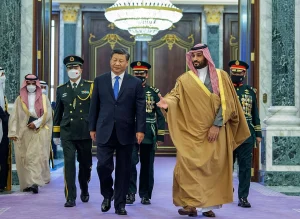
Saudi Crown Prince Mohamed bin Salman welcoming Chinese President Xi Jinping in Riyadh last week.
Now the question is: Why did the German ambassador talk against China and that too being inside Nepali soil?
Does the envoy from a developed Western nation have the right to make such comments against China from the country of his diplomatic posting?
Is he talking on behalf of the US? Questions galore.
The question will also be pertinent to ask Dr Bhim Rawal, a communist veteran, as to why he has so far remained silent and not spoken against India’s intervening in the internal affairs of Nepal.
Why he has so much anger for the US and for that matter Germany?
Why not he is equally interested in making comments against the UNDP and the Norwegian government which has only recently agreed with Nepal’s Parliament and that too without seeking advanced permission from the government in place?
And above all, why Rawal doesn’t talk of China signing a trading pact with India in 2015 which is through the Nepali landmass in Lipulekh? Will he?
Yes! German envoy’s critical comments on China were unwarranted and what is equally true is that the Indian ambassador continued and uninterrupted poking its nose in the day-to-day affairs of Nepal but Dr Rawal for multiple political reasons prefers to keep silent.
But why?
Rawal’s personal intimacy with Indian Congress leader P. Chidambaram remains no longer a secret — his source of inspiration?
It was this Indian Congress which dismantled the previous system and the Indian Congress “sweetheart or stooge” Shyam Saran instead facilitated the current Order which singly serves the Indian regime keeping Nepali integrity and sovereignty in jeopardy.
It is the “India-imposed republican order” that is killing Nepal.
To recall, Dr Rawal too used, as per strong rumors in Kathmandu, to be the US contact person as per WikiLeaks a few years back.
If so then Dr Rawal is riding two boats: Is he both Dr Jekyll and Mr Hyde? Dr Jekyll with China and Mr Hyde with the US?
Now back to the main story and events put in order:
November 14 meeting of the US President Joe Biden and President Xi Xinping in Bali, Indonesia, was meant for the “normalization” of the strained ties in between the two political giants and big names but yet the world peace-loving countries had expected that this Bali Summit meeting will facilitate both the US and China to transform their current overwrought bonds from “confrontation” to “reconciliation” appears to have suffered some glitches.
This becomes evident from the events that have followed in India and the Gulf after the much-hyped G20 Bali meet.
The political goings-on that has come to the fore in series after the G20 Bali meet may be some sort of fluke, however, the way the events have unfolded to the world population does tell that the Bali meet summarily failed to “ease” the tensed relations between the US and China.
India’s stern warning to the US:
On November 16, an irritated India with the US-China entente, an annoyed colonialist India concluded that the US-China meeting in Bali could have even its impact on Nepal and would curtail the influence of the Indian regime and conversely fortify Chinese clout in Nepal and thus India pumped its paid and posted scholars of the so-called Delhi’s think tank to send blunt warning signals to the US stating that “the US must not cross its limit in Nepal and that Nepal was under the “sphere of Indian influence”.
This clearly meant that the current US hobnob in Nepal too must have a limit as “defined” by the Indian Union.
Almost it was a subtle India’s warning to the US and to the entire European countries who of late have increased their influence in Nepal through their “lobbies” mostly through NGOs and INGOs.
The ongoing extra diplomatic activities of the US and the Indian Ambassadors in Nepal to enhance their “preferred lobbies” in Kathmandu do speak that the US and India will have a big tussle in Nepal to secure and ensure its political influence.
China is the mere spectator which is only natural in that the grand departure of the Nepali Monarchy with Chinese consent has boomeranged. That too was an Indian ploy.
China’s loss is US’s and India’s gain in Nepal and vice versa.
Yet Nepal’s sans monarchy is a permanent loss to China.
The conclusion is that India will dominate not only in Nepal but the entire of South Asia, as usual, save Pakistan.
Pakistan is the Achilles heel for India.
India will not allow the US even to have its lobby in South Asian countries. Take it for granted.
And it will be this US-India tussle which surely allows China to “solidify” its presence in South Asia in a significant manner.
This brings Pakistan to the political scene and the US will be forced to seek Pakistan’s active support in establishing its “say” in South Asia and also to deal with China.
Admittedly, Pakistan’s foreign policy in South Asia is almost non-existent which needs to be attuned to the demand of time and the freshly changed political context after the Bali meeting.
The policy demands quietly inching closer to the US and balancing the “region” which is currently in favor of India.
F.M Bilawal Bhutto and the new Army Chief Lt. Gen. Syed Asim Munir, should begin touring the neighboring South Asian nations. Earlier the better for regional stability and lessening of the Indian hegemony.
This will have an amazing bearing in SA ensuring the sure shot shrinking of the Indian whack.
It is only Pakistan — the matching regional force to deter Indian domination. But will Pakistan do so?
The geopolitics too demands Pakistan’s down-to-earth diplomatic activities in South Asia for obvious reasons.
The fact is that since Pakistan is placed in a highly strategic geopolitical location-being situated at the corridor of major maritime as well as having geostrategic hotspots such as Afghanistan, China, India and Iran as immediate neighbors, which warrants thus making or securing its sphere of influence in South Asia for some central-political reasons that India knows better.
US’s interests could only be secured in South Asia if and when the US awards greater attention and role on an equal basis to the region’s largest force equal and fitting to India for the benefit of regional peace and stability.
SA flashpoint Kashmir dispute too demands the US role in the format of mediation.
And for that to prevail, the US is advised to bring in some suitable changes in its South Asian policy as the present policy is not only outdated but redundant in that South Asia has changed after the end of the Cold War. Clearly, US policy for now only strengthens India.
Hopefully, the US when pushed to the wall by India in South Asia will come to its senses and seek Pakistani support in the immediate days ahead.
The US-India joint drill:
Then comes joint India and the US military show of strength perhaps to send a “refined” message to China in a challenging fashion that “we are already close to your borders”.
It is more or less an indirect contest to the Chinese regime which also borders Nepal.
China is not that foolish not to understand the “meaning” of the joint military exercise close to its sensitive border.
However, the US may or may not wish to poke China, but India’s grand design primarily is to use and overuse the US’s military and political strength to “provoke” and pester China-its a declared enemy.
A day after the US-China meet in Bali had concluded, contrary to the Chinese expectations, India and the US initiated the 18th edition joint training exercise, “Yudh Abhyas 22,” beginning November 15, 2022, almost close to the Chinese border in Uttarakhand.
The Indian idea is to poke China with US assistance at regular intervals.
The location of the joint drill was Auli, at 9, 500 feet and at a distance of 62 miles from the Line of Actual Control, taken as a disputed border that separates India and China.
A December 4 article in The Global Times has this to say, “Washington wants to strengthen military cooperation with India to embolden India to provoke China in a more aggressive manner, which can be said to have a strong implication of instigation”.
Who knows India better than China?
Yes. The Global Times is correct simply because the US fails to understand the Indian motive which is to use and overuse the US against India. And that’s it.
This drill tentatively gives the impression that the US will not abandon poking or provoking China together with India come what may.
Isa it that the US with Indian help wants to tame China and that too from the South Asian landmass?
The Chinese media sources say that the joint US-India drill amounts to an interference in the bilateral boundary issue and is a violation of agreements between New Delhi and Beijing that no military drill will be held near the Line of Actual Control (LAC), the de facto border between the two countries”.
India reacted to Chinese comments by saying that “India exercises with whomever it chooses to, and it does not give a veto to third countries on this issue”.
This means that the US and India are on the same wavelength in irritating China dismissing the Bali meet in between Presidents Joe Biden and Xi Jinping.
China’s reaction:
China in some way reacted to the US-India military overtures by summoning an international meet that saw the attendance of some 19 countries consisting of some Indian tails as well, such as Nepal, Maldives, Seychelles and Bangladesh.
The China-Indian Ocean Region Forum on Development Cooperation (CIDCA) organized an international conference on November 21, 2022, in China with the attendance of some 19 countries from across the globe sans India.
The Global Times/People’s Review reports that “according to the CIDCA’s official website, the organization’s goals are to develop strategic guidelines, plans, and policies for foreign aid, coordinate and provide advice on important foreign aid issues, advance national reforms with regard to such issues, and identify significant programmes, oversee, and evaluate their implementation.
Just link the event “China-Indian Ocean Region Forum” and the participation of the countries in China with the Bali meet, and the US-India joint drill.
Observers say that this “China-Indian Ocean Region Forum” shall act like China’s equivalent to the US-designed QUAD.
China will in all likelihood bring these countries into its sphere of influence time permitting.
However, some countries in this group might play “double” with China. Chances remain fair.
China’s grand entry into the Gulf:
Clearly, in “response” to a joint US-India military drill held in India on November 15 Chinese President Xi Jinping’s fresh visit to Saudia Arabia, on December 9 is sure to add to the annoyance of the US in that the visit “expands the Chinese influence in the Gulf (the Oil rich countries) which is a region, it is said, was almost under the US command.
To be more candid, the US for almost seven decades remained a trusted and tested security partner of the Saudi Arabian rulers.
Media sources say that US-Saudi relations saw some seven Saudia monarchs and 15 Presidents over these seven decades. However, with the advent of President Joe Biden, it has touched a new low.
It is this new “low” in US-Saudi ties that has now gone in favor of China.
The US needs to effect a foreign policy change to regain its clout in the Gulf and elsewhere.
Needless to say, the US and the Saudi Arabian rulers are at odds and it is this odd or says strained ties between KSA and the US that have allowed China’s President Xi Jinping to enter into a region which so far had remained glued to the US for security reasons.
President Xi’s visit to Saudi Arabia is a result of “bad American policy”, says the former US Secretary of State, Mike Pompeo while talking to Fox News.
As per the news portal, NPR, in December China’s leader, Xi Jinping, is in Saudi Arabia for a visit showcasing Beijing’s ambitions to expand its influence in the Gulf, a region traditionally seen as a close U.S. security partner.
And the key achievement for the KSA was having an agreement with China which states in part that (stress added), “the two nations would not interfere with each other’s domestic affairs”.
What is more than important for China is that the Saudi Crown Prince, Prince Salman-the de facto ruler of the Kingdom of Saudi Arabia (KSA) had invited some key rulers of the Gulf countries to pay a courtesy call on President Xi in Riyadh.
The Qatari Emir Tamin bin Hamad Al Thani rushed from Doha to Riyadh, on December 9 to meet Xi Jinping and that too leaving the ongoing World Cup soccer festival.
On the morning of December 9 local time, President Xi Jinping met with Qatari Emir Sheikh Tamim bin Hamad Al Thani in Riyadh.
Saudi Arabia and Qatar are not that friendly to each other but yet the temptation was so high that the Emir landed in Riyadh.
However, Qatar enjoys intimate ties with the US.
Gerald Walker for the International Policy Digest, on December 12 says that President Xi’s visit carries significant implications for the future of China-Saudi Arabia relations, as both countries look to strengthen their strategic partnership and expand cooperation in various fields. Saudi Crown Prince Mohammed bin Salman, the Prime Minister and the de facto ruler of Saudi Arabia, the world’s biggest oil exporter, greeted Xi at the Yamamah Palace.
With the US changed from an intimate friend to an estranged partner, Saudi Arabia is said to have signed $30 billion in defense contracts at the time of President Xi’s visit to Riyadh. This speaks much,
Is this a grand shift in the global political order?
That’s all.

Login to add a comment