







By Our Reporter
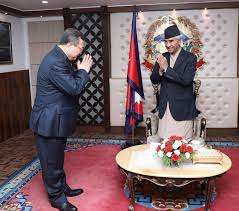
Head of the International Liaison Department of the Communist Party of China Liu Jianchao visited Nepal this week and met almost all top leaders from Prime Minister Sher Bahadur Deuba to Nepali Congress general secretary Gagan Kumar Thapa.
Liu, who arrived in Nepal on Sunday, called on Prime Minister Deuba and Foreign Minister Dr. Narayan Khadka immediately after he landed in Kathmandu.
On Monday, he met Maoist Centre chairman Pushpa Kamal Dahal Prachanda at the latter’s residence in Khumaltar while on Tuesday he met CPN-UML chairman KP Sharma Oli, CPN (Unified Socialist) chairman Madhav Kumar Nepal, leader Jhalanath Khanal and others.
On Wednesday, he called on President Bidya Devi Bhandari before flying back home.
Although those who met the visiting Chinese powerful man said that they discussed the issues of bilateral relations, it is widely assumed that the Chinese leader had expressed concerns on the security issues especially after the officials from the USA started visiting Nepal frequently and Nepal became a part of MCC.
Although Nepal, after public pressure, decided not to accept the State Partnership Programme (SPP), the Chinese officials suspected a possible increase in anti-China activities in Nepal. And the visit of Liu was to convince as well as convey a message to China that the latter would not tolerate anti-China activities increase in Nepal.
Is left alliance possible?
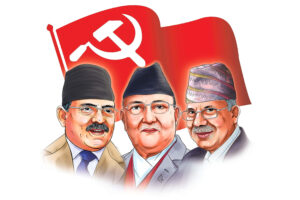
As the general elections are just four months away, leaders of different communist parties have started exercising an alliance among the left parties. Jhalanath Khanal, a respected leader of the CPN (Unified Socialist), Ghanashyam Bhusal of the CPN-UML and former UML vice-chair Bam Dev Gautam are at the forefront to voice for the alliance of the communist parties. Even a few leaders like Narayankaji Shrestha in the Maoist Centre are also reportedly pushing the idea of a left alliance.
However, when the leadership of three major left parties—CPN-UML, Maoist Centre and CPN (Unified Socialist) are not interested in forging such an alliance, the effort has not taken any shape. A week ago, Bam Dev Gautam reached the Balkot residence of KP Oli with a proposal of the left alliance but failed to woo Oli.
Although Jhalanath Khanal of the CPN (Unified Socialist) forged an electoral alliance with the CPN UML in the election of the municipal council in Suryodaya Municipality and District Coordination Committee in Ilam, his home district, by deceiving the ruling NC, with whose support his party had won a few seats in Ilam, his act is likely to be costly for him to win election from Ilam as the NC leaders and cadres irked by his post-local level comments may not vote him in the election.
It seems a new left alliance will be impossible until KP Sharma Oli, Pushpa Kamal Dahal and Madhav Kumar Nepal lead their parties. While Oli has been floating the idea of such an alliance excluding Madhav Kumar Nepal, Khanal and Nepal are not ready to work with Oli unless the latter admits that the act of dissolving the House of Representatives twice was his mistake. Likewise, Oli wants Pushpa Kamal Dahal needs to withdraw the 19-point accusation letter he issued against Oli after the dissolution of the House in December 2020. When Nepal, Khanal and Dahal are not ready to accept Oli’s leadership and when Oli does not want Nepal in the new party and is not ready to accept Dahal’s leadership, a left alliance like in 2017 looks almost impossible.
Yet, Oli needs an alliance because he knows well that winning an election without an alliance is not possible, which was evident from the local polls as well. However, recently in an interaction with the editors, Oli said that he had no interest in such an alliance.
In October of 2017, the Maoist Centre and UML had in a dramatic style decided to unify their parties even when the Maoist leaders were in the government led by Sher Bahadur Deuba and that decision worked as the two parties won around 170 seats in the 275-member House of Representatives. Later, the two parties were unified as Nepal Communist Party, but it could not last for three years because of growing differences among the leaders and they got separated after a controversial verdict of the Supreme Court in March 2021 squashed the unification.
After getting separated, the UML further split and Madhav Nepal formed CPN (Unified Socialist) and the enmity among Oli, Nepal and Dahal only widened. As such, the efforts of a few leaders to bring them together may not work until the UML faces another defeat.
However, rumours have it that leaders from China are working to unify the Communist parties in Nepal as in 2017. But Chief of the International Department of the Communist Party of China Liu Jianchao, who visited Nepal this week, refuted that and said China had no interest in unifying or dividing the parties in Nepal.

Login to add a comment