








By Narayan Prasad Mishra
When I was a small kid studying in the school in Bhaktapur in the 1950s, we had a court case in Kathmandu. My father had to go to the court from time to time for that purpose to be present according to the day and time given by it, which we call Tarikh in Nepali (date given by the court). The case was about three ropanies of land (about half an acre), which was given to him as a gift by his maternal uncle, who had no other offspring and siblings except my grandmother, my father’s mother. After his maternal uncle’s death, a wicked distant relative of my maternal uncle filed a case against my father, claiming that land. After many years in court, my father lost the case and lost the land we had been benefiting from and getting rice every year for many years. My father, a pious man wholly devoted to God, was sad. I heard his sad story; he lost the case, not because of any lack of documents or evidence, but he lost it because of the power of his opponent’s money power and bribery. He solaced himself, thinking that it must have occurred because of his past karma (deeds).
In this context, I also now remember a story about a friend who was in the same class (grade) in school with me and was poor. At that time, there was a system of scholarships of Rs 15 a month to poor students for books and snacks by the Ministry of Education. He enjoyed that benefit because of his poverty. Later, the man studied law and became a judge. Now he became richer and richer every year, being justice in different statuses in different courts. He turned his ancestor’s tiny house into a tall business building with all the facilities. He now has many houses in Kathmandu. He is considered a pretty rich man. Knowing his life story, anyone could tell about how his property could have grown. We have a Nepali proverb — Besar Bhane Pachhi Kotyaunu Pardaina (you need not scratch raw turmeric to confirm when someone says turmeric).
I often hear the many sad stories about bribery and corruption in the judiciary from my friends and relatives who experienced it in their lifetime. With my brothers, I, too, had to go to court for some legal procedures to get the property given to us by our sister-in-law with Bakaspatra (will after death), who had no offspring. I remember when we went to the court for this case, our lawyer compelled us to give a few hundred rupees to an official at every table, even for registering our application and getting copies of some documents. You could not get your work done if you did not give them money. That is our open secret. It was like office rule in Nepal.
I also observed and experienced the difficulties and problems of clients in courts when I actively worked on a library fund corruption case with fake signatures filed against the culprit in a court by the Attorney General’s Office and our university under the leadership of Shanbhu Prasad Gyawali, the legal advisor of Tribhuvan University. I learned many things about the court case when I worked for the case till the money was returned.
I had a cousin brother named Hiranya Garva Mishra, who was a Sanskrit pundit, a learned man. He also was a Sanskrit teacher in a Sanskrit Pathshala (school). He spent his life narrating religious scriptures – Ramayan and Mahabharat, etc. in different localities and religious temple courtyards in Bhaktapur. He was about 30 years senior to me and not living now. He was a great devotee of Lord Shiva, the great God in Hinduism. He was thoroughly acquainted with the trouble and pain one needs to get from a hospital and judiciary when the situation occurred. He always prayed to his great God, Lord Shiva, to save him from the situation so that he would not have to go to these two places. He felt those two places are hell on earth. These are certainly two places better not to go.
Based on my experience, I wrote the following poem: Adalati Khel (Court Game, .which was published in Naya Nepal Post on 2041 Marga 21) 38 years ago. Its Nepali and English versions are given below.
Poem in Nepali
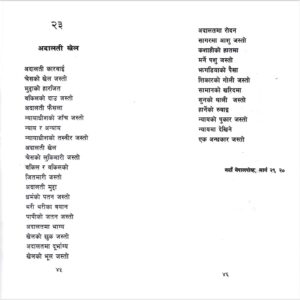
Poem translated into English
Court Game
Court Procedure
Like a chess game
Win and defeat in a case
Like a barrister’s trick
Court’s verdict
Like an exam of a judge
Justice and injustice
Like a picture of a judge
Court’s game
Like hide and seek in chess
Barrister and barrister’s
Like win and win
Judicial case
Like a downfall of a righteousness
Various statements
Like a way to escape from sins
Fate in a court
Like fate in a game
Misfortune in a court
Like a mistake in a game
Crying in a court
Like a drop of water in an ocean
In the hands of a butcher
Like a dying animal
Money of a petitioner
Like a bullet of a hunter
In buying goods
Like a golden plate
Crying and weeping of a loser
Like a prayer for justice
As seen clearly in a verdict
Like a darkness
An audio tape scandal between Rudra Pokharel, a lawyer (barrister), and Raj Kumar Koirala, a judge in Kathmandu District Court, is now the talk of the town. An audio tape is heard about offering a bribe of Rs 2 crores to judge Koirala for securing the release of Ichha Raj Tamang, the culprit for misusing billions of rupees of the Civil Savings and Credit Cooperatives Society Ltd. The audio tape was broadcast by news24, a few days ago.
I admire and salute Birendra Jairu, the journalist and the program presenter of the Sidha Kura of News 24 TV, who presented that audio tape to the country and people courageously and forcefully. He should be thanked and congratulated by all anti-corruption nationalists of our country. The government should praise and award him for his investigation and powerful presentation if the present government stands for anti-corruption in the country.
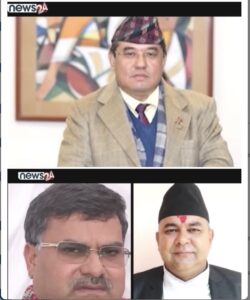 Pictures of the people involved in the Judicial Audio-tape Scandal
The upper one – Ichha Raj Tamang and the lower first – Rudra Pokharel, a lawyer; the second -Raj Kumar Koirala, a judge, Kathmandu District Court.
We all know Ichha Raj Tamang, a Nepal Communist Party (UML) nominated ex-parliamentarian is in jail. Our police force has not been able to arrest his wife, Sirjana Shakya Tamang, and his daughters – Pratishtha and Pratikshya Tamang, despite the police search. I thought our Police Crime Branch is very efficient, and they (his wife and daughters) would be arrested soon. That has been indeed a mystery for all to watch it. Thousands of victims of that cooperatives are in great pain and suffering from dying conditions. The case is in the Patan High Court now. The suffering clients, without any fault of their own besides trusting Ichha Raj’s false reputation and image, are trembling with fear thinking about whether they will get the money back during their lifetime.
Whatever the strong evidence may be against him for his crime, the judge may also play some trick in his favour in some manner if the seating judge is not honest and dignified. We have a Nepali Proverb – Muddako Nau Sing Hunchha; Kunle Kaha Hanchha Kasailai Thaha Hudaina (A case always has nine horns; no one knows which horn will hit where). All of us know the situation in our country. That makes the people worried though there is nothing to fear in the case. But I pray to God let he make the judge for this case righteous like Yudhishthir, the King of righteousness. Besides, I pray to God to make Ichharaj realize his sinful Kukarma and willingly pay the depositor’s money. I also pray to God – Let he make the government pay the victim’s money, thinking it is the government’s responsibility as the people deposited the cash trusting the government’s rules and regulations. The government can easily confiscate his property and get the cashback even by formulating new laws if necessary if they are determined to do so and stand to punish the culprit and give justice to the victims.
The audio tape represents the wrongdoings in the judiciary, which the people have been watching, feeling, and experiencing but not speaking about due to fear. The experienced people feel the severe problem is in the judiciary to get justice. It does not mean all are corrupt. But people feel there are many wrongdoings. We all know the free, independent, and impartial judiciary is the symbol of a civilized society and an essential part of our life. The country automatically crumbles when there are wrongdoings in the judiciary. Judiciary is the last hope for everything, not only for individual justice but even for the country to exist, run, and progress.
We all think the justices should be like God and Goddesses, like Yudhisthir, the King of dharma ( righteousness ), kind, merciful, impartial, and not attached to wealth, relation, friendship, greed, jealousy, or revenge. That is always our expectation from a judge. At the same time, we realize that judges also are human beings. They can not be separated from human qualities. They also may be good or bad. Just being a judge, no one can be impartial as just being a judge can be corrupt. So we must set good effective rules and regulations to control corruption in the judiciary and control judges’ activities to keep them out of corruption, even if some judges are against judicial ethics. In this part, I think the most essential thing is to get the correct property (land, house, ornaments, cash, etc.) statement from all judges, high or low in rank when they were appointed and to keep the record up to date during their service period every year and observe them even after the retirement getting their property statement till they die. That would automatically determine any person’s property increment and make it easy to find the corrupt earnings. We must have someplace to complain against the seating judges for their irregularities, wrongdoings, and corruption so that they can not think they can do anything – right or wrong.
narayanshanti70@gmail.com

Login to add a comment