









By Sunder Nath Bhattarai
No doubt, QUAD, the Quadrilateral Security Dialogue involving Japan, India, Australia and the US, is primarily aimed at countering China’s rise, which the US sees as a grave threat to its post-World War II supra-national hegemonic global supremacy. Biden’s efforts to give it an economic face, by launching Indo-Pacific Economic Forum which is expected to be participated by 14 countries, during the ongoing QUAD Summit in Tokyo, seems to be controversial. The so-called Economic Forum to be launched during the Tokyo Summit, in essence, is taken by many as an American ploy to create an organisation working solely under its tacit supervision and control mainly concentrated to aggrandise its own hegemonic adventurism in the Indo-Pacific region, with no substantive benefits to participating countries, which have to mend their own tastes of relationship, on their own, with China, in one way or the other. In addition, members’ partisan characters and problems may also give rise to various controversies in the Forum.
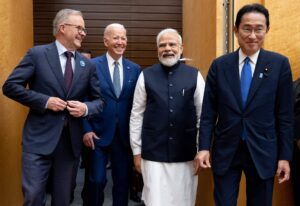
I do not think that in view of China’s great innovative technological progress made by it and the genuine leadership roles it has been playing in solving severe global problems, which are engulfing the world at present, efforts to check China’s rise could so easily be an achievable goal for the US or any other outside forces.
China’s supply-chain capability is wider and more robust with QUAD members themselves like Japan, Australia and India in quantum and value as compared to theirs with the US. China’s contribution to the world’s GDP growth is 20% compared to that of 7% of India and 4% of Japan. These are a few genuine challenges, among others, to the ongoing QUAD Summit and Indo-Pacific Economic Forum.
Nepal, having its very delicate geopolitical situation of its own, has no option other than peace and stability in the region, for its security and development. It is, therefore, effortful in distancing itself from regional or global hegemonic strategic alliances whether it is the Indo-Pacific or QUAD or be it the US or its southern neighbour, India, which is present within the helm of the US alliance, playing a pivotal role in containing China’s rise.
Nepal is a committed member of BRI despite misleading external or say, particularly, Indian propaganda. One of the nine agreements signed between Nepal and China, during the recent visit to Nepal by State Councillor and Foreign Minister Wang Yi, relates to the pre-feasibility study of conceived projects under BRI, sufficiently connoting Nepal’s continued adherence to this Initiative. Its hope and confidence in China are profound and total. Nepal looks forward to China’s forward-moving leading role in the region of South Asia in the restoration of peace and stability through wider connectivity as propounded under BRI and more tangible efforts in widening its collaborations with Nepal in a more candid and subtle manner, which will ultimately benefit both sides in the forthcoming future; immediate and long-run.
The writer is the acting chairman of the China Study Center, Nepal

Login to add a comment