







By K. C. Bhatt
In SriLanka, which had undergone a deadly civil war for nearly twenty-five years, costing it many hundreds of thousands of lives among others, things were never easy to revive as a peaceful and prosperous nation, as many international powers wanted the conflict to continue there.
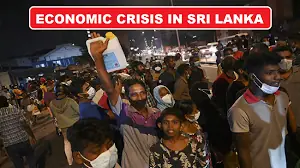
Its war-Hero Prime Minister, who was voted again in power with an overwhelming majority, has been ousted recently after street demonstrations and is under the protection of the army at an undisclosed location currently.
He has been replaced by a PM who even lost his parliamentary seat in the last elections and was the previous incumbent too with an unremarkable last tenure. Besides it is for the sixth time that he is returning to the PM’s office, without having made any remarkable impact earlier too, on the Sri Lankan daily life.
He last time too replaced the same PM he has replaced now, but constitutionally then. His major plus point is being reckoned as his cordial relations with international donor agencies and the West in general.
As soon he had taken over office this time, Japan has promised some money as a help to the country instantly.
It proved that Sri Lanka has a vibrant and functioning democracy, where its people are ever watchful about the economy too, besides other matters. It is unlike in some other countries in the region where there is a remarkable and unnerving peace and stability in their politics, though their economies have been steadily going downhill for decades in the absence of any changes or reforms, though their rulers have changed often through democratic means.
As if the fate of a nation too, like a mortal man, is only to fall into an irreversible degradation with no possibility of a revival.
What is disturbing in Sri Lnaka is that people have resorted to unconstitutional means this time to remove a ruler who they have voted in with a thumping majority only a little more than two years back.
It could actually deepen the conflict and the results could bring more bad days for this continent nation, which was the fastest growing country of the region in every respect, before it was trapped into a deadly ethnic war which was ended equally violently. It is assumed that, else it might have been a more developed nation than Singapore today, if it had not suffered the civil war.
However, if the statistics are taken into account, the debt to GDP ratio in Sri Lanka is one hundred twenty percent only even now, when it is on the verge of yet another serious domestic conflict.
Actually it is still far better off than many Nordic nations, which have a great stability in their daily lives, and the cleanest governments; and the best happiness indexes, as per some reports.
Those Nordic nations actually have two times or more debts than their GDP in most cases. Some have even three times or more.
Even Japan has a debt which is more than two times its GDP. But it is still paying the compensation for being on the wrong side in the last world war.
In France the economic situation is almost comparable to Sri Lanka. Under the previous term of President Macron, the debt to GDP ratio saw a steep incline when it escalated from eighty to one hundred twenty percent.
But, while in Sri Lanka a popularly elected leader has been removed unconstitutionally, In France the incumbent was reelected.
Many analysts talking on a French TV channel in fact, though, labouriously, in English, which the French detest no doubt, even are unwilling to talk about the dwindling economic fortunes of their country; while others have taken no cognizance of the same, and others have no idea if it is at all important.
It brings to the light the low intellectual quality of the people, who speak English too not so well either, who participate in those debates while the Presidential election was ahead or when it is over now. Hopefully, France is not that weak today too on that count, as it has been a great power throughout its history.
One fear which led to the Emmanuel Macron-victory, reportedly, was that: else a woman President might have came to office, who not only was a right wing candidate but also was sympathetic to the Russian President Putin.
So people of France voted out of that fear, as per some analysts, in an election which was held under the shadow of the ongoing Russian aggression in Ukraine.
Besides the connections of most of the French politicians in high ranks, across the parties, with the international donor agencies, has been a key feature in the recent past, though there were some exceptions too. In the French Presidential elections in recent memory they get more pronounced and prominent for some strange reasons at time, as the forgettable DSK saga testifies.
So what is leading Sri Lanka to a deep conflict has almost gone unnoticed in France. What sustains this kind of international politics is a great mystery. Without solving which, no lasting peace in the world looks likely.
There have been economists winning all kinds of awards every year. But none seem interested to unravel this riddle.
As if they are all rewarded to not see the glaring in an area they spend a life time focusing upon.
GPO BOX 20460, Dillibazar, Kathmandu.

Login to add a comment