







 By K. C. Bhatt
Before long the novel starts reading like page 3 columns of a newspaper or a piece in a film magazine. It is when the main protagonist looks at his engagement party. He is being engaged to a woman who was upper class–before her family started losing its fortune—Istanbul–lish and French-educated, who he believes was a virgin who he deflowered soon after their marriage was arranged by their parents. He gloats over it in his thoughts. His marriage to her might salvage the sinking financial fortune of her family–he thought.
His lover too is in the party, who is a distant cousin who is poor. She is nearly half his age. She works in the Turkish modeling industry and is soon appearing for her final school exam before she expects to join a college. She too surrendered her virginity to him almost simultaneously like his soon-to-be wife, knowing fully well that he is about to be married soon. He never questions both their claims of being a virgin or their motives for surrendering it to him.
He rubbishes everyone he saw in the party for either having made a fortune in shoddy businesses, for being provincial enough to take his two wives together to a party, or for having no skills to flirt with a woman for his habit of seeing prostitutes often; or for, simply, wearing an inferior kind of perfume.
He does so all without a sense of irony. He just is too pleased with himself for having two women in his life to make him happy just as he has entered his thirties, unlike his father and uncles, who had such a fortune only after the age of post fifty.
So he is in conflict with every person around him. His father and mother similarly criticize and dump every person their eyes land on–at the party. Not to mention his brother and his sister-in-law. Who too spare no chance to cast aspersions on the people they meet in the party behind them.
His eighteen-year-old distant cousin and lover comes to him for taking mathematics’ tuition, under which pretext they had begun their relationship for the first time.
And afterwards, every time they make love in an apartment he only goes for that purpose, away from his family home, he distracts her by reminding her about her problems in mathematics after a rigourous sex session, when she starts worrying about the fate of their relationship. He assures her about getting good marks in the forthcoming exams to calm her.
But he has also made it appear as if, an American-educated man in his thirties, who had a busy sex life before too, was actually seduced by her. But he gives no motivation for it on her part, besides her being too poor and himself too rich. She was someone who he knew since when she was only a child and came to his house with her mother. Her mother does minor help at their house to earn some cash or kind.
So she is an ideal sex slave in making. Who hopefully will die like a lover of his father, who dies out of cancer at a young age and costs only a house to his father and no marriage or children: A house which her mother sells out and disappears.
His father, however, grieves for her even at an age he has a limited life to live, near his son, the main protagonist, drowning glass after glass of Raki (Raksi?) in a five-star restaurant with his son, who is impatiently waiting to leave to go to his lover in that apartment. She was especial to his father as she was so young and unlike any other of the lovers he had. In describing things names are dropped, of posh areas, hotels, markets and/or brands, to keep the story, upper class.
So it goes on. The main protagonist is too clever, rich and fortunate in every respect than the people around him and it is unlikely that something will stop him from having all the happiness and fun in his life.
You might have ignored it all and never tried to discover or read such a book only if it was not authored by someone who already had won the Nobel Prize for literature before he wrote it.
So the prospects for a reader like you are not so bright. You are to be left behind every time you open a book. Every new chapter brings a new defeat for you and there is no salvation in sight till you keep reading.
Nobel prizes in later years in literature went even to the people who wrote folk songs and also sang them, besides to those who wrote romantic short stories.
Then you discover that this author had a relationship with an Indian Booker-prize winning author who too wrote a similar brutish novel, in which she rubbished a whole community for being other than what she was or for not being the ones she would have liked them to be in her mind. For one has fixed ideas about the others too, in her mind, if one is a writer worth a prize in literature.
Mercifully she wrote in English and was not translated from Turkish, like this novel, so that her loathing of the people she intended to loath came across even more sharply, as they were of other than her ethnicity and not only inclination. So they were more despicable than the ones of your own kind–who were only poorer on one count or another, like in this novel.
Unsurprisingly, the relationship between the Nobel winner and The Booker-prize-winner lasted only a brief while.
And then you see the things around in a world which was already sinking economically just before it was hit by a pandemic. Trying to appear one-uppish, by finding a scapegoat for the pandemic and the general vicissitudes of the life, the measure taken to handle the condition worsened the situation and lead to great suffering among the people who had no resources to influence the policies. One aspect was that it was a disease which was a great leveler. So it killed without making exceptions on one or other ground. So it tore away many ideas about security the world had acquired so far.
And there has a war started in Europe again, which seemed to escalate by the day, even while the pandemic is still on. You tend to think if the world deserved it all for the failings it made on the literature it was reading.
Or you deserved the world you have, for this Nobel laureate author also teaches writing in an American university.
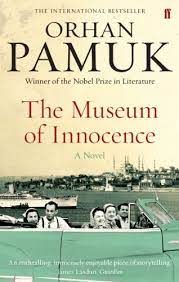
So things keep on getting collected all the time: to The Museum of Innocence.
GPO Box 20460, Dillibazar, Kathmandu

Login to add a comment