








By P.R. Pradhan
What are the priorities of the present government, we are confused! Although there is a foreign minister to look after the foreign policy, it is said that Prime Minister Sher Bahadur Deuba’s wife Dr Arju Deuba is solely looking after foreign affairs.
Arju’s priorities are to serve the American interests and strengthen her husband’s relations with the Indian establishment. China is not in priority for her, according to the Nepali Congress observers.
Amidst controversy, the Millennium Challenge Corporation (MCC) was endorsed by Parliament using a “veto power” for its adoption from PM Deuba. Notably, CPN Maoist Center chairman Pushpakamal Dahal and NCP US chairman Madhav Kumar Nepal performed a double standard while ratifying MCC.
Contradicting, Nepal denied moving forward with projects under the BRI saying that it is yet to complete a detailed study.
According to the Baluatar sources, Prime Minister Deuba, showing the present economic position of the country, denied accepting loan projects clarifying that Nepal would accept only grant projects. It makes clear that Nepal under the present government is not ready to adopt projects under BRI.
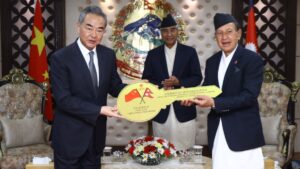
Chinese State Councilor and Foreign Minister Wang Yi spent three days in Nepal giving special priority to the relations with Nepal.
During his stay, a senior Chinese diplomat, who is aware of Nepali politics, gave the message that the affairs of Nepal should be decided by its people, and China opposes any attempt to undermine Nepal’s sovereignty and independence, interfere in its internal affairs and engage in geopolitical games in the country.
The Chinese message is clear that it doesn’t want to see any kind of interference and geopolitical games exhibited by foreign countries on Nepali soil.
“No matter how the international or domestic situations of the two countries change, China will strive to promote a China-Nepal community with a shared future along the direction set by the leaders of the two countries”, Wang said.
China will support Nepal in finding a development path suited to its national conditions, Wang said, encouraging all parties and party factions in Nepal to engage in inclusive consultation for the sake of the fundamental and long-term interests of the people.
Wang further suggested that all parties in the country should also jointly explore a governance model that is conducive to promoting political stability, economic growth and people’s livelihoods, according to a report published by Xinhua-Global Times.
The message is clear that the present political system imposed by the Indo-West powers doesn’t match the Nepali soil.
The other message given by the top Chinese diplomat to Deuba is that China supports Nepal in pursuing independent domestic and foreign policies…China believes that all countries are equal regardless of size, and respects the sovereignty, independence and territorial integrity of all countries.
“Nepal should become a promising land for cooperation between China and South Asia, and China is glad to see Nepal co-exist friendly with other countries and play a bigger role in regional and international affairs”, Wang said.
Lesson to learn:
Considering the geopolitical existence of Nepal, it has very limited options for initiating foreign policy strategies. Nepal cannot be a pro-west nation, neither it can be a pro-Indian or a pro-China nation. Maintaining equidistance relations will all the friendly countries and safeguarding the security interests of the two giant neighbours India and China are the security as well as foreign policy priority for Nepal. Otherwise, if Deuba wishes to be the new avatar of Volodymyr Zelenskyy, Ukrainian President, the nation may face the fate of Ukraine.
Lack of trust and confidence among the leaders:
The Chinese Foreign Minister also met with opposition leader and former prime minister K.P. Sharma Oli and Maoist Center chairman Pushpakamal Dahal Prachanda. Both of them lauded China’s role in Nepal and urged China’s support in infrastructural development under the BRI. To note, Prachanda is the key ally of the ruling alliance. Why Prachanda didn’t put pressure on Deuba for moving forward with the BRI projects, is surprising.
Oli was the prime minister when a historical breakthrough was made in the history of Nepal-China relations with the Chinese permission to use its ports in trade with foreign countries and using China’s inland transportation for cargo service including importing petro-products from China. Due to the reluctance of Oli and now Deuba, we are unable to enjoy such facilities from China.
The performance of the Nepali leaders seems that when they feel problems during that time, they look towards the North, otherwise, they are always trying to serve the South’s interests.
The Chinese problem:
Since the dethronement of the institution of monarchy, China has not been able to get a trustworthy partner in Nepal as all are either pro-west or pro-India.
Until the existence of the Monarchial rule, Nepal had stood as a buffer nation or a security wall for both the giant nations. The institution of monarchy was always conscious of the security interests of both the neighbours.
It seems, now the time has come to review the gains made by China during the monarchial rule, a traditional institute and true friend of China, and the republican era. If China wishes to find a trustworthy friend and avoid foreign interference in Nepal’s domestic issues, it must consider for restoration of the institution of monarchy which was not removed in the wish of the Nepali people and which is still popular among the people compared to the leaders of the day!

Login to add a comment