







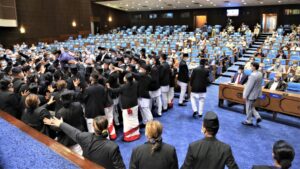
MPs protesting against MCC in Parliament on Sunday.
By Our Reporter
Unfortunately, the political parties in Nepal have been unable to have a common view regarding the country’s foreign policy. This is way they get divided over every sensitive issue, including the country’s foreign policy. It is because the leaders tend to give more importance to their petty interests than the national interest while deciding any such issues. Even within the party, the leaders have conflicting views on foreign policy and other national issues. This was evident before, during and after the tabling of the Millennium Challenge Corporation (MCC) in the parliament on Sunday amidst protests outside the parliament building.
Integruingly the leaders of the ruling CPN-Maoist Centre and CPN (Unified Socialist) who agreed to table the MCC in parliament at the meeting held at the Prime Minister’s official residence in Baluwatar in the morning mobilised their cadres for violent demonstrations outside the parliament. Maoist chairman Pushpa Kamal Dahal and chairman of the CPN (Unified Socialist) Madhav Kumar Nepal had allowed the government to present the MCC in the parliament and both of them were present in the meeting when Minister for Communication and Information Technology Gyanendra Bahadur Karki was tabling the MCC, their lawmakers including former PM Jhalanath Khanal was chanting slogans against the MCC in the House while their cadres in New Baneshwor were pelting stone at the police. It was also Dahal who had convinced Speaker Agni Sapkota to table Bill. Dahal who has earned a bad name for his dubious political move for years, had also exhibited double standards in MCC case as well.
Moreover, after the tabling of the MCC both the ruling communist parties said they were against the MCC and they would vote against it.
Yet, they have not quit the government. It is unethical to remain in the same government by opposing a bill presented by it. But the two communist parties are showing double standards, which has exposed the true colour of the communists of Nepal.
Even in the UML, whose government had registered the MCC in parliament earlier, leaders were divided. Bhim Rawal objected to the MCC when the individual leaders of the UML are expressing their views in favour of the grant. Leaders like Surendra Pandey and Bishnu Rimal have been voicing for endorsing the MCC. However, no UML cadres joined the violent protest of Sunday against MCC. When division and paradoxes prevailed in all communist parties, both ruling and opposition, regarding the MCC, Nepali Congress has stood united in favour of MCC. Moreover, the rival factions of the NC have come together over the MCC.
MCC tabled in House amid violent protest outside parliament

Demonstration against MCC in Kathmandu
After holding marathon talks with the leaders of the ruling two communist parties, the government on Sunday tabled the Millennium Challenge Corporation (MCC) Compact, a US foreign aid proposal, at the parliament amid obstructions from the main opposition party, the CPN-UML.
Minister for Communication and Information Technology Gyanendra Bahadur Karki tabled the MCC in the House of Representatives (HoR) on behalf of Minister for Finance Janardan Sharma, who did not attend the parliament meeting citing that he was unwell. Indeed, he remained absent as his party is against the grant.
After Speaker Agni Prasad Sapkota gave time, Minister Karki tabled the agreement. But a few Maoist lawmakers protested the tabling of MCC.
Clarifying that the Constitution of Nepal prevails over all the provisions of the MCC compact, expressing commitment that Nepal’s sovereignty, freedom and independence will remain intact and respecting Nepal’s foreign policy not to join any armed organistion as per the spirit of the UN Charter, Principle of Panchasheel of Non-Alignment Movement, international laws and world peace, I propose with this House to ratify this proposal,” Minister Karki said while tabling the MCC proposal in the House of Representatives on Sunday.
Karki also recalled the registration of the Millennium Challenge Compact by then Finance Minister Yubaraj Khatiwada of the previous government led by the CPN-UML in the Parliament Secretariat as per a Cabinet decision of February 8, 2019, under Section 4 of the Nepal Treaty Act, 2047 (1990).
The compact was tabled in the parliament two and a half years after it was registered in the Parliament Secretariat as the parties have divided views on it.
Before Minister Karki tabled the MCC, lawmakers of the main opposition CPN-UML and some ruling coalition parties put forth reservations against the compact.
“Nepalis are in fear whether the MCC Compact is in favour of the country or not and are protesting against it right now. Similarly, the political parties have not come in agreement over the compact as well. It should not be tabled and ratified until an agreement is reached after solving the issues and assuring Nepal’s sovereignty,” said Bhim Rawal, of the CPN-UML.
Similarly, Prem Suwal of Nepal Majdoor Kisan Party and Durga Paudel of Rastriya Janmorcha stated reservations from their parties against ratifying the MCC Compact from the parliament in its present form.
Nepal government will contribute 130 million US dollar to MCC programme in which the US will provide 500 million dollars.
Speaker Sapkota adjourned the session immediately after the tabling of the MCC. The next meeting of the House of Representatives is scheduled for 1 PM, Thursday.

Login to add a comment