







Review of World Affairs (RWA)

By Shashi P.B.B. Malla
The MCC Quagmire
The Nepali politicians have made a laughing stock of Nepal in the eyes of the world.
The government has now finally tabled the Millennium Challenge Corporation-Nepal Compact (MCC) in Parliament, but amid continued obstructions by the main opposition CPN-UML of former prime minister K.P. Sharma Oli and violent protests outside the Parliament building.
The CPN-Maoist Centre was previously dead set against tabling of the MCC-compact in parliament and had even threatened to quit the ruling alliance if the government tabled it amid its ‘firm’ reservations.
But it remained in the government even after its volte-face. And it had the effrontery to deploy its sister wings to protest against the compact on the streets.
The CPN-Unified Socialist, which had also been insisting that the MCC compact cannot be tabled in the House without amendments, finally decided not to obstruct it from being tabled. But it also sent its sister wings to protest against the compact.
It is difficult to make head or tail of the Communist parties decision-making process.
It is, therefore, anybody’s guess how they will react when the compact comes to a final vote. However, an educated guess points to the possibility that PM Sher Bahadur Deuba will have the last laugh by manipulating various permutations and combinations of members in a last-ditch effort to have the MCC-Compact ratified in a last-gasp move. Deuba had been classified by all and sundry as “incompetent” [including the present commentator]. The final ratification of the MCC compact maybe his legacy to the nation.
Ukraine: To War or Not To War
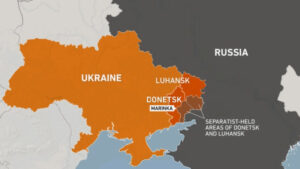
Photo: Al Jazeera
At the time of writing on Tuesday morning [2.22.22], Putin had done the unthinkable and sent regular troops Monday into the separatist regions of eastern Ukraine – calling them “peacekeepers”. With that, he has brought not only Ukraine but Europe to the precipice of an all-out war.
In order to understand the current tensions in Europe between Russia on the one hand, and Ukraine, the U.S., NATO and the European Union (EU) on the other, the concepts of deterrence and coercive diplomacy seem to be appropriate.
However, those very tensions must be seen through a broader and more holistic lens, because the crisis is the result of interlocking, multifaceted and dynamic factors at play [vide: WPR/World Politics Review, Nikolas Gvosdev, Feb. 17).
As the confrontation in Eastern Europe continues to unfold the New Atlanticist has tapped its expert network to explore the burning questions about the implications for Europe, Russia, Ukraine, and the wider world (Feb. 17).
- Russia is moving aggressively against Ukraine right now because Russian President Vladimir Putin thinks that the time is ripe – domestically and internationally – for him.
For Putin, Ukraine’s overall progress – despite his efforts to dismember and destabilize it since 2014 – represents a dangerous development that could inspire the Russian people themselves [and also neighbouring Belarus] to demand the same freedoms that Ukrainians enjoy. Undoubtedly, this represents a grave danger to the authoritarian regime he has built in Russia over the past two decades.
Currently, there is absolutely no security threat to Russia from NATO, the US or Ukraine that can justify the nearly 150,000 troops he has deployed around Ukraine’s borders and almost surrounding it – and poised to attack!
The crisis was of Putin’s own making.
Ukraine is at the centre of this crisis only because its very existence as an independent, democratic state threatens Moscow’s ability to dominate its neighbours and reverse the geopolitical changes in Europe since the collapse of the Soviet Union and the accompanying end of the Cold War.
- The United States is actively engaged in this confrontation because its vital interests are involved. First, the Atlantic Alliance is part of its global outreach. Second, Russia, with its vast area spanning two continents, its energy sources and the fact that it is a pre-eminent nuclear power mean that it is still America’s geostrategic rival worldwide.
Ever since his infamous speech at the Munich Security Conference (MSC) in February 2007, Putin has been pursuing a revisionist foreign policy designed to overthrow the global security order that emerged at the end of the Cold War.
Putin’s grand design seeks to re-establish Moscow’s hegemony – its geopolitical sphere of influence in all the areas previously controlled by the Soviet Union with an iron fist – including current NATO members in Eastern Europe [Poland, Baltic states, Romania].
With this, Putin wants to kill two birds with one stone – that is, to weaken both NATO and the European Union (EU).
Third, failure to stop Putin in Ukraine – according to security pundits – may also strengthen China’s resolve to challenge the US over Taiwan. China is closely following developments in and around Ukraine [which it recognizes as an independent and sovereign state].
A Putin success in this theatre would definitely signal a lack of resolve of the Western powers, especially the US, and above all, their inherent weakness. This could embolden China to move assertively in the East China and South China Seas, especially self-governing Taiwan.
- There are definite risks that the conflict could spiral outside of Ukraine.
An armed conflict could generate refugee flows that could be destabilizing in many aspects to neighbouring countries – Poland, Slovakia, Hungary and Romania – all members of NATO and the EU.
The conflict may be difficult to contain and a military accident could have unintended consequences. Thus, a Russian missile attack against Ukraine could accidentally end up in a NATO country.
One thing is certain: Putin will not have the guts to attack a NATO member directly as this would immediately trigger the collective security arrangement of Article 5 of the military alliance treaty. And Joe Biden has promised to “defend every inch of NATO territory”.
Putin is, therefore, playing with fire, in fact, atomic fire.
- As long as any armed conflict remains contained to Ukraine, US and NATO troops will not be directly involved. In fact, Biden has explicitly promised [the American public] not to send US troops into Ukraine.
However, if there is an accidental attack by Russia – or one it claims was an accident – on a NATO ally – all bets are off the table. No expert can envision how the conflict scenario could develop.
- NATO has emerged as a key player in the unfolding crisis.
It was established to safeguard Western Europe from possible aggression from the Soviet Union, then armed to the teeth.
It is a forum for consultations among its allies and partners; a moral authority condemning the Kremlin’s belligerence against all the norms of international law and the United Nations Charta and at the same time a conduit for dialogue with Russia.
NATO Secretary-General Jens Stoltenberg has stated repeatedly that NATO has no obligation to defend Ukraine [which is not a member or member-in-waiting] and will not send forces there.
However, many member states have sent arms and ammunition to Ukraine.
The Alliance will focus on deterring Russian aggression against NATO territory by increasing the readiness of its forces, supplementing its force posture in the frontline states, and harmonizing command-and-control of those forces.
It is also postulated that the routine cooperation which NATO promotes among its allies and partners will enable members to act on behalf of Ukraine bilaterally or through coalitions of the willing. However, if the push comes to a shove, i.e. if Russia actually invades Ukraine, how will NATO collectively react?
- NATO expansion as a direct result of the current crisis is unlikely.
Despite a 2008 pledge that Ukraine and Georgia would eventually join NATO, Russia’s forced occupation of territories in both countries has practically terminated that possibility, a fact the present crisis has reinforced.
Although NATO has refused Moscow’s demands to reverse its open-door policy, all parties understand that Ukrainian membership in NATO is currently unfeasible.
The possible, but unlikely, cases for NATO expansion involve Finland and Sweden, which are NATO’s closest partners but not yet members. Each has a difficult history with Moscow and shares serious concerns about the trajectory of Russia’s actions in its immediate neighbourhood.
- Russia’s political/territorial/military aims in a possible Ukraine invasion are multifaceted.
Putin could aim to depose or displace Ukrainian President Volodymyr Zelenskyy, expand territorial gains in eastern Ukraine to recognize the breakaway republics of Donetsk and Luhansk, establish a land bridge from the Crimean Peninsula [currently occupied by Russia] to Odesa [sovereign Ukrainian territory] and the occupied Moldovan territory of Transnistria – but most probably all three.
These are part and parcel of Putin’s revanchist and irredentist policy.
On the ground, Russian forces are likely to execute three simultaneous offensives: a northern thrust to threaten the capital Kyiv, a western advance from the occupied Donbas [Ukraine’s industrial base comprising Donetsk and Luhansk] towards the Dnieper River and a southern push from Crimea, likely turning west towards Odesa.
Russia will seek to establish air superiority within the first two to three days by destroying the very smaller Ukrainian air force.
It will quickly consolidate naval superiority in the Sea of Azov and the Black Sea and blockade Odesa.
Even in this scenario, Russia is unlikely to annex Ukraine outright. Even the Soviet Union attempted to maintain some illusion of Ukrainian autonomy.
- Ukraine is definitely poised to put up a spirited fight against Putin’s forces. It is not the war of choice of ordinary Russians.
The overall morale in the Ukrainian armed forces is very high, and they are ready to engage.
Ukraine has already managed to stop Russian forces before, and every single battalion has direct battlefield experience, including all top commanders.
It will be a very tough challenge – like David against Goliath — primarily because of the overwhelming advantage of the Russians in the air. However, this advantage may not be decisive, since the Ukrainians are adept at changing tactics, including operating in small-group formations. Ukraine also possesses a superior number of anti-tank weapons.
The armed forces also have popular support, are enhanced by the territorial defence, have large reserves, are more motivated, and know the area.
Based on an assessment of the capabilities, a former Ukrainian defence minister is fully convinced that Russia cannot complete the full-scale occupation of the country even with the huge forces they have managed to gather. It will be bogged down like previously in Afghanistan – but on its very doorstep – and will have to confront a determined, resolute and resilient resistance fully supported by NATO countries.
- In the Ukraine confrontation, Putin is not primarily driven by acute domestic political considerations.
He is motivated by his erroneous perception of a golden opportunity to advance his long-standing geopolitical goal of reestablishing Moscow’s control over key areas of the former Soviet space.
The last time Putin invaded Ukraine, it resulted in a sharp rise in his popularity.
This time, if he launches a full-scale invasion of Ukraine, it will result in a resolute insurgency, a high level of Russian casualties, and severe economic pain due to Western sanctions.
By pursuing his overblown geopolitical ambitions, Putin could be taking on significant domestic political risks.
- The Ukrainian public’s reaction to the crisis has been mixed.
Ukrainians have been divided in their response to the looming Russian aggression. While many people have engaged in impressive acts of collective defence and preparation, many others seem to be ignoring the situation completely.
The stoicism and resilience that has allowed the Ukrainian people to weather the trauma of eight years of war after the last Russian invasion and support of separatists in two eastern regions, is at once, helping them deal with the current situation and also allowing many to avoid even thinking about it, according to Vladislav Davidzon, who is a non-resident fellow at the Eurasia Center.
- After a possible Russian invasion, the future for Ukraine, according to Melinda Haring, a deputy director of the Eurasia Center, would trigger the following five developments:
- If Putin’s armies roll in and seize everything east of the Dnieper River, including the capital Kyiv, Europe will be flooded with refugees. Two to three million Ukrainians will seek refuge in Poland and other neighbouring countries. The EU would be very welcoming and supportive of this massive refugee crisis in Europe.
Putin will not be able to hold about one-third of the country.
45 % percent of Ukrainians have said they would defend Ukraine in such a situation.
A temporary capital would be established in Lviv near the Polish border.
- Ukraine will survive but in a smaller form. Putin may successfully occupy more of its territory by armed force, but Ukraine’s sovereignty will remain intact and its Western aspirations will be further nurtured.
- NATO will admit Ukraine as a full member, in spite of Russian occupation of Crimea, parts of the Donbas and other recent ‘conquered territory’. These will become the albatross around Putin’s neck!
- Finland and Sweden will gladly and finally join NATO.
- The confrontation has already breathed new life and purpose into NATO. A Russian invasion will re-invigorate the military alliance beyond measure and establish a new “Fortress Europe”.
[The effects on Russia itself, including the impact of sanctions and the geo-strategic ramifications, especially the future role of a rising China will still have to be explored].
The writer can be reached at: shashipbmalla@hotmail.com

Login to add a comment